Cutting the Cord: Using an ADT System Without Monitoring
What You Can (and Can’t) Do With an ADT Alarm Without Monitoring
Using an ADT alarm without monitoring is possible — but the experience varies a lot depending on which system you have and how it was set up.
Here’s the short answer:
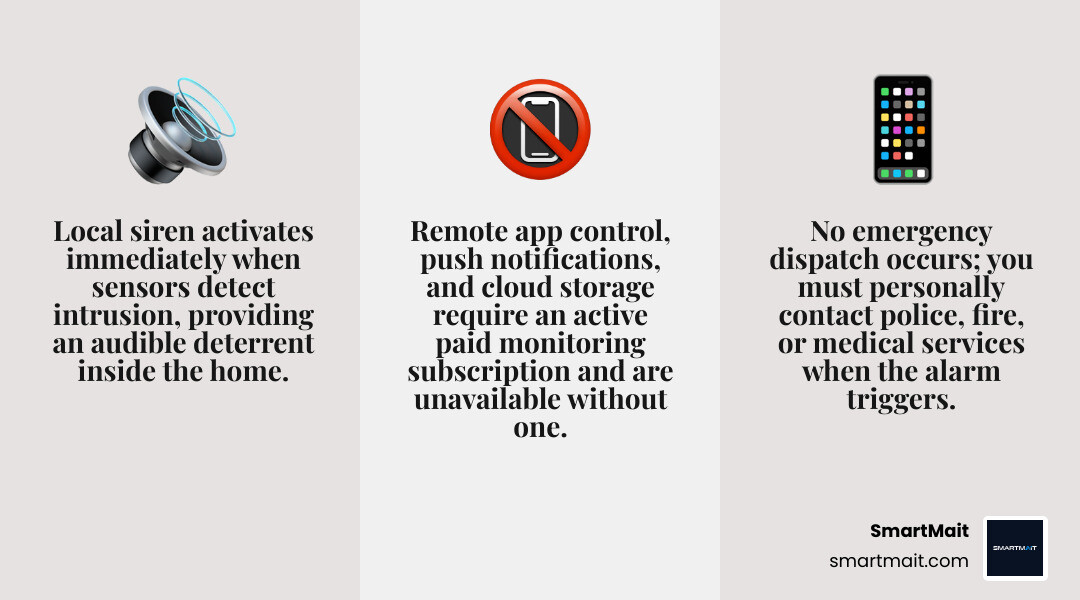
- Local siren still works — when triggered, the alarm will sound inside your home
- Emergency dispatch stops — no one calls the police, fire department, or ambulance for you
- App access is mostly gone — remote arming, push notifications, and cloud features require an active subscription
- Cellular backup goes dark — the system can no longer “call out” on its own
- Self-monitoring is possible — but you become responsible for contacting emergency services
If you moved into a home with an existing pre-installed system, recently canceled your contract, or simply want to understand what your hardware actually does without the monthly bill — you’re not alone. Many homeowners find themselves with legacy equipment and no active service, wondering whether that hardware is still worth anything.
The honest answer? It depends. Older wired systems tend to hold up reasonably well as standalone local alarms. Newer smart systems lose most of their value once the subscription lapses. And the self-setup line sits somewhere in between — with a self-monitoring option that keeps some functionality intact.
This guide walks you through exactly what still works, what shuts off, and how to get the most out of your legacy hardware — with or without a monthly plan.
Simple adt alarm without monitoring glossary:
What Happens to an Unmonitored Alarm?
When you cancel your professional monitoring contract, your security system transitions from a fully backed-up, 24/7-guarded shield into a localized alert system. According to industry insights on can you use an alarm system without the service?, the physical hardware does not automatically self-destruct or lock up entirely. Instead, it becomes a “local-only” alarm.
If an intruder breaches a door or window sensor while the system is armed, the sensors will still talk to your main control panel. The control panel will then trigger the physical siren inside your house. This local siren is incredibly loud—often around 85 to 115 decibels—which is highly effective at scaring off opportunistic burglars. However, the critical link to the outside world is severed.
Without active monitoring, your system will not send an automated signal to central monitoring centers. No professional dispatcher will look at your system’s status, and no emergency services (police, fire, or medical) will be dispatched to your address. Furthermore, the cellular backup module inside your panel—which acts as a safety net if your home internet goes down—will be deactivated. To understand the financial trade-offs of keeping or canceling these services, you can review our breakdown in The Price of Peace: ADT Security Prices Per Month Explained.
Lost Features and Subscription Limitations
While the local siren remains functional, the smart features that modern homeowners rely on will disappear. If you are attempting to run a modern adt alarm without monitoring setup, you must prepare for several immediate feature limitations.
According to a detailed breakdown in Can I Use Adt Without Subscription: Does it Make Sense for You?, canceling your subscription usually results in:
- App Lockout: You will lose access to the proprietary mobile apps. This means you cannot check your system status, view live camera feeds, or review history from your phone.
- No Remote Arming/Disarming: You must physically use the wall keypad to arm or disarm your system. You cannot do it remotely while sitting at your office in Troy or vacationing away from Southeast Michigan.
- Loss of Cloud Storage: Your security cameras will stop saving recorded clips to the cloud. Without a subscription, most pre-installed cameras will either stop recording entirely or restrict you to live-only viewing (if they connect at all).
- Cellular Dialer Deactivation: The internal cellular communicator that sends outbound signals is turned off by the carrier once the service line is canceled.
Understanding System Monitoring Statuses
If you use newer “Self Setup” product lines, your system can exist in several different monitoring statuses. Understanding these states is crucial to managing how your hardware behaves:
- Not Monitored / Unsubscribed: The system operates purely as a local noisemaker. The control panel will chime when doors open and sound the siren when breached, but it has no communication with the outside world.
- Practice Mode: When you first set up a new system, the provider often places you in a mandatory 7-day “Practice Mode.” During this week, you can test your sensors, trigger alarms, and get used to the keypad without worrying about accidental police dispatches. Many municipalities in Oakland County require this period to prevent costly false alarm fines.
- Test Mode: If you are performing home renovations or testing your sensors, you can contact support to place your system in “Test Mode.” This temporarily pauses emergency dispatch while keeping the system connected.
- Self-Monitored: Under this specific plan (typically starting at lower price points for DIY kits), you do not have professional 24/7 dispatch. Instead, the system uses your home Wi-Fi to send push alerts directly to your smartphone via the proprietary app, putting the responsibility of calling 911 entirely on you.
How to Use and Self-Monitor Existing Equipment
If you have inherited a home in Bloomfield Hills, Rochester Hills, or Birmingham with pre-installed security hardware, you do not necessarily have to throw it in the recycling bin. Repurposing existing hardware is a fantastic way to enjoy basic home security without committing to a restrictive 36-month contract.
With some patience, you can convert your system into a highly effective local noisemaker or a self-monitored setup. For a broader look at how this compares to other DIY approaches, check out our guide on DIY Home Alarms That Actually Work.

Can You Run a Legacy Alarm Without Monitoring?
Legacy wired systems (often built around standard legacy boards) are highly resilient. If you cancel your service, these systems will continue to function as local alarms indefinitely. However, as noted in the community discussions on Will an ADT alarm system still function without monitoring?, you may run into a few technical hurdles:
- The “Beeping” Keypad: Once the monitoring service is canceled, the control panel will realize it can no longer reach the central monitoring station. It will begin to beep constantly to warn you of a “Comm Failure” (Communication Failure) or “FC” error.
- Disabling the Dialer: To stop the annoying beeping, you must access the installer programming menu. This requires the system’s “Installer Code.” While original installers often change this code from the manufacturer default, you can sometimes find guides online to reset the panel and disable the dialer function entirely.
- Unplugging the Telephone Line: If your system is trying to dial out over a traditional landline, physically unplugging the phone connection from the main board can stop it from tying up your home phone line.
For those looking to optimize their home’s security layout without a massive financial investment, our tutorial on How to Secure Your Home Without Breaking the Bank offers excellent low-cost strategies.
Self-Monitoring Options for Modern Hardware
For modern, wireless hardware—such as the self-setup hub—the path to self-monitoring is much simpler. Some manufacturers offer official self-monitoring plans that allow you to use their proprietary app to receive push notifications, view live camera streams, and control smart home integrations without paying for 24/7 professional dispatch.
If you prefer to move away from proprietary ecosystems altogether, you can work with a professional integrator like us at SmartMait Home Automation and Security. We specialize in taking fragmented, consumer-grade security setups and integrating them into a unified, high-performance smart home network. By shifting your security sensors over to an open, robust standard like Z-Wave, you can self-monitor your home through a single, elegant interface without any forced monthly subscriptions.
Technical Workarounds and Smart Home Integrations
If you want to keep your sensors but ditch the proprietary ecosystem entirely, there are several technical workarounds available. This is where we transition from basic DIY tricks to true smart home integration. For a comprehensive look at how security hardware fits into a modern home, refer to The Definitive Guide to Buying the Best Security Alarms.
Integrating an ADT Alarm Without Monitoring Into Smart Home Hubs
Most wireless sensors operate on standard radio frequencies, such as 345 MHz or 433 MHz. Because these sensors use standard frequencies, they can often be intercepted and repurposed by third-party smart home hubs.
Using open-source automation platforms (such as Home Assistant) or dedicated smart home hubs, you can install a wireless receiver to listen to your existing door and window sensors.
By pairing these sensors with a professional-grade Z-Wave ecosystem, you can build a highly resilient, local smart home network. Unlike standard consumer-grade Wi-Fi or Bluetooth devices, Z-Wave operates on a dedicated, low-frequency band that won’t interfere with your home network. It creates a robust mesh network where every mains-powered device acts as a repeater, ensuring that your security sensors in the basement or detached garage never lose connection.
If you are looking for smart ways to bridge the gap between legacy hardware and modern automation, check out our insights on How to Secure Your Home Without Breaking the Bank.
Repurposing Legacy Cameras and Sensors
Repurposing legacy security cameras is slightly more challenging, but highly rewarding if you want to avoid e-waste. Many older outdoor and indoor cameras are rebranded models from standard manufacturers.
If your camera model supports standard streaming protocols like RTSP (Real-Time Streaming Protocol) or ONVIF, you can disconnect the camera from the proprietary network, reset it to factory defaults, and connect it to a local Network Video Recorder (NVR) or local smart home software. This allows you to:
- View live video streams locally on your smart devices.
- Store continuous 24/7 footage on a local hard drive or a microSD card without paying for cloud storage.
- Keep your private video feeds entirely within your local home network, protected from external servers.
Frequently Asked Questions About Unmonitored Alarms
Will my alarm still go off if I cancel my subscription?
Yes. Your system’s door sensors, window sensors, and motion detectors will still trigger the local, physical siren inside your home if the system is armed. It will make a massive amount of noise to scare off intruders, but it will not call the police.
Can I use the proprietary app without a monthly monitoring plan?
Generally, no. For professionally installed systems, the provider locks app access behind a paid subscription. If you cancel your plan, you will be locked out of the app. However, if you use the newer self-setup hardware, they do offer a lower-cost “self-monitoring” tier that preserves basic app access.
Do I need a permit for an unmonitored alarm system?
This depends entirely on your local municipality. While most cities require permits primarily for professionally monitored systems (to cover the cost of police dispatches for false alarms), some local ordinances in Southeast Michigan require registration for any system with an audible outdoor siren.
For example, if you live in Farmington Hills, you should review the Farmington Hills Local Alarm Ordinances to ensure your unmonitored system complies with local decibel limits and registration rules.
Conclusion
Repurposing an adt alarm without monitoring is a great way to save money and reduce electronic waste. However, managing a patchwork of old sensors, dealing with constantly beeping keypads, and trying to handle your own emergency dispatch can quickly turn into a stressful, time-consuming hobby.
At SmartMait, we believe your home security and automation should work seamlessly in the background, without requiring a second job as a system administrator. We design, install, and maintain premium smart home automation, security systems, access control, and structured Wi-Fi networks across the most affluent suburbs of Southeast Michigan—including Bloomfield Hills, Troy, Rochester Hills, Farmington Hills, and Birmingham.
Instead of fighting with outdated proprietary hardware, we can integrate your home’s security into a professional, architect-grade Z-Wave ecosystem. This gives you complete, robust control over your security, mood lighting, audio/visual systems, and climate control through a single, elegant interface.
What truly sets us apart is what happens after the installation. With our exclusive SmartService concierge maintenance program, we build an ongoing relationship with you. While other integrators install a system and disappear, we stay. We provide regular updates, system optimizations, and proactive maintenance to ensure your smart home runs flawlessly for years to come.
Ready to upgrade your home with a professionally integrated, subscription-free smart ecosystem? Contact us at SmartMait today to schedule your private consultation.