Don’t Get Robbed: Choosing the Best Business Security System for 2026
Why Your Business Needs the Best Security System in 2026
Choosing the best business security system is one of the most important decisions you’ll make as a business owner. Here’s a quick breakdown of the top system architectures to help you decide fast:
| System Type | Best For | Monitoring Cost | Equipment Cost | Key Strength |
|---|---|---|---|---|
| Enterprise Professional | Professional monitoring | From $52.99/mo | From $269 | 12 monitoring centers, ~30-sec response |
| DIY Live Video | Live video monitoring | From $22.99/mo | From $250 | Intruder intervention, no contract |
| Integrated Smart Office | Smart office automation | From $24.99/mo | From $199 | Full smart integration, touchscreen hub |
| Cellular-First DIY | Affordable small offices | From $44.99/mo | From $69 | Cellular-first, fast 25-sec response |
| Local NVR Storage | Offices with security staff | No monthly fee option | From $399 | Local NVR storage, no subscription required |
Office spaces are prime targets. They sit empty for hours at a time, and they’re packed with laptops, electronics, and sensitive data. The numbers back this up:
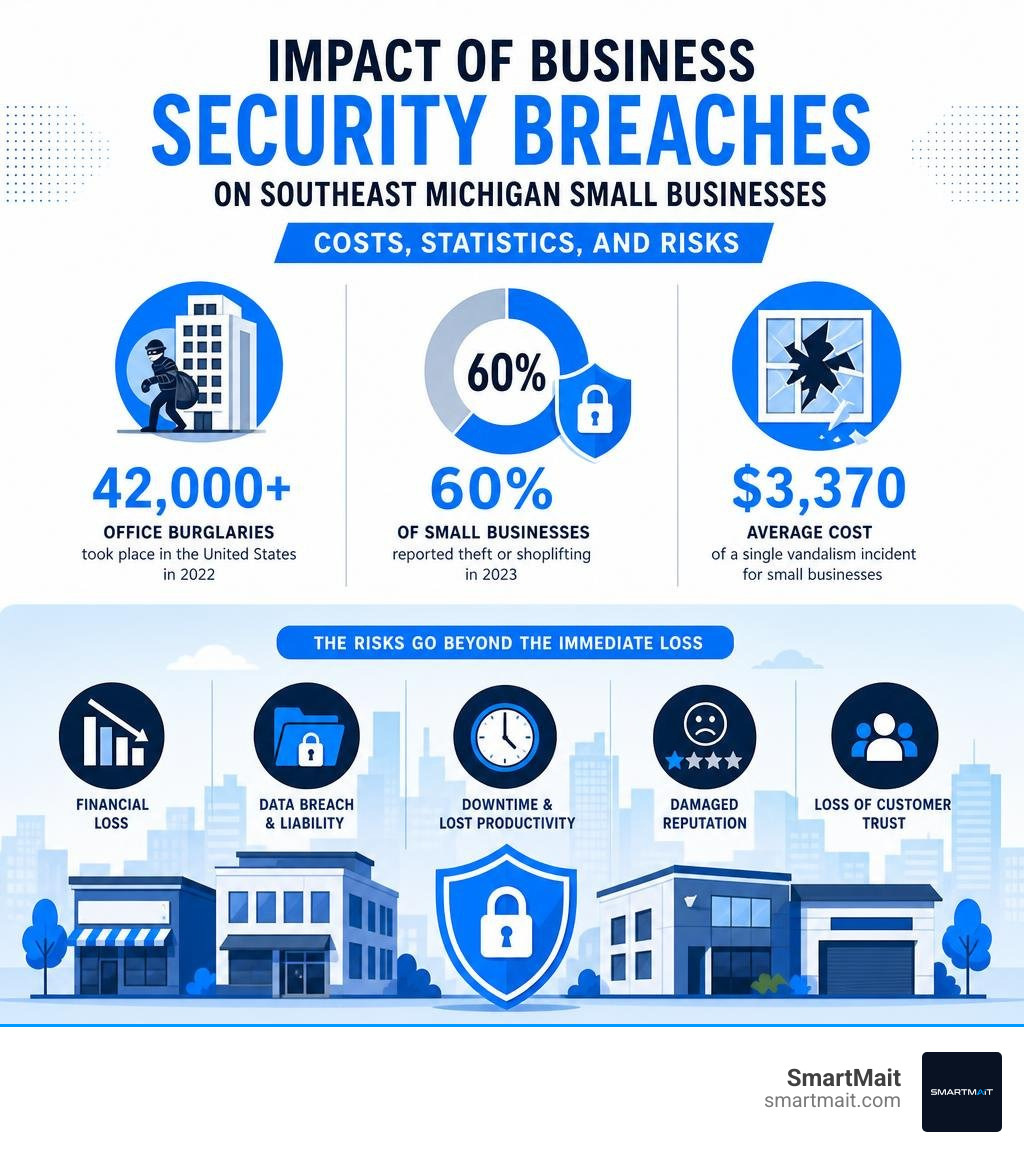
- Over 42,000 office burglaries took place in the United States in 2022
- Nearly 60% of small businesses reported theft or shoplifting in 2023
- A single vandalism incident costs small businesses an average of $3,370
And those are just the incidents that get reported.
The problem most business owners run into isn’t a lack of options — it’s too many options with no clear way to compare them. A camera kit from a big-box store looks similar to a professionally integrated system on paper. It isn’t. The difference shows up at 2 a.m. when something trips an alarm and nobody responds.
This guide cuts through the noise. We’ll compare the top systems by features, monitoring quality, installation type, and real-world performance — so you can make a confident, informed decision.
I’m Dominic Hesano, founder of SmartMait and a low-voltage installation specialist serving Southeast Michigan businesses, and I’ve seen what separates a reliable best business security system from one that looks good on a shelf but fails when it matters. Every recommendation in this guide reflects what I’d actually install for my own clients.
Best business security system terms at a glance:
Key Features of the Best Business Security System
When evaluating the best business security system, you must look beyond basic consumer-grade features. A true commercial-grade setup requires robust hardware, redundant communication, and highly responsive professional monitoring to ensure your assets remain secure.

Redundant Communication & Cellular Backup
A standard internet connection is highly vulnerable. If a burglar cuts the fiber lines outside your building or your local ISP suffers an outage, a Wi-Fi-only system becomes completely useless. The best systems utilize cellular-first communication with Wi-Fi as a backup.
For instance, professional cellular-first systems utilize a cellular connection to avoid putting strain on your local network while ensuring the system stays online during power or internet outages. Similarly, commercial-grade base stations feature a 24-hour backup battery and built-in cellular connectivity so that your business remains protected even in a total blackout.
Crash-and-Smash Protection
Experienced criminals know that if they can locate and destroy the security hub before it finishes its entry delay countdown, the signal will never reach the monitoring center. Premium business security systems combat this with “Crash-and-Smash” protection. When a door is opened, the system immediately sends a silent signal to the monitoring station. If the hub does not send a subsequent “disarm” signal within the entry delay period, the monitoring station automatically treats it as an active break-in and dispatches emergency services.
Professional Monitoring and Dispatch Times
In an emergency, every second counts. The gold standard for professional monitoring is a rapid, verified response. Here is how different monitoring architectures compare:
- Enterprise-Grade Monitoring: Operates redundant, enterprise-certified monitoring centers. Because these providers own and manage their own centers, they boast incredibly reliable dispatch times, often averaging around 30 seconds.
- Cellular-First Monitoring: Achieves rapid response times, though this is sometimes paired with a mandatory entry delay that can slow down overall dispatch in unoccupied offices.
- Live Video Verification: Offers real-time intruder intervention. This allows live monitoring agents to view camera feeds in real time, speak directly to intruders through the camera’s speaker, and verify the threat to expedite police dispatch.
For small business owners, choosing a system that supports rapid verification is critical to avoiding heavy fines for false alarms. You can read more about selecting the right hardware in our guide on commercial security systems for small businesses. Furthermore, businesses operating in specific municipalities must adhere to strict local guidelines. For example, if your business is located in Oakland County, you must follow the official Bloomfield Hills alarm monitoring guidelines to ensure your system is registered and compliant with local police dispatch policies.
Comparing Commercial Security System Architectures: DIY vs. Professional Integration
The market is split between off-the-shelf DIY security kits and custom, professionally integrated systems. While DIY kits appeal to startups looking for a low upfront cost, growing businesses and high-value offices require a more robust, integrated approach.
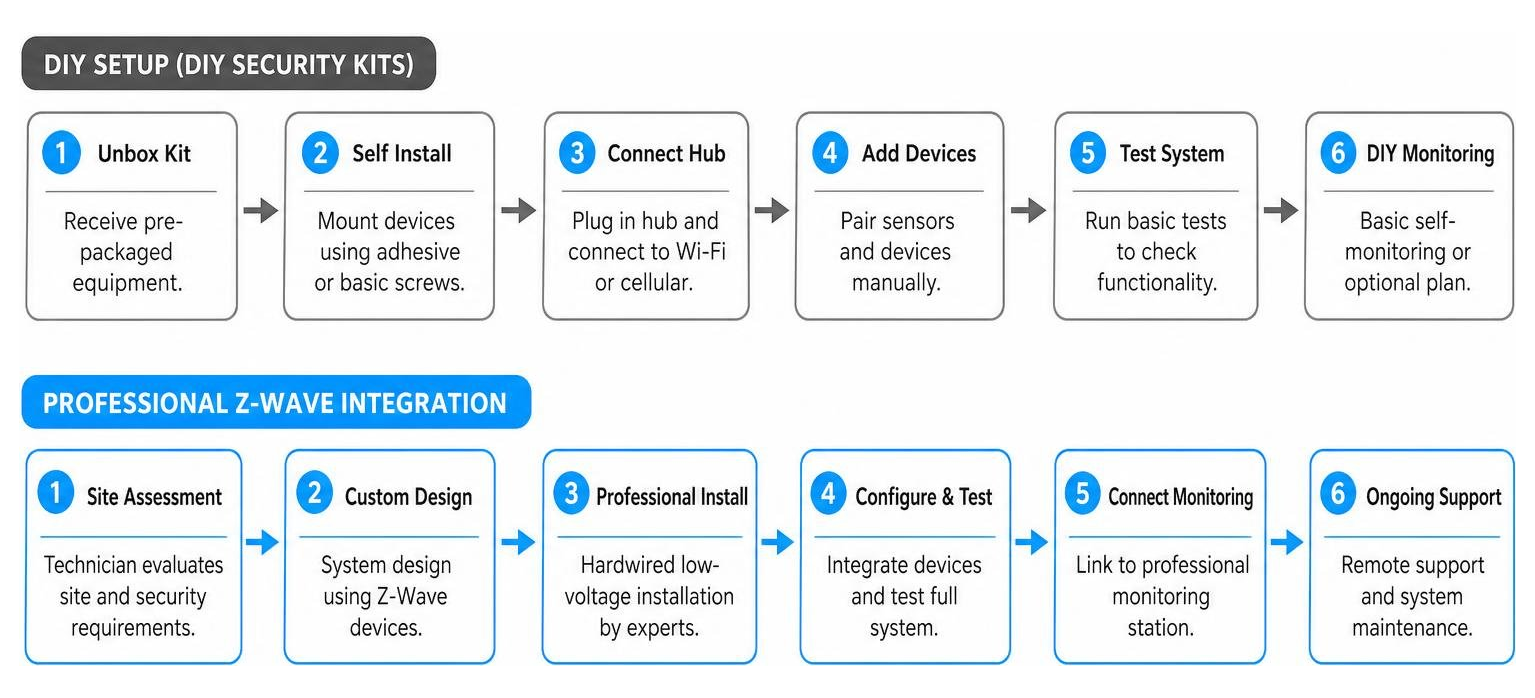
DIY Security Kits vs. Professional Custom Integration
| Feature | DIY Security Kits | Professional Custom Integration (SmartMait) |
|---|---|---|
| Installation | Self-installed; relies on double-sided tape and basic screws | Clean, hardwired low-voltage installation by certified technicians |
| Ecosystem | Closed consumer ecosystems; limited third-party integration | Open, standardized Z-Wave ecosystem and commercial-grade controllers |
| Reliability | Susceptible to Wi-Fi drops, interference, and battery failure | Highly reliable, interference-resistant mesh networking with physical backups |
| Maintenance | Owner must troubleshoot, replace batteries, and update firmware | Ongoing concierge support, proactive maintenance, and remote updates |
| Access Control | Basic smart locks with limited user management | Enterprise-grade fob entry, turnstiles, and multi-site management |
The Power of the Z-Wave Ecosystem
For a professional-grade security system, consumer-grade Wi-Fi and Bluetooth protocols simply don’t cut it. They clog your office network, have limited range, and are prone to interference.
At SmartMait, we design our systems around the Z-Wave ecosystem. Z-Wave is an international wireless standard that operates on a dedicated, low-frequency radio band (around 908 MHz in the US). Because it does not compete with your office Wi-Fi, it is completely immune to network congestion.
Furthermore, Z-Wave devices operate on a mesh network. Each mains-powered device (such as a smart switch or thermostat) acts as a repeater, passing the signal along to the next device. This ensures flawless coverage even in large commercial offices, historic brick buildings, or multi-story workspaces.
Structured Networking & Proactive Maintenance
A security system is only as strong as the network hosting it. DIY systems often fail because they are connected to standard consumer routers that drop signals when too many devices connect. Professional integration includes structured networking – laying down dedicated Cat6 cabling, setting up managed switches, and partitioning your security traffic onto its own secure Virtual Local Area Network (VLAN).
Furthermore, while DIY systems leave you to deal with dead batteries and offline cameras, professional integration with our SmartService concierge maintenance program ensures your system is constantly monitored, updated, and maintained. If a sensor goes offline, we know about it and fix it before it puts your facility at risk.
For businesses exploring centralized API integrations, understanding how modern stations operate is essential. Learn more about whether API alarm monitoring stations are the right fit for your operational workflow. If you are comparing regional options, prioritize a provider that can design, install, and maintain the full system rather than handing you off to separate vendors for cameras, access control, networking, and service.
Advanced Camera Technology and Storage Solutions for Offices
A camera that only records when it detects motion is not sufficient for commercial liability. If an employee slips and falls, or if a high-value asset goes missing, you need to see what happened before and after the event.

High-Resolution, Night Vision, and AI Threat Detection
Modern commercial cameras offer stunning 4K resolution, allowing you to zoom in on faces and license plates with crystal clarity. Combined with advanced infrared night vision or color night vision, your property is protected 24/7.
The real game-changer in 2026 is AI threat detection. Rather than triggering false alerts every time a moth flies past the lens, advanced systems use on-device AI to distinguish between humans, vehicles, and animals. For example, a high-end PoE NVR Security System features bullet-PTZ hybrid cameras that combine a 4K wide-angle view with a 2K pan-tilt-zoom lens. It tracks subjects up to 164 feet away using an on-device 8-core processor, executing live cross-camera tracking to seamlessly hand off a subject from one camera to another across your property.
Local NVR Storage vs. Cloud Event Storage
How your footage is stored is a critical security and cost consideration:
- Local NVR (Network Video Recorder) Storage: Professional-grade local NVR systems utilize local storage (often pre-installed with 4TB HDDs, expandable up to 16TB). This allows for continuous, 24/7 recording of multiple camera feeds without eating up your office internet bandwidth or requiring monthly cloud subscription fees. It also ensures your data remains completely private and accessible even during internet outages.
- Cloud Event Storage: Standard consumer-grade systems upload short, event-triggered clips to the cloud. While convenient for quick mobile viewing, they do not offer continuous 24/7 recording unless you subscribe to premium tiers (such as continuous recording add-ons). Without continuous recording, you risk missing crucial moments that occur right outside the motion detection zone.
For specialized regional commercial installations, it is highly recommended to work with local experts who understand the climate, construction styles, cabling constraints, and structural requirements of your area. In Southeast Michigan offices, that local design work can make the difference between a camera system that simply records video and a security platform that reliably supports investigations, liability protection, and day-to-day operations.
Access Control, Automation, and Multi-Site Management
Securing a business involves more than just monitoring the perimeter; it requires managing who enters, when they enter, and what happens when they are inside.
Modern Door Access Control & Fob Entry Systems
Physical keys are a major security risk. They can be copied, lost, or stolen, and rekeying an entire office building is incredibly expensive. Modern commercial properties utilize electronic access control.
By implementing modern door access control solutions, you can assign unique key fobs, keycards, or mobile credentials to each employee. If an employee leaves the company, you can instantly revoke their access in the software without replacing a single lock. A fob door entry system also provides a complete audit trail, showing exactly who unlocked which door and at what time.
For high-security areas or high-traffic entrances, integrating advanced barrier controls is highly effective. You can learn why your facility might benefit from our guide on why your business needs an automatic turnstile gate.
Multi-Site Monitoring & Centralized Dashboards
If you manage multiple offices, retail shops, or warehouses across Southeast Michigan, you cannot afford to log into ten different apps to check on your properties. Platforms like Alarm.com for Business solve this by providing a unified Enterprise Dashboard. From a single screen, you can:
- View live video feeds from multiple locations simultaneously.
- Manage employee access codes and credentials globally.
- Track temperature and energy usage across all facilities.
- Set up custom automation rules (e.g., if the alarm is armed at night, automatically lock all Z-Wave smart locks and lower the smart thermostats).
Climate Control and Energy Management
Integrating your security system with smart automation allows for massive operational savings. By installing automated climate control systems, your building can automatically adjust temperatures based on occupancy sensors or your security system’s arming status. When the last employee arms the system at 6 p.m., the thermostats automatically enter energy-saving mode, and the smart lighting shuts off, directly lowering your monthly utility bills.
To explore how these unified technologies come together for commercial properties, view our comprehensive Commercial services page.
Frequently Asked Questions about Business Security
What is the best business security system for a small office?
The best system for a small office is one that is modular, scalable, and tailored to your specific layout. To start, a reliable system requires a central hub and a keypad. From there, you should scale your protection by adding entry sensors to all doors and accessible windows, and placing motion sensors in corners (ideally 6 feet above the floor for a 90-degree field of view and 35-foot range).
If your office has large windows or sliding glass doors, pairing motion detectors with glassbreak sensors is highly recommended. For DIY small business setups, you can customize your own system using an online interactive system builder, or opt for an all-in-one package like a pre-configured multi-piece business alarm kit.
How do professional monitoring response times compare?
Professional monitoring dispatch speeds vary based on the provider and whether the alarm is verified. Enterprise-grade monitoring centers average a 30-second response time due to their redundant infrastructure. Some cellular-first systems boast a 25-second response time but have a built-in 30-second entry delay.
To maximize dispatch speed and reduce false alarm fines, choose a system that supports video verification. When an alarm is triggered, the monitoring agent can view live video to confirm a break-in is in progress, allowing them to request priority dispatch from local emergency services.
What are the legal considerations for office security cameras?
When installing cameras in a business, you must respect employee and customer privacy rights:
- Expectation of Privacy: Cameras must never be placed in areas where people have a reasonable expectation of privacy, such as restrooms, locker rooms, or employee break lounges.
- Audio Recording Consent: Federal and state wiretapping laws are incredibly strict regarding audio. In many jurisdictions, recording audio without the consent of all parties is illegal. Because of this, many business owners choose to disable audio recording entirely. For example, when setting up a system via a commercial-grade security application, you can easily disable audio streaming and recording for both live events and saved video through the app settings.
- Employee Policies: Clearly outline your security camera policy in your employee handbook, explaining where cameras are located and how the footage will be used.
Conclusion: Securing Your Southeast Michigan Business with SmartMait
Protecting your business in 2026 requires a unified, professional approach. While consumer-grade DIY kits are tempting, they often leave gaps in coverage, rely on congested Wi-Fi networks, and lack the robust support that a growing business demands.
At SmartMait, we design, install, and maintain commercial-grade security, access control, and automation systems across Oakland County, Macomb County, and Wayne County, Michigan. By utilizing the professional-standard Z-Wave ecosystem, we ensure your security devices communicate flawlessly on an interference-free mesh network.
What truly sets us apart is what happens after the installation. With our SmartService concierge maintenance program, we establish an ongoing relationship with your business. We don’t just hang cameras and disappear; we proactively manage your system, replace batteries, execute firmware updates, and troubleshoot issues before they create vulnerabilities.
If you are ready to secure your workspace with an architect-grade, fully integrated solution, visit the SmartMait Homepage to schedule your custom commercial consultation.
Why SmartMait is the Best Business Security System Partner in Michigan
We specialize in serving the premier business communities of Southeast Michigan, including Bloomfield Hills, Troy, Rochester Hills, Farmington Hills, and Birmingham. As a full-ecosystem integrator, we eliminate the headache of managing multiple fragmented vendors. We handle everything:
- High-definition commercial camera networks and NVR storage.
- Smart door access control and fob entry systems.
- Custom commercial AV installation to give your office a modern tech facelift.
- Expert audio-video system design for conference rooms and collaborative spaces.
- Structured, enterprise-grade Wi-Fi and networking.
- Architectural mood lighting and automated climate systems.
Don’t leave your business’s physical and digital security to chance. Partner with a local integrator who stays. Secure your shop with local security experts who understand your community and are dedicated to keeping your business safe, productive, and efficient.