Stop Worrying with the Best 24/7 Alarm Monitoring
Why Choosing the Right 24/7 Alarm Monitoring Service Is the Most Important Security Decision You’ll Make
A 24/7 alarm monitoring service is what stands between your home or business and a slow, uncoordinated emergency response — and not all of them work the same way.
Here’s a quick look at the different tiers of monitoring so you can compare at a glance:
| Monitoring Type | Average Cost | Response Time | Contract Required | Best For |
|---|---|---|---|---|
| Budget DIY | $5 – $15/mo | Variable | No | Basic self-setup |
| Standard Professional | $20 – $30/mo | <30 sec | Varies | No-contract flexibility |
| Premium Integrated | $40 – $60+/mo | ~10 sec | No (with SmartMait) | Complete peace of mind & smart home integration |
Prices as of July 2026. Response times vary by plan and alert method.
Most homeowners don’t think about monitoring quality until something goes wrong — a break-in while they were at dinner, a fire that started at 2 a.m., or a carbon monoxide alarm they slept right through. By then, the difference between a fast, verified response and a missed notification isn’t just frustrating. It’s dangerous.
Self-monitoring sounds practical. But if you’re in a meeting, asleep, or on a flight, you are the weakest link in your own security chain. Professional monitoring removes that gap entirely.
This guide compares the leading 24/7 monitoring services — what they cost, how fast they respond, what they cover, and where they fall short — so you can make a confident, informed decision.
I’m Dominic Hesano, founder of SmartMait and a low voltage installation specialist serving Southeast Michigan homeowners who need their 24/7 alarm monitoring service integrated properly — not just plugged in and left. I’ve seen what happens when monitoring is treated as an afterthought, and this guide reflects what I actually recommend to clients in homes like yours.
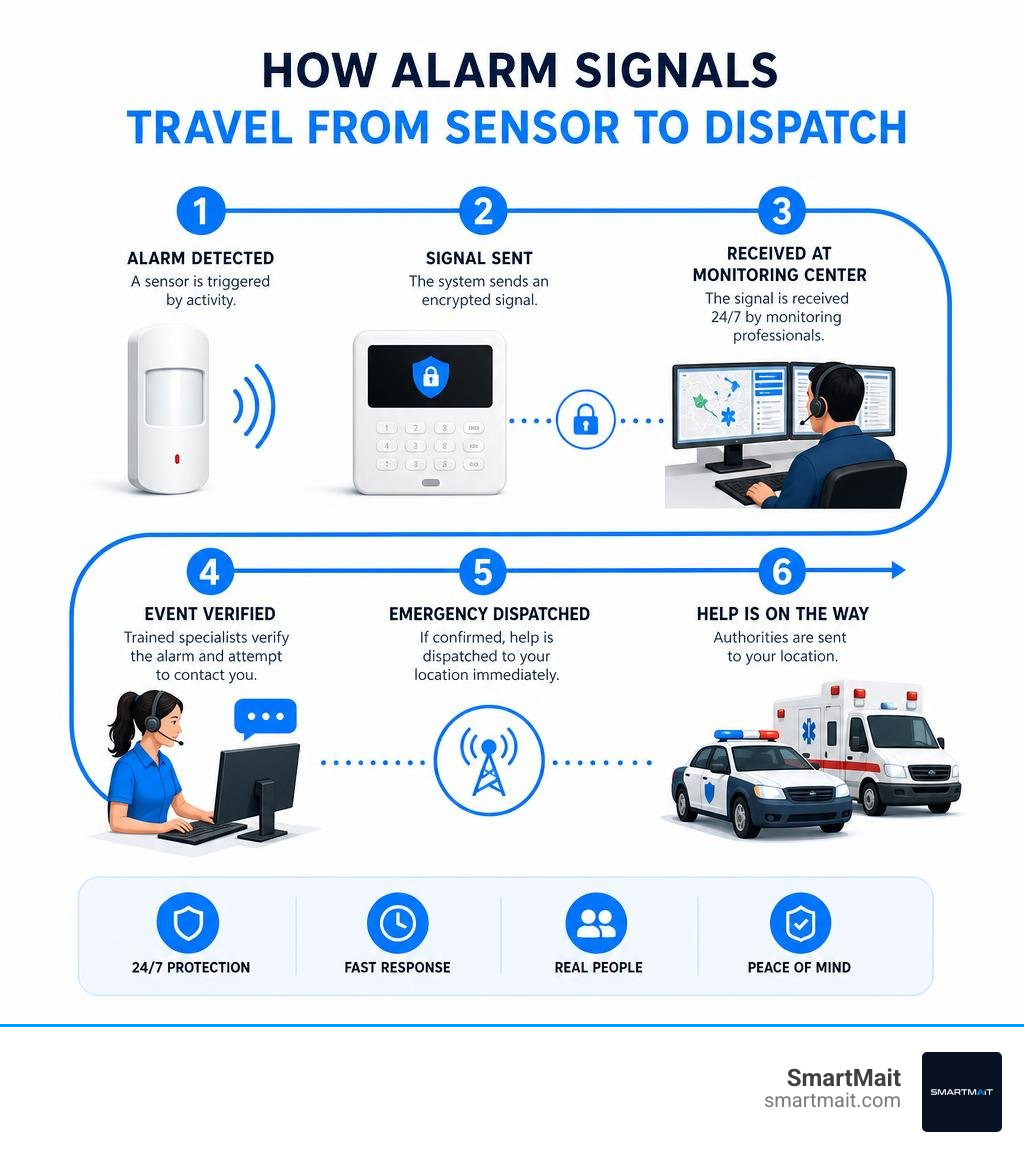
Simple guide to 24/7 alarm monitoring service:
How a Professional 24/7 Alarm Monitoring Service Protects Your Property

When you invest in a 24/7 alarm monitoring service, you aren’t just buying hardware; you are hiring a dedicated team of off-site professionals who watch over your property every second of the day. If a sensor is tripped, your security panel immediately transmits a signal to a central monitoring station.
A professional monitoring station is a secure facility staffed by highly trained operators. These centers operate under strict redundancies, ensuring that even if one facility experiences a power grid failure or a localized natural disaster, your alarm signal is instantly rerouted to another active station.
This continuous coverage spans multiple layers of protection:
- Intrusion Detection: Glassbreak sensors, door/window contacts, and motion detectors instantly alert the station if an unauthorized entry is attempted.
- Fire and Life Safety: Monitored smoke and heat detectors communicate with the station even if your system is disarmed, ensuring the fire department is dispatched immediately while you focus on evacuating your family.
- Environmental Hazards: Water leak detectors and freeze sensors alert you to plumbing failures or furnace breakdowns before they result in thousands of dollars in property damage.
- Medical and Panic Alarms: Dedicated panic buttons on key fobs, keypads, or mobile apps allow residents to summon immediate medical or police assistance during an emergency.
To understand exactly who is receiving these critical alerts and how they keep you safe, check out our comprehensive central monitoring guide.
Understanding the Emergency Dispatch Process
The moments directly following an alarm trigger are highly structured to ensure speed and accuracy. The entire emergency dispatch sequence typically unfolds in under 60 seconds:
- Signal Transmission: A sensor triggers, and the control panel sends an encrypted alert via cellular networks or broadband internet to the central monitoring station.
- Operator Verification: To prevent costly false alarm fines, operators immediately attempt to verify the emergency. Modern systems use advanced text-verification platforms, which deliver notifications in roughly 10 seconds. This allows users and their trusted emergency contacts to confirm or cancel the alarm with a quick tap.
- Dispatch Routing: If the alarm is confirmed or if the homeowner cannot be reached, the operator immediately contacts the local Public Safety Answering Point (PSAP) to dispatch the police, fire department, or emergency medical services.
Leading providers leverage advanced ASAP-to-PSAP (Automated Secure Alarm Protocol to Public Safety Answering Point) technology. Instead of an operator making a manual phone call to local dispatchers, ASAP-to-PSAP transmits the digital data directly to emergency services, shaving up to two minutes off dispatch times.
For a deeper look at how these systems maintain round-the-clock vigilance, read our guide on 24-hour security systems.
Comparing a National 24/7 Alarm Monitoring Service vs. Local Custom Integration
When choosing a 24/7 alarm monitoring service, homeowners generally face two paths: mass-market national brands or a localized custom integration.
National DIY and mass-market dealer networks offer fast, standardized setups. However, they are frequently limited by consumer-grade hardware, rigid contract requirements, and zero post-installation support. If a sensor falls off your wall because the cheap double-sided tape failed, or if your Wi-Fi router updates and disconnects your cameras, you are entirely on your own to troubleshoot the system.
A local custom integration, like what we provide at SmartMait, bridges the gap between high-end hardware and reliable local support. We design and install architect-grade systems utilizing the Z-Wave ecosystem. Unlike standard consumer-grade Wi-Fi setups that clog your home network and are highly susceptible to wireless interference, Z-Wave operates on a dedicated, low-power mesh network. This ensures that every door sensor, smart lock, and motion detector communicates flawlessly over long distances without dropouts.
Furthermore, we don’t just “install and disappear.” Through our exclusive SmartService concierge maintenance program, we provide ongoing system health checks, battery replacements, and firmware updates for our clients across Southeast Michigan’s premier communities, including Bloomfield Hills, Troy, Rochester Hills, Farmington Hills, and Birmingham.
For high-net-worth homeowners and local small businesses, this ongoing care is crucial to prevent system drift and ensure your system is always ready when it matters most. You can learn more about the differences between these approaches in our breakdown of professional vs DIY installation.
Local regulations also play a massive role in how alarms are handled. For example, the city of Bloomfield Hills maintains strict guidelines regarding false alarms and system registration, which you can review directly on the official Bloomfield Hills Alarm Monitoring portal. Working with a local integrator ensures your system is fully compliant with municipal codes in Oakland, Macomb, and Wayne counties.
Key Benefits: Professional Monitoring vs. Self-Monitoring
While self-monitoring via a smartphone app might seem like an easy way to save a few dollars a month, it places an immense burden of responsibility on your shoulders.
| Feature | Professional 24/7 Monitoring | Self-Monitoring |
|---|---|---|
| Emergency Dispatch | Automatic dispatch by certified operators | You must call 911 yourself |
| Outage Protection | Battery and cellular LTE backups active | Fails if home power or Wi-Fi drops |
| Response Speed | Instant text alerts and dispatch in seconds | Dependent on when you see your phone |
| Insurance Benefits | Up to 20% discount on homeowners insurance | No discount offered by most carriers |
| False Alarm Management | Operator-verified to prevent municipal fines | High risk of accidental dispatch fines |
| Life Safety Coverage | Smoke, CO, and freeze monitoring 24/7 | Alerts only; no automatic fire dispatch |
Self-monitoring relies entirely on your ability to see, process, and react to a push notification in real time. If you are sleeping, driving, in a business meeting, or vacationing in an area with poor cellular coverage, an active break-in or fire will go completely unnoticed until it is too late.
Professional monitoring provides a continuous safety net. To explore why this constant coverage is essential for absolute peace of mind, read our comprehensive 24-hour security guide.
The True Cost of a Premium 24/7 Alarm Monitoring Service
When evaluating the cost of a 24/7 alarm monitoring service, it helps to understand what you are actually paying for. Standard monthly fees across the industry generally range from $15 to $60 per month, depending on the complexity of your system and the level of interactive features you select.
- Basic Monitoring ($15 – $25/mo): Typically covers standard intrusion and life-safety sensors via cellular or landline communication, with basic app controls.
- Interactive Smart Monitoring ($30 – $45/mo): Adds smart home automation integrations, remote lock control, real-time push notifications, and basic video streaming.
- Complete Video Verification ($50+/mo): Includes active live-agent video monitoring, cloud video storage, and priority emergency dispatch based on verified threats.
While cheap, contract-free plans may seem appealing, they often lack the deep system integration, dual-path communication, and ongoing maintenance required to keep a complex smart home running smoothly.
Investing in professional monitoring also delivers immediate financial returns. Most major homeowners insurance companies offer premium discounts of up to 20% for properties protected by a certified, professionally monitored security system. Over time, these savings can offset a significant portion of your annual monitoring costs.
For a detailed breakdown of what you should expect to pay for reliable security, check out our guide on monitoring costs.
Technical Redundancy: Outages, Privacy, and Video Verification

A truly reliable 24/7 alarm monitoring service must be built to withstand worst-case scenarios, including deliberate physical tampering, power grid failures, and local internet outages.
Premium security systems utilize dual-path communication as their primary defense. The control panel uses your high-speed home Wi-Fi network for daily smart home tasks and video streaming, but instantly fails over to a dedicated, encrypted cellular LTE backup network (using major carriers like AT&T or Verizon) if your internet line is cut or your router goes offline.
Furthermore, professional systems feature:
- 24-Hour Battery Backup: If a severe storm knocks out power across Oakland County, your main control panel remains fully operational on an internal backup battery for up to 24 hours.
- Carrier Outage Supervision: This protocol actively monitors the cellular connection between your home security panel and the carrier network, instantly alerting the central station if a carrier-side network drop occurs.
- System Sabotage Protection (Crash-and-Smash): If an intruder breaks through your front door and immediately smashes your control panel, standard systems might fail to send an alert. Sabotage protection solves this by sending an entry-delay signal to the cloud the moment the door opens. If the panel does not send a corresponding “clear” code within the designated window, the central station automatically registers a “crash-and-smash” event and dispatches the police.
To visualize how these communication paths fail over seamlessly during an emergency, refer to the diagram below:

Video Verification and Privacy Protection
False alarms are a massive strain on local police departments, often leading to slow response times or steep municipal fines for homeowners. This has led many police forces to implement “verified response” policies, meaning they will not dispatch officers to an alarm unless there is physical or visual proof of an intruder.
This is where video verification becomes invaluable. When a sensor triggers, compatible outdoor and indoor cameras securely send short video clips to the monitoring center. A live operator can instantly review the footage to confirm an active threat, allowing them to secure priority dispatch from local authorities.
Understandably, privacy is a major concern for homeowners installing cameras inside their properties. Premium monitoring services protect your privacy through strict technical guardrails:
- No Constant Surveillance: Monitoring agents cannot access your live camera feeds at will. They can only view video clips associated with a specific sensor trigger, and only during an active alarm event.
- Secure Data Lockboxes: Video clips are stored in highly encrypted, proprietary digital lockboxes, preventing unauthorized access by third parties or the security company itself.
- User-Controlled Permissions: You maintain absolute control over which cameras are accessible for video verification and can toggle these settings instantly within your security app.
To learn more about how integrating cameras with your monitoring service enhances your perimeter defense, read our article on video surveillance benefits.
Frequently Asked Questions About Alarm Monitoring
What happens to my monitoring during a power or internet outage?
Your security system is designed to remain fully functional during local utility failures. The control panel contains a backup battery that keeps all sensors and communication modules running for up to 24 hours. If your home Wi-Fi goes down, the system automatically switches to its built-in cellular LTE backup to transmit alarm signals. Additionally, compatible smart cameras can store up to one hour of recorded video locally during an outage and upload it once connectivity is restored.
Can monitoring agents watch my camera feeds at any time?
Absolutely not. Your privacy is protected by strict encryption protocols and operational rules. Monitoring agents only have access to your camera feeds when an alarm is actively triggered, and only for the brief window required to verify the emergency. You can customize these permissions in your app, choosing to restrict agent access entirely or limit it to outdoor cameras only.
Do I need a long-term contract for professional monitoring?
While many mass-market national brands require rigid 36-to-60-month monitoring contracts to offset the cost of their “free” hardware, modern security integrations offer far more flexibility. At SmartMait, we believe in earning your business every single month. We provide premium, contract-free monitoring options paired with our comprehensive SmartService concierge maintenance program. This ensures your system receives ongoing professional care, hardware updates, and local support without locking you into an inflexible long-term commitment.
Conclusion
Choosing a 24/7 alarm monitoring service is about more than just buying a box of sensors and downloading an app. It is about creating a reliable, continuous shield around your family, your home, and your assets.
While mass-market DIY setups offer basic alerts, they lack the technical redundancy, professional-grade Z-Wave communication, and local, hands-on support required for absolute peace of mind.
At SmartMait, we do things differently. We don’t just install hardware and disappear; we build ongoing relationships with our clients in Southeast Michigan’s premier neighborhoods through our dedicated SmartService concierge maintenance program. From custom low-voltage design and professional Z-Wave integration to ongoing system health checks and local troubleshooting, we handle the technical details so you can stop worrying.
Ready to secure your home with a premium, professionally integrated security system? Visit the SmartMait Home Page today to schedule your custom home consultation.