The Best Amazon CO2 Detector Options for a Safer Home
CO vs. CO2: Why Confusing These Two Gases is a Dangerous Mistake
#
If you’re researching an Amazon CO2 detector, here’s a quick look at the top-rated options available right now:
| Product | Type | Price | Key Feature |
|---|---|---|---|
| Dienmern 5-in-1 | CO2 + Temp/Humidity | $21.65 | Portable, 1600mAh battery |
| Temtop CO2 Monitor | CO2 + Temp/Humidity | $29.99 | 25% off, 800+ bought/month |
| VEVOR CO2 Detector | CO2 + Temp/Humidity | $39.99 | NDIR sensor, WiFi, 72-120hr battery |
| SwitchBot CO2 Detector | CO2 + Temp/Humidity | $50.57 | Prime Day Deal, smart app |
| 16-in-1 Air Quality Monitor | CO2/PM2.5/TVOC + more | $75.98 | 7″ display, 9 AQI readings |
Important before you buy: CO2 detectors (carbon dioxide) and CO detectors (carbon monoxide) are not the same thing. Buying the wrong one is a surprisingly common mistake — and a potentially dangerous one. More on that below.
Shopping for an indoor air quality monitor can get confusing fast. Amazon returns over 350 results for “carbon dioxide detector,” and the listings mix together CO2 air quality monitors, CO life-safety alarms, and multi-gas combo units — often without making the difference clear. Many shoppers searching for one end up buying the other.
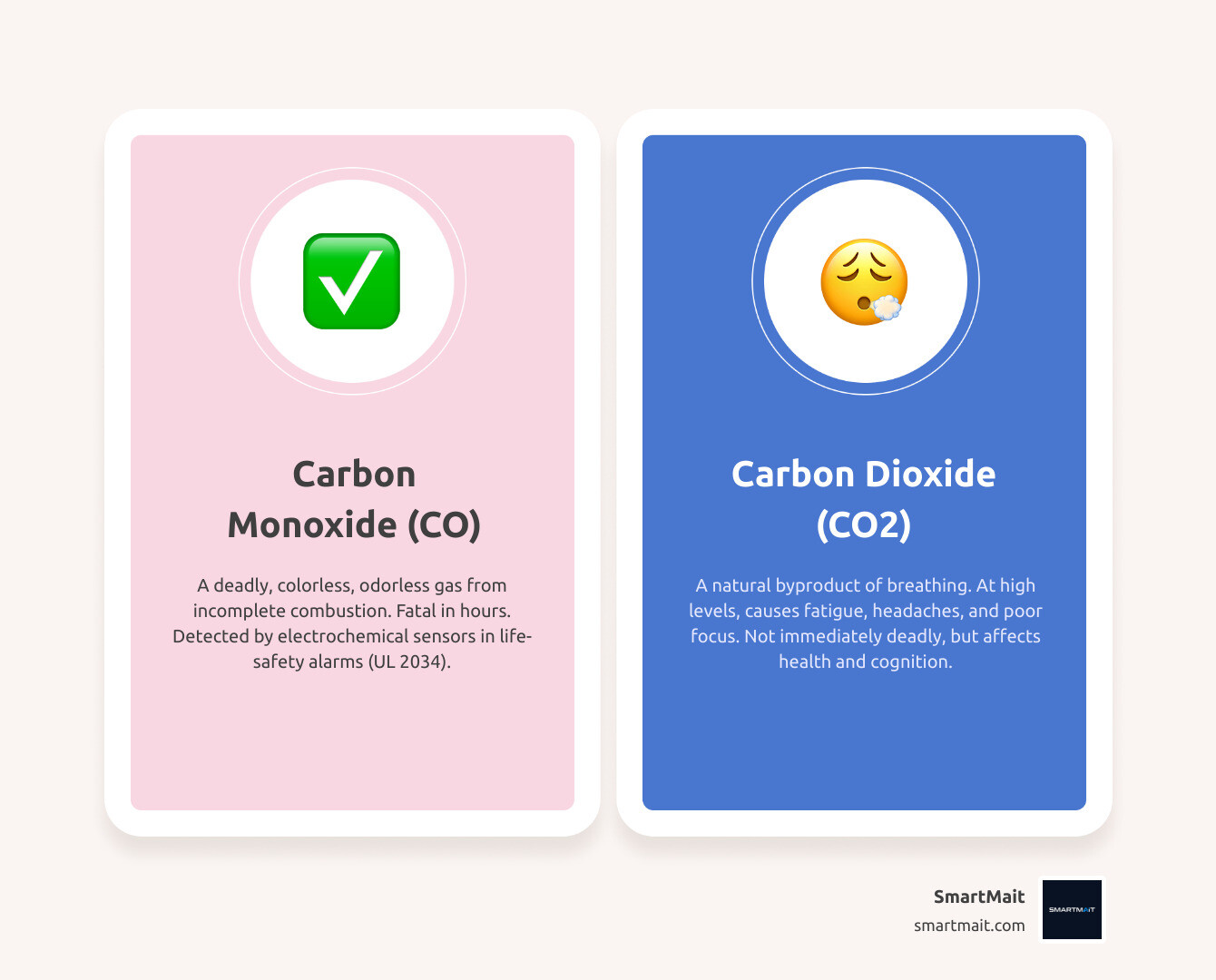
This matters. Carbon monoxide is a colorless, odorless gas that can be fatal within hours. Carbon dioxide is a natural byproduct of breathing that, at high levels, causes fatigue and poor focus — uncomfortable, but not immediately deadly. These are two very different problems requiring two very different devices.
I’m Dominic Hesano, founder of SmartMait and a low-voltage and smart home installation professional serving Southeast Michigan homeowners — and sorting through the noise around the amazon co2 detector market is exactly the kind of problem I help clients navigate every day. In the sections below, I’ll break down the key differences, what to look for, and which options are actually worth your money.
Handy amazon co2 detector terms:
Confusing Carbon Monoxide (CO) and Carbon Dioxide (CO2) is one of the most common and potentially hazardous mistakes consumers make when shopping on Amazon.com . Because their chemical formulas look almost identical, many people purchase a CO2 monitor thinking it will protect their family from a silent, deadly heating leak. In reality, they are buying a device meant to measure air freshness and ventilation, leaving their home completely vulnerable to lethal gas poisoning.
Let’s break down the science behind these two gases:
- Carbon Monoxide (CO): This is a highly toxic, completely odorless, colorless, and tasteless gas produced by the incomplete combustion of fuels (such as gas furnaces, fireplaces, generators, or car engines). Because humans have no natural way to detect CO, it is often called the “silent killer.” Exposure to high concentrations can cause permanent brain damage or death within minutes. To prevent these tragedies, home safety standards require dedicated CO alarms certified to the voluntary UL 2034 safety standard.
- Carbon Dioxide (CO2): This is a natural gas that humans and animals exhale. It is also used by plants for photosynthesis. In indoor environments, CO2 acts as a primary ventilation metric. High levels of CO2 indicate that a room is stuffy, poorly ventilated, and lacking fresh outdoor air. While elevated CO2 levels can cause headaches, drowsiness, and cognitive decline, it is not an immediate life-safety threat in typical residential settings like carbon monoxide is.
Because of this confusion, online retail algorithms often mix these products together. If you search for an amazon co2 detector, you will find highly rated CO life-safety devices like the LSENLTY Upgraded Carbon Monoxide Detector Plug in Wall, Carbon Monoxide Detectors with HD Screen&Indicator Visual&Audible Alarm, 3-in-1 CO Detector(CO Meter, Temp and Humidity) for Home RV Camping : Amazon.co.uk: DIY & Tools alongside pure air quality sensors.
While a 3-in-1 CO detector with temperature and humidity tracking is fantastic for travel or spot-checking near a boiler, it does not measure carbon dioxide. Conversely, a pure CO2 air quality monitor will sit silently during a lethal furnace leak.
For complete peace of mind, homeowners should look beyond cheap, uncoordinated DIY gadgets. Integrating certified life-safety sensors with a professional home automation system ensures that if carbon monoxide is detected, your home can automatically shut down the HVAC system to prevent the gas from circulating, turn on emergency lighting, and alert professional dispatch centers. You can learn more about how professional monitoring protects your household in our guide on Hot Deals on Cold Hard Safety ADT Fire Monitoring Explained.
How to Choose the Best Amazon CO2 Detector for Your Space
If your goal is to monitor air quality, ventilation, or grow tent environments, choosing the right amazon co2 detector requires looking closely at the sensor technology and hardware specifications. Not all monitors are created equal, and cheap sensors often rely on estimated metrics rather than direct chemical measurements.
When shopping, keep these technical factors in mind:
- NDIR (Non-Dispersive Infrared) Sensor Technology: This is the gold standard for carbon dioxide detection. An NDIR sensor uses infrared light to measure the exact concentration of CO2 molecules in the air. Avoid cheap sensors that claim to measure “CO2 equivalent” (eCO2) using volatile organic compound (TVOC) sensors. These equivalent sensors merely guess the CO2 levels based on other chemicals in the room, leading to highly inaccurate readings.
- Battery Capacity and Portability: If you plan to move your monitor between your home office, bedrooms, and the car, look for a device with a reliable rechargeable lithium battery. A capacity of 1600mAh to 2000mAh typically provides 72 to 120 hours of continuous operation on a single charge. If you need 24/7 continuous monitoring, ensure the device can run permanently plugged into a USB power outlet.
- LED Display Resolution and Readability: A high-definition, clear screen allows you to check your indoor air quality at a glance. Look for displays that feature a three-color backlight or indicator system (green for safe, yellow for moderate, and red for high) so you don’t have to memorize specific parts per million (ppm) thresholds.
- Additional Environmental Sensors: Many modern CO2 monitors are multi-functional. They often include sensors for temperature, relative humidity, TVOCs (volatile organic compounds), and particulate matter (like PM2.5 or PM10). Tracking humidity and temperature alongside CO2 gives you a complete picture of your indoor climate, helping you optimize comfort and prevent mold growth.
Top-Rated Amazon CO2 Detector Options and Air Quality Monitors
If you are ready to purchase a dedicated air quality monitor, several popular options on Amazon offer excellent performance, especially during sales events like Prime Day. Let’s look at the top-rated models that shoppers have purchased by the hundreds in the past month.
- Dienmern 5-in-1 Portable Air Quality Monitor: Boasting over 766 ratings and 700+ bought in the past month, this highly portable unit is priced at an accessible $21.65 (typical price: $22.79). It features a 1600mAh battery and tracks CO2, temperature, and humidity, making it an excellent budget-friendly starter device.
- Temtop CO2 Monitor Indoor Air Quality Monitor: A highly popular portable CO2 meter with over 624 ratings and 800+ bought in the past month. It is currently available at a 25% discount for $29.99 (typical price: $39.99). It is widely praised for its straightforward display and reliable NDIR sensor.
- SwitchBot CO2 Detector: This smart-enabled air quality monitor has 252 ratings and is a popular choice for smart homes. It is currently featured as a Prime Day Deal at $50.57 (list price: $69.99), with an additional 5% off coupon available. It integrates with the broader SwitchBot ecosystem to trigger other smart appliances.
- 16-in-1 Air Quality Monitor with 7″ Large Display: For those who want a comprehensive dashboard for their home, this massive display tracks 9 AQI metrics and offers 7 customizable alerts. It has 319 ratings, with over 800 bought in the past month. It is currently on an exclusive Prime Day Deal for $75.98 (list price: $99.99).
The table below compares these top-selling options to help you choose the best fit for your home:
| Device | Primary Sensor Type | Power Source | Smart Integration | Best For |
|---|---|---|---|---|
| Dienmern 5-in-1 | Electrochemical / NDIR | 1600mAh Rechargeable | None | Budget-conscious buyers, travel |
| Temtop CO2 Monitor | True NDIR | Rechargeable Lithium | None | Classrooms, offices, quick audits |
| SwitchBot CO2 Detector | Photoacoustic / NDIR | USB Plug-in / Battery | WiFi & Bluetooth | Smart home enthusiasts, automation |
| 16-in-1 Large Display | Multi-sensor array | USB Plug-in with Backup | None | Living rooms, comprehensive tracking |
Portable and Budget-Friendly Amazon CO2 Detector Picks
For those who need mobility — whether you are auditing air quality across different office spaces, checking a backyard greenhouse, or packing a sensor for a trip — portable devices are the ideal solution.
A standout in this category is the VEVOR Carbon Dioxide Detector, Temperature and Humidity Display, 15ft NDIR Sensor Cable, CO2 Monitor Steadfast Haven CO2 Detector for Outdoors, Home, Office, Car, Wall-Mounted Use: Amazon.com: Industrial & Scientific . Priced at $39.99, this lightweight 0.46-pound device is incredibly easy to carry. It features a high-precision NDIR sensor that accurately measures CO2 levels between 400 and 5000 ppm.
Equipped with a 2000mAh rechargeable battery, the VEVOR detector can run on standby for 72 to 120 hours, allowing you to perform multi-day spot checks without hunting for a wall outlet. Its three-color backlight system gives you an instant visual status of your air quality: green for safe (400–700 ppm), yellow for moderate (700–1500 ppm), and red for poor ventilation (1500–5000 ppm) that requires opening a window immediately.
Premium and Smart Home Amazon CO2 Detector Solutions
For modern smart homes, a standalone sensor that simply beeps when the air gets stuffy can feel incredibly fragmented. Premium homeowners want devices that can communicate with the rest of their home.
If you are looking to build a connected ecosystem, Amazon Prime includes: access to a wide variety of smart home integrations. Premium smart CO2 monitors, like the SwitchBot CO2 Detector or the 16-in-1 Air Quality Monitor, use WiFi connectivity to push real-time data to your smartphone.
With these smart integrations, you can set up automated scenes. For example, when the CO2 levels in your home office exceed 1,000 ppm during a long afternoon meeting, the sensor can talk to your smart thermostat or ventilation system to automatically turn on the HVAC fan and bring in fresh outdoor air. This transitions your air quality management from a manual chore (running around opening windows) to an automated, hands-off climate solution.
Recommended CO2 Levels for Health, Safety, and Ventilation
Understanding the numbers on your amazon co2 detector is key to maintaining a healthy, high-performing environment. Carbon dioxide levels are measured in parts per million (ppm), representing the concentration of CO2 molecules in the air.
Because we spend up to 90% of our lives indoors, monitoring these levels is crucial. Stagnant, high-CO2 air is a direct indicator of poor ventilation, which has been shown to decrease cognitive function, cause headaches, and significantly increase the transmissibility of airborne pathogens.

Here is a breakdown of what the different CO2 ppm levels mean for your health and comfort:
- 400 – 450 ppm: This is the typical concentration of outdoor atmospheric air. It represents the cleanest, freshest air possible.
- 450 – 600 ppm: Excellent indoor air quality. This range indicates outstanding ventilation, often achieved by keeping windows open or running a dedicated fresh-air intake system.
- 600 – 1,000 ppm: Good, acceptable indoor air quality. This is the standard target for well-ventilated offices, schools, and homes.
- 1,000 – 2,000 ppm: Poor ventilation. At this level, occupants may start to experience mild drowsiness, stuffiness, lack of concentration, and headaches.
- 2,000 – 5,000 ppm: Severely stagnant air. This level causes significant cognitive impairment, lethargy, rapid heart rate, and nausea. Prolonged exposure in this range should be avoided.
- 5,000+ ppm: This is the maximum workplace exposure limit for an 8-hour workday set by safety agencies. It indicates unusual air conditions or sensor calibration errors.
In specialized settings like grow tents, managing CO2 is even more precise. Plants thrive in elevated CO2 environments (often between 1,200 and 1,500 ppm) to maximize photosynthesis and accelerate growth. If you are monitoring a grow tent, a dedicated CO2 sensor with automatic alerts is essential to keep the environment perfectly balanced without letting excess gas leak into your living spaces.
Frequently Asked Questions About Indoor Air Quality
What is the difference between a CO and CO2 detector?
A Carbon Monoxide (CO) detector is a critical life-safety device designed to sense extremely toxic, odorless gas leaks resulting from incomplete combustion in appliances like boilers, fireplaces, or gas stoves. These devices use high-precision electrochemical sensors and sound a loud, 85 dB alarm to warn you of immediate danger.
A Carbon Dioxide (CO2) detector is an indoor air quality monitor that measures the freshness of your air and the adequacy of your ventilation. It typically uses NDIR infrared sensors to track respiration byproducts. While high CO2 levels make a room feel stuffy and cause drowsiness, it is not an immediate life-safety threat like CO.
If you are looking for a multi-threat safety device that protects against combustion hazards, you will want a combination alarm like the Kidde Carbon Monoxide Detector, Propane, Natural, Methane, & Explosive Gas Alarm, Plug-in Wall with 9-Volt Battery Backup, Digital LED Display – Combination Explosive Gas Carbon Monoxide Detectors – Amazon.com . This unit plugs directly into the wall and uses specialized metal oxide and electrochemical sensors to monitor for both toxic carbon monoxide and explosive fuel gases (like methane or propane), offering a digital display to track rising gas levels before they reach dangerous thresholds.
Do Amazon smart detectors integrate with professional home security?
Most consumer-grade smart detectors purchased on Amazon run on standalone Wi-Fi networks. While they can send a push notification to your phone, they often create a fragmented “app-heavy” setup. If your Wi-Fi router loses power or your internet connection drops, these standalone devices cannot communicate with each other or alert emergency services.
For true, estate-grade protection, environmental and safety sensors should be integrated into a unified, professional Z-Wave smart home ecosystem. Z-Wave operates on a dedicated, interference-free sub-gigahertz radio frequency, creating a secure mesh network that doesn’t clog your home’s Wi-Fi.
By connecting your safety sensors to a professional smart hub, you can automate whole-home safety events — such as shutting down the furnace during a CO leak, turning on emergency path lighting, and sending an instant dispatch signal to emergency responders. You can explore how professional integration secures your home’s perimeter and interior in our guide on how to Secure Your Perimeter with Top Alarm Systems and Monitoring.
How often should I calibrate or replace my CO2 sensor?
Like all scientific instruments, the chemical and optical components inside gas sensors degrade over time.
- CO2 Sensors (NDIR): High-quality NDIR carbon dioxide sensors generally last between 10 to 15 years. Many modern units feature “Automatic Baseline Calibration” (ABC), which recalibrates the sensor’s lowest reading to outdoor ambient levels (400 ppm) over a period of several days. However, if a sensor is placed in a permanently occupied space or a sealed greenhouse where CO2 never drops to outdoor levels, it must be manually calibrated outdoors once a year to maintain accuracy.
- CO Sensors (Electrochemical): Carbon monoxide safety sensors have a much shorter, strict lifespan of 7 to 10 years due to the natural degradation of the chemical detection gel. Even if the device has a replaceable battery — such as the X-Sense Smart Wi-Fi Carbon Monoxide Detector, with Temperature & Humidity Monitor, Voice Alert, Replaceable Battery, Digital Display and Historic CO Peak Level, XC0M-iR 1-Pack : Amazon.co.uk: DIY & Tools — the entire unit must be completely replaced once the sensor reaches its end-of-life.
Conclusion
When you search for an amazon co2 detector, it is easy to get overwhelmed by hundreds of standalone, plastic gadgets, sponsored listings, and confusing technical jargon. While cheap plug-in monitors and DIY Wi-Fi sensors can provide a basic visual reading, they often leave you with a fragmented, unreliable setup that cannot automatically respond to air quality or safety emergencies.
At SmartMait, we believe your home’s safety and air quality deserve a professional, integrated approach. We design, install, and maintain estate-grade smart home systems across Southeast Michigan’s premier communities — including Bloomfield Hills, Troy, Rochester Hills, Farmington Hills, and Birmingham.
By integrating your environmental sensors into a robust, professional Z-Wave ecosystem, we ensure your home works as a single, intelligent unit. If CO2 levels spike in your home office or a bedroom, your HVAC system automatically activates its fresh-air intake to flush the room. If a life-threatening carbon monoxide leak is detected, your furnace shuts down instantly, and professional monitoring centers are notified immediately.
What truly sets us apart is our commitment to what happens after the installation. With our exclusive SmartService concierge maintenance program, we establish an ongoing relationship with you. We don’t just install your systems and disappear; we handle the recurring testing, battery replacements, and sensor calibrations so you never have to worry about a dead battery or an expired sensor when it matters most.
Ready to elevate your home’s intelligence from simple warning beeps to fully automated, professional climate and safety control? Visit SmartMait Home Automation today to schedule your custom system design and discover the peace of mind that comes with professional smart home integration.