The Essential Guide to Audio Visual Installation Jobs
What an Audio Visual Installation Technician Does
An audio visual installation technician builds and brings to life the systems people rely on to see, hear, meet, and control technology in a space. The job can include running low-voltage cable, mounting displays and speakers, building equipment racks, configuring conference-room controls, tuning audio, and testing every connection before handoff.
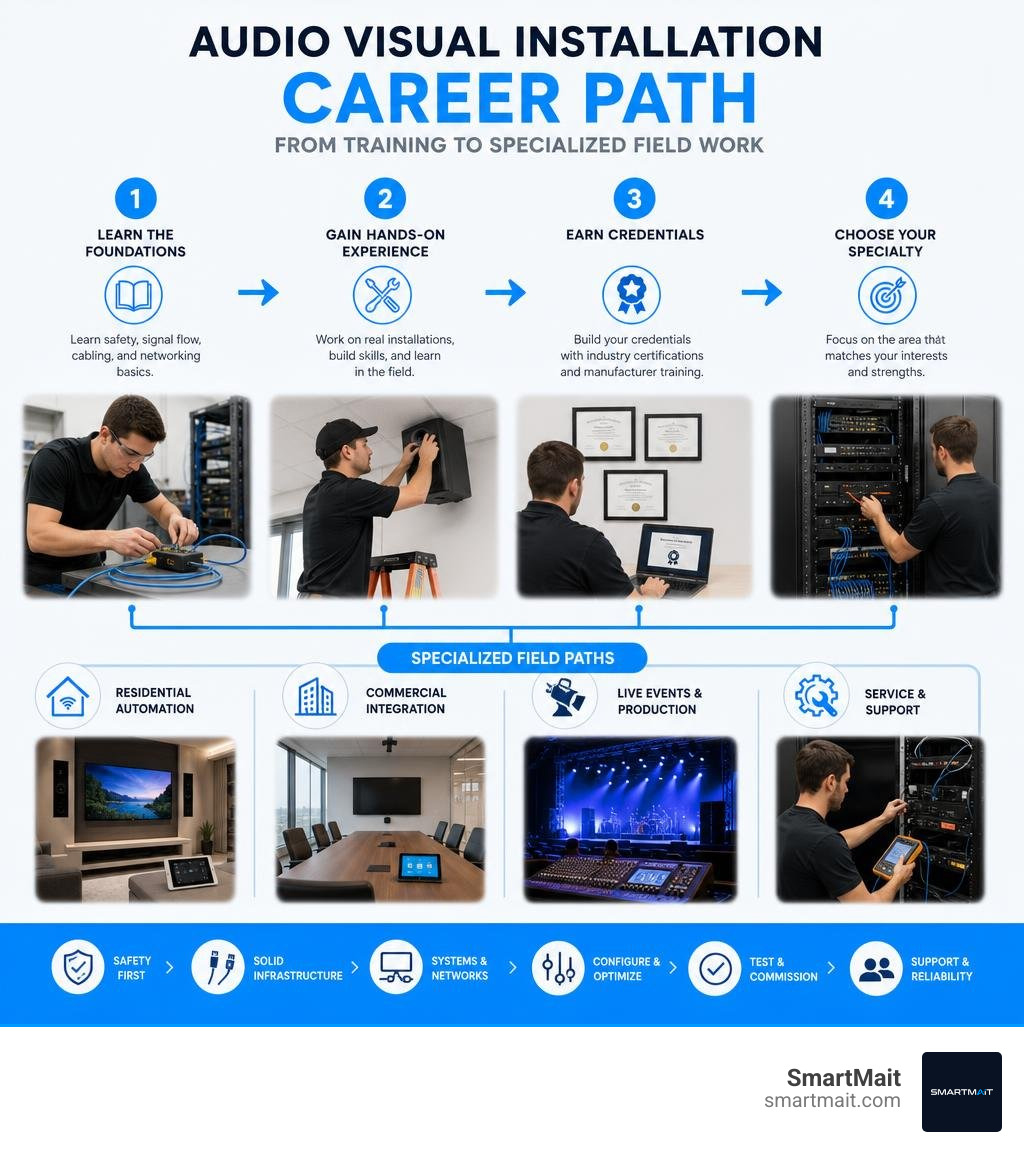
For someone exploring AV installation as a career, the practical path is straightforward:
- Learn core electrical safety, signal flow, cabling, and networking basics.
- Get hands-on experience through entry-level installation work, training, or an apprenticeship.
- Build credentials such as AVIXA CTS and, later, CTS-I or manufacturer training.
- Choose a specialty, such as residential automation, commercial integration, live events, or AV service.
This is not simply a job of hanging TVs. Modern technicians connect physical infrastructure with software, networks, video conferencing, digital signal processing, and control systems. In homes, that may mean reliable theater audio, whole-home music, smart lighting, cameras, and Wi-Fi that work together. In commercial spaces, it may mean a boardroom, classroom, video wall, or multi-room audio system that staff can use without calling IT.
The work remains largely on-site and hands-on, but it is changing. AI can help automate room tuning, monitoring, and basic diagnostics. It cannot replace careful cable work, safe mounting, system commissioning, or the calm problem-solving needed when a client needs every part of a connected system to work.
I am Dominic Hesano, founder of SmartMait, with hands-on experience in low-voltage installation, structured wiring, security, networks, and smart-home systems throughout Southeast Michigan. My work alongside audio visual installation technician projects has shown that dependable AV starts with sound infrastructure, clear documentation, and a technician who stays accountable after the install.
Discover more about audio visual installation technician:
Core Responsibilities of an Audio Visual Installation Technician
The daily workflow of an AV installation pro balances heavy structural craftsmanship with meticulous digital engineering. We start long before any hardware is unboxed. The foundation begins with site surveys and blueprint interpretation. A technician must read architectural drawings, reflected ceiling plans, and electrical schematics to map out cable pathways, verify load-bearing wall studs, assess room geometry, and locate power drops.
Once the layout is confirmed, the physical infrastructure phase begins:
- Cable Pulling and Pathway Routing: Running uncompressed 4K video feeds, control lines, and speaker wires through conduit, open joists, and drop ceilings.
- Low-Voltage Termination: Terminating bulk CAT6, coaxial lines, and delicate fiber optic glass connections with absolute precision to avoid packet loss.
- Rack Fabrication: Assembling centralized AV equipment racks where clean cable dressing, thermal heat dissipation, and organized power distribution keep critical gear running cool.
- Display and Acoustic Mounting: Securely rigging multi-panel video walls, commercial displays, motorized projection screens, and in-ceiling architectural speakers.
- Digital Calibration: Configuring digital signal processors (DSPs) to eliminate audio feedback loops, balance room acoustics, and calibrate video displays for vibrant color accuracy.
While installation and service share common technical knowledge, their core objectives differ substantially on the jobsite.
| Category | AV Installation Technician | AV Service Technician |
|---|---|---|
| Primary Focus | New system construction, rough-in wiring, structural mounting, and end-to-end commissioning. | Post-install diagnostics, component repair, preventative maintenance, and system updates. |
| Daily Environment | Active construction zones, new commercial buildouts, and residential retrofit jobsites. | Occupied client homes, active corporate offices, and live operational facilities. |
| Core Skillset | Blueprint reading, structural rigging, cable pulling/termination, rack building, DSP setup. | Root-cause analysis, signal testing, hardware replacement, firmware patching, client service. |
| Success Metric | Flawless system turnover, clean rack dressing, zero signal drops at initial handoff. | Rapid issue resolution, reduced downtime, and long-term hardware reliability. |
Jobsite Operations and Systems Commissioning
Commissioning is the crucial moment where raw physical hardware transforms into an operational, unified ecosystem. Technicians do not just plug in boxes and walk away; they program control systems, configure IP-based video routing switchers, and map out touch-panel user interfaces.
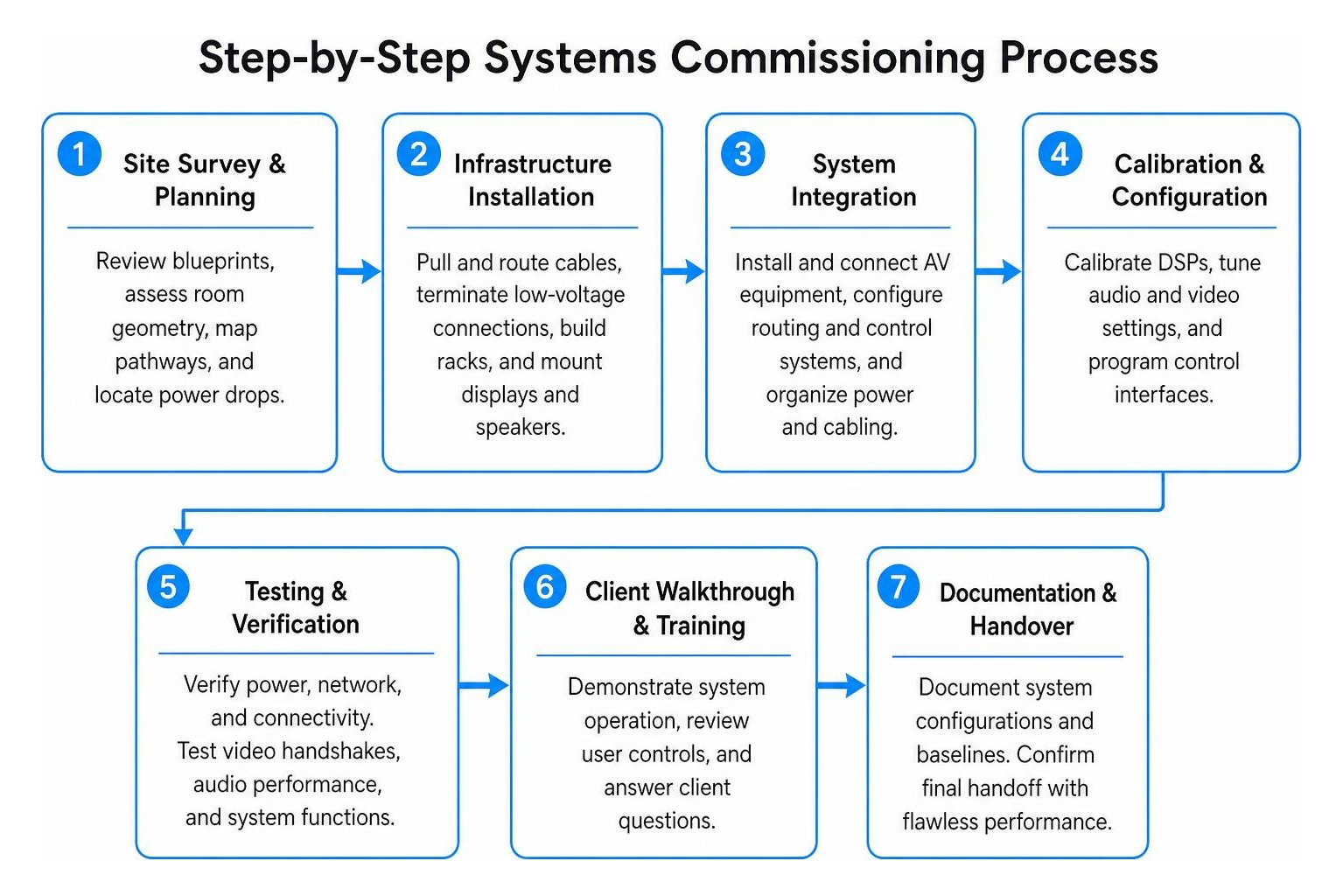
During this phase, technicians enforce strict electrical and jobsite safety standards. Low-voltage wiring must maintain proper physical separation from high-voltage AC lines to prevent 60 Hz hums, electromagnetic interference, and fire hazards. Once hardware is powered up, the technician verifies network subnets, tests video handshakes across HDMI and Audio-over-IP endpoints, and documents baseline performance metrics.
Essential Toolkit for the Audio Visual Installation Technician

You cannot build world-class audiovisual environments with consumer-grade tools. Professional field technicians carry specialized toolkits engineered for structural mounting, structured cabling, and digital diagnostics:
- Cable Testers & Certifiers: Essential for validating CAT6, CAT6A, and fiber optic continuity, ensuring bandwidth capacity for uncompressed media streams.
- Tone Generators & Probes: Indispensable for identifying specific wire runs hidden behind walls or within packed conduit pathways.
- Spectrum Analyzers & Sound Pressure Level (SPL) Meters: Used for precision acoustic calibration, measuring decibel levels, and eliminating room frequency reflections.
- Digital Multimeters: Critical for checking voltage drops, verifying continuity, and troubleshooting grounding issues.
- Heavy-Duty Power Tools & Laser Levels: High-torque hammer drills, oscillating multi-tools, and cross-line laser levels ensure commercial video walls and flush-mount speakers align symmetrically.
- Precision Crimpers & Wire Strippers: Specialized ratcheting tools for terminating RJ45, coax BNC, compression connectors, and fiber quick-connects cleanly every single time.
Career Paths, Education, and Professional Certifications
Entering the audiovisual field offers multiple accessible pathways. Many professionals begin through formal vocational programs or an associate degree in electronics, digital media, or electrical engineering. Hands-on programs, such as the Entertainment Technologies – Goldsboro curriculum, provide foundational knowledge in acoustics, lighting design, live sound reinforcement, and stagecraft.
Other technicians enter through structured low-voltage electrical apprenticeships or by transitioning from carpentry, IT networking, or staging trades. Regardless of entry point, long-term career advancement hinges on industry-standard certifications.
The globally recognized benchmark for our industry is administered by AVIXA (Audiovisual and Integrated Experience Association):
- AVIXA CTS (Certified Technology Specialist): The core industry standard covering AV math, signal flow, infrastructure wiring, and troubleshooting.
- AVIXA CTS-I (Installation Specialist): The advanced credential focusing on physical installation mechanics, project management, rack fabrication, and jobsite safety standards.
- AVIXA CTS-D (Design Specialist): Tailored for systems engineers designing complex commercial and residential layouts.
- OSHA 10/30-Hour Construction Safety: Mandatory credentials for lead technicians working on commercial and residential job sites.
Career Specializations for an Audio Visual Installation Technician
The AV landscape offers diverse niches spanning multiple market sectors:
- High-End Residential Integration: Designing whole-home audio distribution, dedicated private home cinemas, motorized window treatments, and Z-Wave smart home automation ecosystems across luxury communities like Bloomfield Hills, Birmingham, and Rochester Hills.
- Commercial Boardrooms & Unified Communications: Outfitting executive conference rooms, hybrid huddle spaces, and municipal chambers with automated camera tracking and interactive collaboration boards in business hubs such as Troy, Southfield, and Warren.
- Smart Lighting & Architectural Shading: Engineering low-voltage lighting control networks, multi-zone mood lighting scenes, and automated daylight harvesting for modern architectural builds.
- Live Event Staging & Hospitality: Rigging modular LED video walls, digital soundboards, and line-array speakers for corporate galas, hotels, and entertainment venues.
- Broadcast & Post-Production Suites: Integrating multi-camera video switchers, SDI routing matrices, and acoustic isolation rooms for production studios.
Vendor Credentials and Control System Ecosystems
Modern audiovisual installations rely on robust IT backbones. Leading technicians validate their expertise with specialized hardware and software certifications:
- DSP Platforms: Hardware-specific credentials like Biamp Tesira Forté and QSC Q-SYS (Level 1, Control, and Video) demonstrate deep competence in acoustic echo cancellation (AEC) and digital audio routing.
- Control System Programming: Crestron (DMC-E-4K) and Extron Certified AV Associate credentials prepare technicians to configure enterprise-grade control processors and touch interfaces.
- Audio-over-IP (AoIP) & Network Protocols: Advanced networking accreditations, such as Netgear Pro AV Level 1 and Dante Audio routing certificates, verify that a technician can configure managed network switches, IGMP snooping, and VLANs for latency-free media delivery.
Compensation Benchmarks, Job Outlook, and Industry Challenges
The career outlook for audiovisual technicians is exceptionally strong. The U.S. Bureau of Labor Statistics projects 13,000 annual openings for AV technicians through 2033, alongside an overall 10% job growth rate between 2021 and 2031. This expansion is driven by the modernization of hybrid workspaces, digital healthcare facilities, smart schools, and luxury residential home automation.

Nationally, compensation scales with experience, certifications, and technical specialization:
- Average Hourly Wage: Approximately $26.28 per hour across general AV roles.
- Entry-Level Technicians: Start between $19.00 and $20.00 per hour.
- Experienced & Lead Technicians: Earn upwards of $36.00 per hour (or $75,000+ annually).
- Event AV Specialists: Earn between $40,000 and $60,000 annually (with freelance day rates ranging from $200 to $500).
- Broadcast & Post-Production Technicians: Range from $40,000 to $90,000 per year depending on specialization.
- Systems Integration Specialists: Command the highest compensation tier, ranging from $50,000 to over $100,000 per year due to the advanced network engineering and DSP programming required.
- Specialized institutional roles, such as Performing Arts Technicians, frequently range between $23.83 and $34.71 per hour.
Jobseekers can explore diverse technical roles through resources like the Audio Visual Support Technician – inSync Staffing listings to benchmark market requirements.
Despite high demand, the profession comes with genuine challenges:
- Physical Demands: Technicians must lift heavy commercial displays, maneuver in tight attic spaces or crawlspaces, climb ladders, and pull dense wire bundles through conduit.
- System Drift: Over time, undocumented client modifications, unscheduled firmware updates, or subtle network changes can introduce latency and unexpected bugs into an installed system.
- Bridging Construction with IT: Installation leads must coordinate seamlessly with general contractors, master electricians, interior designers, and corporate IT managers, ensuring physical rough-ins match digital requirements perfectly.
To solve the recurring challenge of system drift, forward-thinking integrators pair initial installations with proactive maintenance. That is why our SmartService concierge maintenance program provides ongoing remote diagnostics, regular firmware patching, and priority on-site support across Oakland, Wayne, and Macomb counties. We stay engaged to ensure our clients’ smart automation, structured Wi-Fi, and entertainment systems perform flawlessly year after year.
Frequently Asked Questions About Audio Visual Installation
What is the difference between an AV installation technician and an IT specialist?
While AV and IT fields increasingly intersect over network infrastructure, their primary domains are distinct. An IT specialist manages local area networks, server databases, cloud computing, cybersecurity, and computer hardware.
An AV installation technician focuses on media endpoints, spatial sound dynamics, and human-machine control interfaces. Technicians engineer acoustic calibration, terminate fiber and video feeds, tune multi-zone audio amplifiers, adjust video latency, and install structural hardware mounts. In short: IT builds the digital data highway; AV makes sure the sound, picture, and user experience travelling across that highway look and sound pristine.
How long does it take to become a fully qualified AV technician?
The timeline depends on your chosen training pathway:
- Vocational Certificate: 6 to 12 months of structured classroom study covering basic electronics and wiring.
- Associate Degree: 2 years focusing on audiovisual technology, digital media, or telecommunications.
- Apprenticeship & On-The-Job Training: 1 to 3 years of hands-on field experience assisting lead technicians with rough-in cabling, mounting, and rack building.
- Mastery & Lead Status: 3 to 5 years of active field experience, paired with AVIXA CTS/CTS-I credentials and vendor certifications (such as Q-SYS, Crestron, or Biamp).
How is artificial intelligence transforming audio visual installation?
Artificial intelligence is streamlining setup workflows and system monitoring across the audiovisual industry:
- Automated Room Tuning: AI algorithms analyze room reflections and automatically adjust DSP equalizer curves and acoustic delay settings in seconds.
- Intelligent Camera Tracking: Conference cameras leverage computer vision to frame active speakers naturally without manual presets.
- Predictive Diagnostics: Smart monitoring tools detect network packet drops, overheating rack components, or failing display backlights before the client notices an issue.
However, AI cannot pull wire through conduit, safely anchor a 98-inch commercial display into structural framing, dress an equipment rack cleanly, or troubleshoot unexpected jobsite layout changes. Human precision and craftsmanship remain irreplaceable.
Conclusion
A career in audio visual installation blends the satisfaction of physical craftsmanship with cutting-edge network engineering. As homes and businesses integrate smarter automation, immersive multi-room audio, and unified conferencing, the demand for certified, detail-driven technicians will continue to surge.
Building a dependable AV infrastructure requires more than basic retail electronics—it demands architect-grade structured cabling, disciplined rack organization, and an ongoing commitment to post-installation service.
Whether you are designing a high-performance home cinema in West Bloomfield, configuring corporate conference technology in Troy, or seeking concierge-level system reliability across Southeast Michigan, explore our full suite of smart technology and integration solutions at SmartMait to build connected spaces engineered to last.