Understanding the AV System and Electoral Reform
Why AV System Politics Is More Complex Than You Think
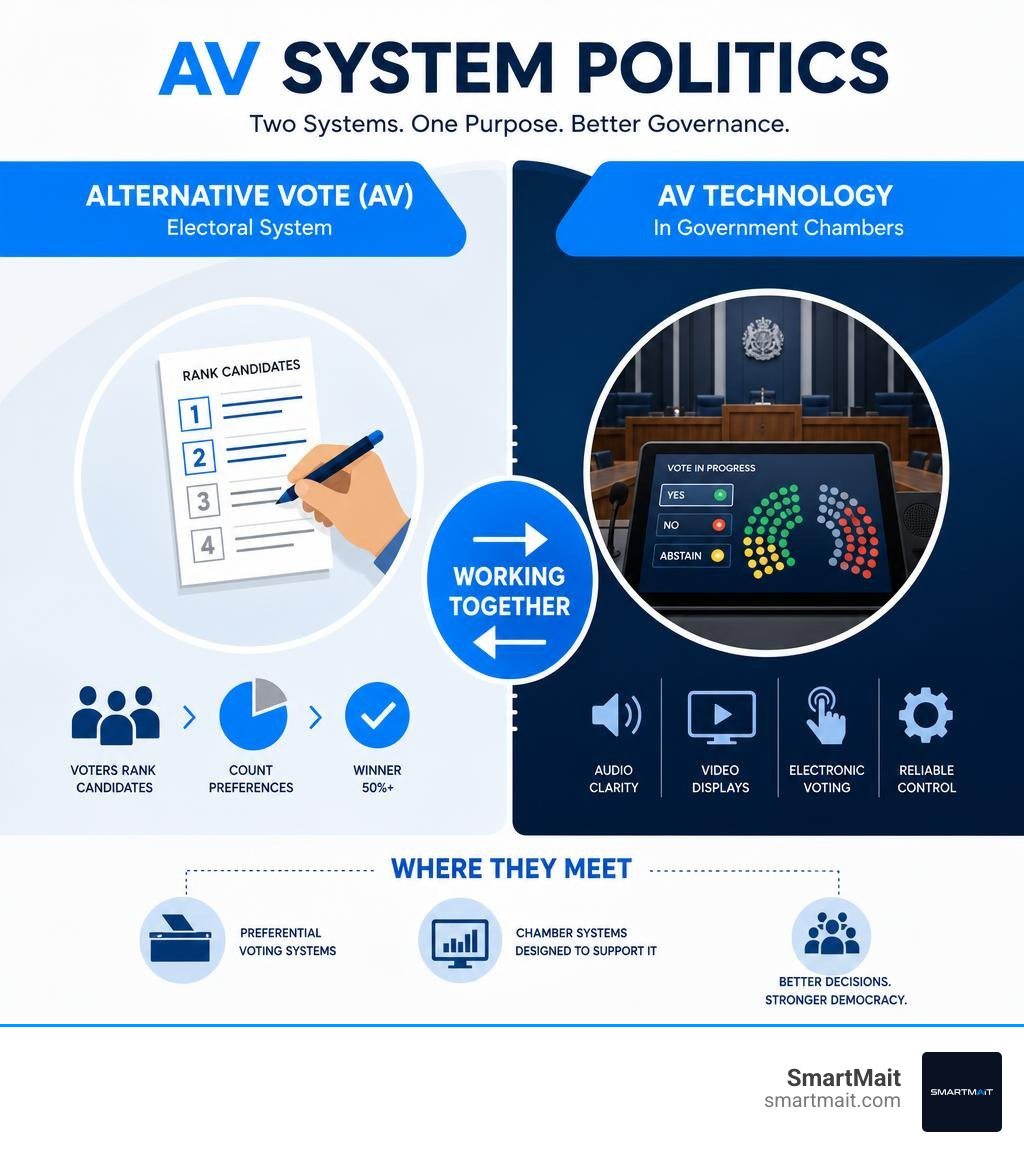
AV system politics sits at the crossroads of two very different worlds: the Alternative Vote (AV) electoral systems that shape how democracies elect their leaders, and the audio/visual (AV) technology that makes modern legislative chambers actually function. Understanding both is key to seeing how governments run — and how they can run better.
Here is a quick breakdown of what “AV system politics” covers:
- Alternative Vote (AV): A preferential voting method where voters rank candidates by number instead of marking a single “X.” A winner must earn more than 50% of the active vote.
- AV technology in government: The physical audio, video, and electronic voting systems installed inside parliamentary chambers, council rooms, and legislative buildings.
- Where they meet: When a government adopts a preferential voting system like AV or the Single Transferable Vote (STV), the electronic voting hardware and software inside the chamber must be designed to support it — from touchpanel ballot interfaces to real-time vote-count displays.
The 2024 UK General Election was described as the most disproportional in British electoral history. That kind of result puts electoral reform — and the AV systems that would need to support it — squarely back in the public conversation.
I’m Dominic Hesano, founder of SmartMait, and while my work is rooted in residential and commercial AV integration across Southeast Michigan, the principles behind AV system politics — reliable signal distribution, centralized control, and systems that just work when it matters most — are the same ones I apply to every project. Understanding how high-stakes AV environments are designed and built is exactly what separates a system that performs under pressure from one that fails at the worst possible moment.
Explore more about av system politics:
What is the Alternative Vote (AV) System in Politics?
To understand how voting rules affect technology design inside legislative chambers, we must first look at how the Alternative Vote (AV) system works in practice. AV is a majoritarian, preferential voting system. Instead of choosing just one candidate with a single “X,” voters rank candidates on their ballot paper in order of preference (1, 2, 3, and so on).
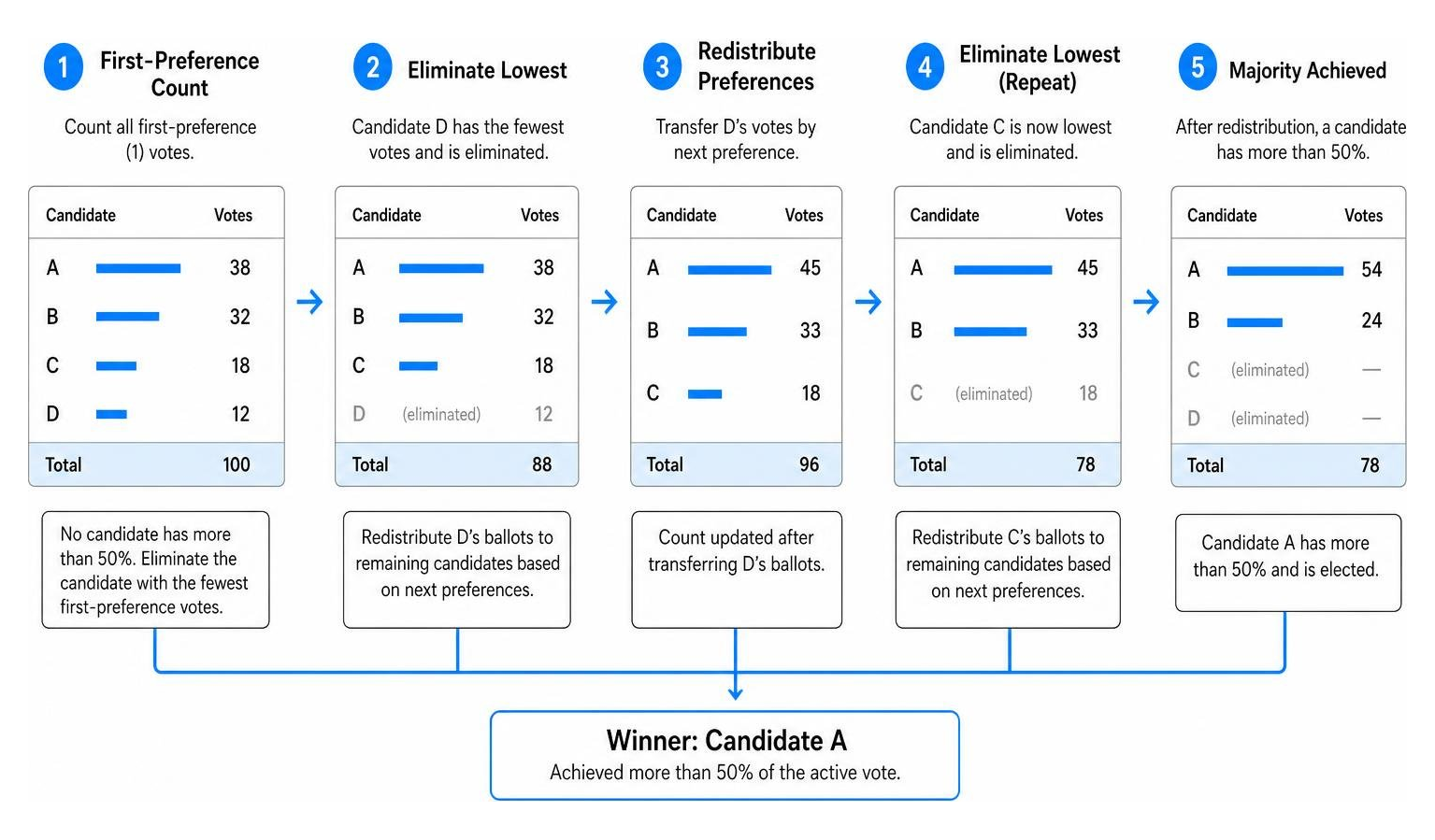
The counting process follows a structured sequence designed to ensure the winning candidate has a genuine majority mandate (over 50% of the active vote):
- First-Preference Count: All first-preference (number 1) votes are counted. If a candidate secures more than 50% of these votes, they are elected immediately.
- Sequential Elimination: If no candidate reaches the 50% threshold, the candidate with the fewest first-preference votes is eliminated.
- Preference Redistribution: The ballots of the eliminated candidate are reviewed, and their votes are transferred to the remaining candidates based on the voters’ second preferences (number 2).
- Iterative Rounds: This process of eliminating the lowest-placed candidate and redistributing their votes continues until one candidate crosses the 50% majority threshold.
This system stands in stark contrast to First-Past-the-Post (FPTP), where the candidate with the most votes wins, even if they only secure a small fraction of the total vote. Under FPTP, barely 1 in 3 MPs can claim support from a majority of their voters—a record low in modern democratic history. In fact, the 2024 UK General Election was noted as the most disproportional election in British history.
However, the Alternative Vote is not a form of proportional representation (PR). In the 2011 UK referendum on AV, where 68% voted against and 32% voted in favor (with a 42% turnout), critics pointed out that AV can sometimes produce results that are even less proportional than FPTP, as was demonstrated in analyses of the 2015 General Election.
Despite this, AV is highly effective at mitigating “vote splitting” and reducing the need for tactical voting. It forces candidates to run less divisive campaigns because they must appeal to their opponents’ supporters for crucial second- and third-preference votes. Today, the UK Parliament uses AV internally to elect the chairs of most House of Commons committees, the Lord Speaker, and in by-elections for hereditary peers.
| Feature | First-Past-the-Post (FPTP) | Alternative Vote (AV) |
|---|---|---|
| Ballot Style | Single choice (“X” next to one candidate) | Preferential ranking (1, 2, 3…) |
| Winning Threshold | Plurality (most votes wins, no majority needed) | Absolute majority (over 50% of active votes) |
| Vote Splitting | High risk; similar candidates split the vote | Low risk; backup preferences protect the vote |
| Tactical Voting | Common; voters avoid “wasting” votes on third parties | Minimal; voters can rank their true favorite first |
| Proportionality | Generally low; can lead to highly disproportional results | Low to moderate; majoritarian but ensures local majority |
How Electoral Systems Shape Legislative AV System Politics
The specific voting rules of a legislative body directly dictate the engineering, scale, and complexity of the physical AV systems installed in their chambers. A chamber operating under First-Past-the-Post requires simple “Yes/No/Abstain” voting interfaces. However, when a parliament transitions to preferential systems like the Alternative Vote or the Single Transferable Vote (STV), the technology must scale up significantly to handle the complex, multi-round mathematics of preference redistribution.
For instance, in a chamber using STV or multi-member preferential voting, the electronic voting terminals must allow delegates to input numerical rankings quickly and securely. The backend system must then process these rankings in real time, calculating quotas and transferring surplus votes instantly.
This requires a highly sophisticated integration of hardware and software. The user interface on the delegate’s desk must be intuitive enough to prevent spoiled ballots, while the central media processors must handle complex database logic without latency. This is where advanced system architecture becomes critical. To explore how we approach complex routing and infrastructure challenges, you can read More info about professional AV system design.
Designing Hardware for Preferential AV System Politics
Designing secure, reliable electronic voting systems for legislative bodies presents unique challenges. Unlike public elections, which rely on paper ballots for anonymity, legislative votes often require a mix of open, recorded votes and secure secret ballots for sensitive internal appointments.
To support these varied requirements, modern legislative chambers are replacing legacy Programmable Logic Controller (PLC) systems and mechanical push-buttons with high-resolution touchpanels. For example, during a major $15 million renovation of the Nevada Legislative Building (originally constructed in 1969 with its last major update in 1996), the old mechanical voting and microphone systems were completely replaced.
The upgrade utilized advanced Crestron PRO3 and PRO4 processors running custom C# programming to interface the physical AV hardware with the state’s proprietary meeting management and business logic systems. Rather than relying on physical buttons that wear out over time, the Assembly (42 members) and Senate (21 members) now use dedicated touchpanels at each desk to:
- Cast secure, real-time votes.
- Request permission to speak, feeding into an automated request-to-speak queue.
- Control local microphone muting.
This level of custom programming ensures that the system is completely secure, highly redundant, and tailored to the exact legislative rules of the chamber. You can learn more about this integration in the Case study on Nevada Legislative Building.
How Global Voting Rules Influence Chamber AV System Politics
Electoral systems also shape how democratic proceedings are shared with the public. In countries pushing for “e-democracy” and increased legislative transparency, AV systems must be integrated directly with municipal document management systems.
A prime example of this is Lithuania’s nationwide Electronic Democracy project, which began in 2010. The goal was to install integrated voting, discussion, and video streaming systems across all 60 of the country’s self-government institutions. By integrating digital congress discussion units with automated pan-tilt-zoom (PTZ) cameras and central media processors, the system automated the entire public broadcast workflow.
When a council member activates their microphone, the central Crestron processor automatically triggers a PTZ camera preset to frame the speaker. Simultaneously, the system links to the council’s document management database to display the active agenda item and the speaker’s name on the public live stream, publishing voting results to the web instantly as soon as a vote concludes. This eliminates the need for manual camera operators and administrative staff to manage the broadcast. To see how this unified approach to digital democracy was executed, read the Case study on Lithuania’s e-democracy.
Overcoming Technical Challenges in Historic Government Chambers
One of the greatest challenges for AV integrators is installing modern, high-performance technology inside historic or heritage government buildings. These chambers often feature highly reflective architectural surfaces—such as marble walls, high plaster ceilings, and large glass windows—that create severe acoustic reflections, destroying speech intelligibility. Furthermore, strict historic preservation rules prevent integrators from cutting into walls, running visible conduit, or adding heavy acoustic treatments.
To solve these acoustic challenges without altering the architectural aesthetics of historic chambers, we rely on digital beam-steering technology. During the intensive three-year, €52.1 million ($58.6 million) renovation of the State Parliament of Baden-Wuerttemberg completed in 2016, the acoustic design required high speech intelligibility in a highly reflective plenary chamber.
The solution was the integration of slim, digitally steerable line arrays from Renkus-Heinz. These speakers allow sound beams to be mathematically steered and focused directly at the delegates’ ears, keeping the acoustic energy off the reflective glass windows and high ceilings. By building these slim columns directly into the back walls and architectural pillars, the technology remains virtually invisible, preserving the chamber’s historic grandeur while delivering pristine audio quality.

You can read more about how this advanced acoustic engineering was implemented in the Case study on Baden-Wuerttemberg State Parliament.
Ensuring Democratic Integrity and Transparency in Hybrid Governance
Modern governance demands that public meetings support hybrid and remote participation without compromising democratic integrity. Remote voters and physical attendees must have identical voting and speaking rights, and the public must have seamless access to live and archived proceedings.
Unifying fragmented hardware—such as discussion microphones, PTZ cameras, voting systems, and streaming encoders—into a single, secure ecosystem is critical. In the public sector, councils are increasingly moving away from legacy analog systems to scalable AV-over-IP (AVoIP) networks.
At the Mid Ulster District Council, a complete upgrade using a centralized Kramer AV control and AVoIP ecosystem transformed the main council chamber and five meeting rooms. The system allows secure remote voting and hybrid participation, managed through a standardized, single-touch user interface that simplifies operation for non-technical staff. Proactive monitoring software allows IT teams to track device health and run diagnostics remotely, ensuring that a technical glitch never disrupts a live democratic vote.
To learn more about how modern AVoIP and centralized control protect democratic processes, read the Case study on Mid Ulster District Council and find More info about commercial AV installation.
Frequently Asked Questions about Legislative AV Systems
How do push-to-talk microphones simplify chamber audio without an AV technician?
Managing a high-input environment with dozens or hundreds of microphones without an active AV technician is a scenario that keeps system designers awake at night. The solution lies in shifting physical control to the users through push-to-talk (momentary) hardware combined with cascaded digital automatic matrix mixers.
In the North Dakota House of Representatives, the sound reinforcement system manages 108 individual floor microphones without a dedicated AV operator. The system utilizes rugged “grip-to-talk” microphones, meaning a representative’s audio feed is only active while they are physically holding the switch. These feeds are routed through seven cascaded automatic matrix mixers that automatically adjust levels, manage gain, and prevent acoustic feedback, ensuring a clean audio mix for both the local chamber and the public broadcast.
Why are rear-projection cubes sometimes preferred over LCD panels in parliaments?
In large-format legislative displays, high-resolution data—such as detailed voting results, legislative text, and multi-party seating charts—must be perfectly legible from anywhere in the chamber. When designing these displays, standard LCD video walls present a major drawback: the visible bezels (seams) between the panels can cut through critical text and numbers, causing visual confusion.
During the upgrade of the Chamber of Deputies in Romania’s parliament, which accommodates 341 delegates, the integration team chose specialized rear-projection cubes over standard LCD panels to construct a massive 120-inch diagonal video wall in a 2×2 configuration. Because these specialized cubes have a depth of only 26cm and feature virtually bezel-free seams, they provide a completely seamless, high-contrast display. This ensures that complex voting data is perfectly readable without any visual fragmentation. You can read more about this in the Case study on Romania’s Chamber of Deputies.
What are the advantages of centralized control systems in government chambers?
Centralized control systems (such as Crestron) offer significant advantages over decentralized approaches in legislative environments:
- Unified Operation: A single touchpanel interface automates the configuration of microphones, cameras, displays, and lighting, eliminating the need for manual hardware adjustments by non-technical staff.
- Automated Camera Tracking: Centralized processors can link microphone activation directly with PTZ camera presets, automating the broadcast feed without requiring manual camera operators.
- Enterprise Management: IT teams can monitor device status, run diagnostics, and push firmware updates across multiple rooms from a single, secure network interface.
- High Redundancy: Centralized control allows for the deployment of dual, mirrored processors, ensuring that if one processor fails during a critical vote, the backup instantly takes over without interrupting the legislative session.
Conclusion
Whether managing the high-stakes voting procedures of a national parliament or integrating advanced audio and automation into a premium boardroom or private estate in Southeast Michigan, the core engineering principles remain identical. High-reliability systems require meticulous design, robust hardware platforms, and expert integration.
At SmartMait, we bring this exact level of professional, architect-grade engineering to homes and light commercial spaces across Oakland, Macomb, and Wayne counties. By utilizing the ultra-reliable, interference-resistant Z-Wave ecosystem, we design smart home automation, security, lighting, and AV systems that operate as a single, unified environment.
What truly sets us apart is what happens after the physical installation. Through our exclusive SmartService concierge maintenance program, we build ongoing relationships with our clients in Bloomfield Hills, Troy, Rochester Hills, Farmington Hills, and Birmingham. While other integrators install a system and disappear, we stay to ensure your technology performs flawlessly year after year.
If you are ready to experience the reliability of a professionally integrated, beautifully maintained AV and automation ecosystem, Get started with expert AV integration today.