Why Your Business Needs Expert Audio Video System Design
Why Your Business Needs Expert Audio Video System Design
Why Expert Audio Video System Design Makes or Breaks Your Space
Audio video system design is the process of planning, selecting, and integrating the audio, video, and control technologies that work together in a space — whether that’s a corporate boardroom, a retail lobby, or a smart home.
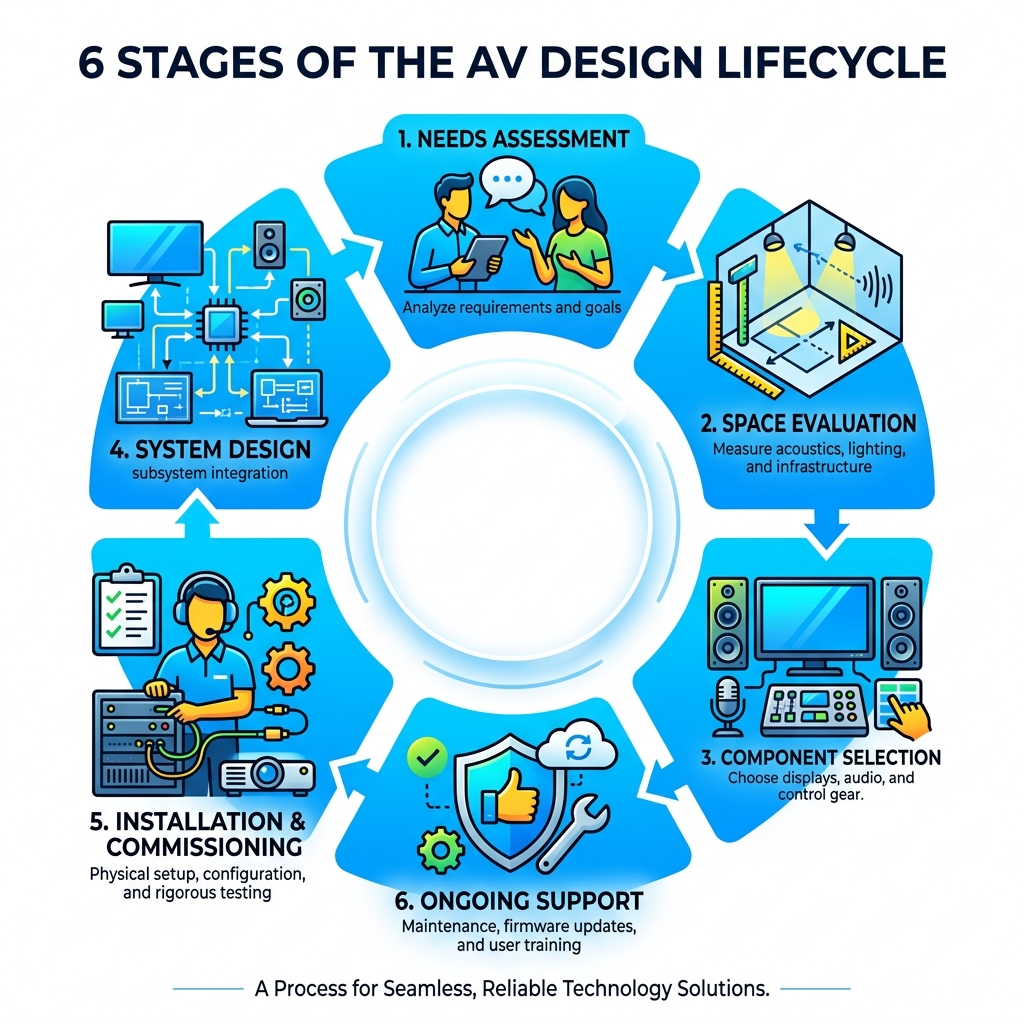
Quick answer — what expert AV system design involves:
- Needs assessment — understanding how the space is used and who uses it
- Space evaluation — measuring room acoustics, sightlines, lighting, and infrastructure
- Component selection — choosing displays, speakers, microphones, and control systems that work together
- System design — mapping signal flow and integration across all subsystems
- Installation and commissioning — physical setup, configuration, and thorough testing
- Ongoing support — maintenance, firmware updates, and user training
Most people think AV is just about buying good equipment. It isn’t.
A poorly designed system — even with expensive gear — delivers frustrating audio, unreliable video, and controls nobody wants to use. That’s not just annoying. For a business, it undermines communication, productivity, and the impression you make on clients.
The real goal of AV system design is making technology invisible. When it works well, people just communicate, present, and collaborate — without thinking about the tech behind it.
For business owners and homeowners who want seamless, reliable performance from day one, the design process matters just as much as the equipment itself.
Understanding the Core of Audio Video System Design
When we talk about audio video system design, we aren’t just talking about hanging a TV on a wall in a Troy boardroom or placing a few speakers in a West Bloomfield living room. We are looking at a technical and professional perspective on AV integration that ensures every piece of hardware and software talks to each other perfectly.
At its heart, AV design is about “signal flow.” This is the path that audio and video data take from a source (like a laptop or a microphone) through processors and switchers, finally reaching the output (the speakers or the display). If there is a break or a bottleneck anywhere in that flow, the whole experience suffers.
We focus on subsystem synchronization. This means when you press “Present” on a touch panel, the lights dim, the shades lower, the projector turns on, and the audio switches to the correct input—all at once. This level of harmony requires a deep understanding of how different brands and protocols interact.

Key Components of a Professional Setup
To achieve this “magic,” we utilize several high-level components and protocols that go far beyond consumer-grade gear:
- Digital Signal Processors (DSPs): Think of the DSP as the “brain” of your audio. It handles echo cancellation (crucial for clear Zoom calls), manages volume levels automatically, and removes background hiss.
- HDBaseT: This technology allows us to send uncompressed 4K video, audio, power, and control signals over a single Category cable (like CAT6) for up to 100 meters. This reduces clutter and simplifies wiring in large Oakland County offices.
- Dante Protocols: Dante is the industry standard for “Audio over IP.” It allows us to distribute near-zero latency audio across your existing network infrastructure.
- Input/Output Devices: This includes everything from 4K laser projectors and LED video walls to ceiling-mounted beamforming microphone arrays.
To ensure the highest reliability, we partner with industry-leading manufacturers. You can explore the premium hardware we trust by visiting our brands.
The Step-by-Step Audio Video System Design Process
A successful project follows a strict complete guide to the AV design process. We don’t guess; we calculate.
- Stakeholder Interviews: We sit down with your team in Southfield or Farmington Hills to ask: Who is using this room? What is the primary goal? Is it for high-stakes sales presentations or internal brainstorming?
- Site Surveys: We visit the location to measure dimensions, check for structural obstacles, and evaluate existing electrical and network capacity.
- System Schematics: We create detailed “blueprints” of the signal flow. This ensures every cable and connection is accounted for before a single hole is drilled.
- Equipment Specification: Based on the schematics, we select the specific models that meet your performance needs and budget.
Assessing Space and User Requirements for Audio Video System Design
The physical environment dictates the technology. In our commercial solutions, we pay close attention to several environmental factors:
- Sightlines: We ensure every person in the room has a clear view of the display without straining their neck. This involves calculating “closest and farthest viewer” distances.
- Ambient Light: High-rise offices in Birmingham often have massive windows. We specify high-nit displays or specialized projector screens that can “reject” ambient light so the image doesn’t look washed out.
- Acoustic Treatment: Hard surfaces like glass walls and hardwood floors create echoes. We integrate acoustic panels or “bass traps” to ensure speech is intelligible.
- Viewing Angles: We select displays with wide viewing angles so that people sitting at the edge of the conference table see the same vibrant colors as those in the center.
Maximizing ROI through Integration and Control
The best equipment in the world is useless if your employees can’t figure out how to turn it on. That’s why centralized management and intuitive user interfaces are the cornerstones of our audio video system design.
We aim for “one-touch” automation. Instead of fumbling with five different remotes, a single button labeled “Meeting” should prepare the entire room. We also implement remote monitoring, which allows our team to see if a projector lamp is nearing the end of its life or if a device has gone offline, often fixing the issue before you even notice it.
DIY vs. Professional Integration
| Feature | DIY / “Prosumer” Approach | Professional AV Integration (SmartMait) |
|---|---|---|
| Reliability | Prone to “handshake” issues and lag | Fully redundant paths and high-uptime gear |
| Control | Multiple apps and remotes | Single, customized touch interface |
| Audio | Basic speakers; high echo | DSP-tuned audio with echo cancellation |
| Scalability | Hard to expand; proprietary locks | Modular design for future growth |
| Support | “Google it” or call a 1-800 number | Local Michigan-based expert support |
The Role of Network Infrastructure in Audio Video System Design
Modern AV is IT. Your audio and video signals now live on your network. To prevent your 4K video stream from crashing your office internet, we implement:
- Bandwidth Allocation: A single 4K stream can pull 25 Mbps or more. We ensure your network can handle the load.
- VLAN Segmentation: We put your AV traffic on its own “Virtual Local Area Network.” This keeps your private data secure and prevents AV traffic from slowing down your computers.
- Power over Ethernet (PoE): Many of our microphones and control panels get their power directly from the network cable, eliminating the need for extra power outlets.
- Wireless Stability: In places like Royal Oak or Bloomfield Hills, where wireless interference is high, we design robust WiFi 6 networks to ensure wireless screen sharing never drops.
Avoiding Common Pitfalls in Audio Video System Design
We’ve seen it all—and usually, we’re called in to fix it. Common mistakes include:
- Ignoring Room Acoustics: Buying a $10,000 sound system for a room made of glass and marble without adding acoustic treatment is a recipe for disaster.
- Proprietary Limitations: Some systems lock you into one brand forever. We prefer open standards that allow you to swap or upgrade components later.
- Insufficient Power: Large amplifiers and displays pull significant juice. We coordinate with electricians early to ensure the circuits can handle the peak load.
Ensuring Long-Term Reliability and Scalability
A system shouldn’t just work on launch day; it should work five years from now. We build in redundancy—if one network path fails, the system automatically switches to a backup. We also provide comprehensive user training and documentation, so your team feels confident operating the tech.
For those looking to bring this level of sophistication to their living space, our residential solutions offer the same professional-grade reliability tailored for the home, including seamless Z-Wave integration for smart lighting and security.
Frequently Asked Questions about AV Design
What is the difference between an AV designer and a systems integrator?
An AV designer is the “architect.” They focus on the vision, the user experience, and the technical schematics. The systems integrator is the “builder” who handles the physical installation, wiring, and programming. At SmartMait, we handle both roles to ensure the vision is never lost during the build.
How do I determine the right budget for a commercial AV system?
A general industry rule of thumb is that equipment accounts for about 60-70% of the total project cost, with the remainder going toward design, labor, programming, and training. For a standard boardroom in Troy or Livonia, you should budget for high-quality displays and DSP-based audio to ensure a professional experience.
Why is testing and commissioning important before project handover?
Commissioning is the final “stress test.” We check every input, every button on the touch panel, and every speaker level. We also verify that the system meets fire and electrical codes. This ensures that when we hand you the “keys,” the system is 100% stable.
Conclusion
In the competitive business landscapes of Oakland, Macomb, and Wayne Counties, your technology should be an asset, not a hurdle. Expert audio video system design ensures that your communication is clear, your presentations are impactful, and your team is productive.
Whether you are outfitting a new corporate headquarters in Southfield or a custom home theater in Bloomfield Hills, our team at SmartMait specializes in creating seamless, integrated environments. By leveraging the power of Z-Wave for total automation and following a rigorous design-first approach, we turn complex technology into a simple, user-friendly experience.
Ready to transform your space? Contact us for an expert consultation at https://smartmait.com/.