Everything You Ever Wanted to Know About Alarm Monitoring
What Alarm Monitoring Does for Your Property
Alarm monitoring means a trained central station receives signals from your security system 24/7 and follows a preset response plan. When a door contact, motion detector, smoke alarm, panic button, or environmental sensor triggers, the system sends an alert through a communication path such as cellular or internet. The monitoring team can contact you, verify the event when possible, and request police, fire, or medical response when appropriate.
For a home or business in Troy, Birmingham, Bloomfield Hills, or elsewhere in Oakland County, the key choice is simple: do you want to be personally responsible for every alert, or do you want a professional team watching when you are asleep, traveling, in a meeting, or unable to respond?
Modern systems can also connect alarm monitoring with security cameras, smart locks, lighting, climate alerts, and water sensors. Video verification can help distinguish a real intrusion from a false trigger, while dual communication paths help keep signals moving if internet or power fails.
I am Dominic Hesano, and I have spent years installing and troubleshooting low-voltage security, networking, and smart-home systems across Southeast Michigan. In alarm monitoring, I have seen why dependable wiring, clear system design, and professional integration matter as much as the alert itself.
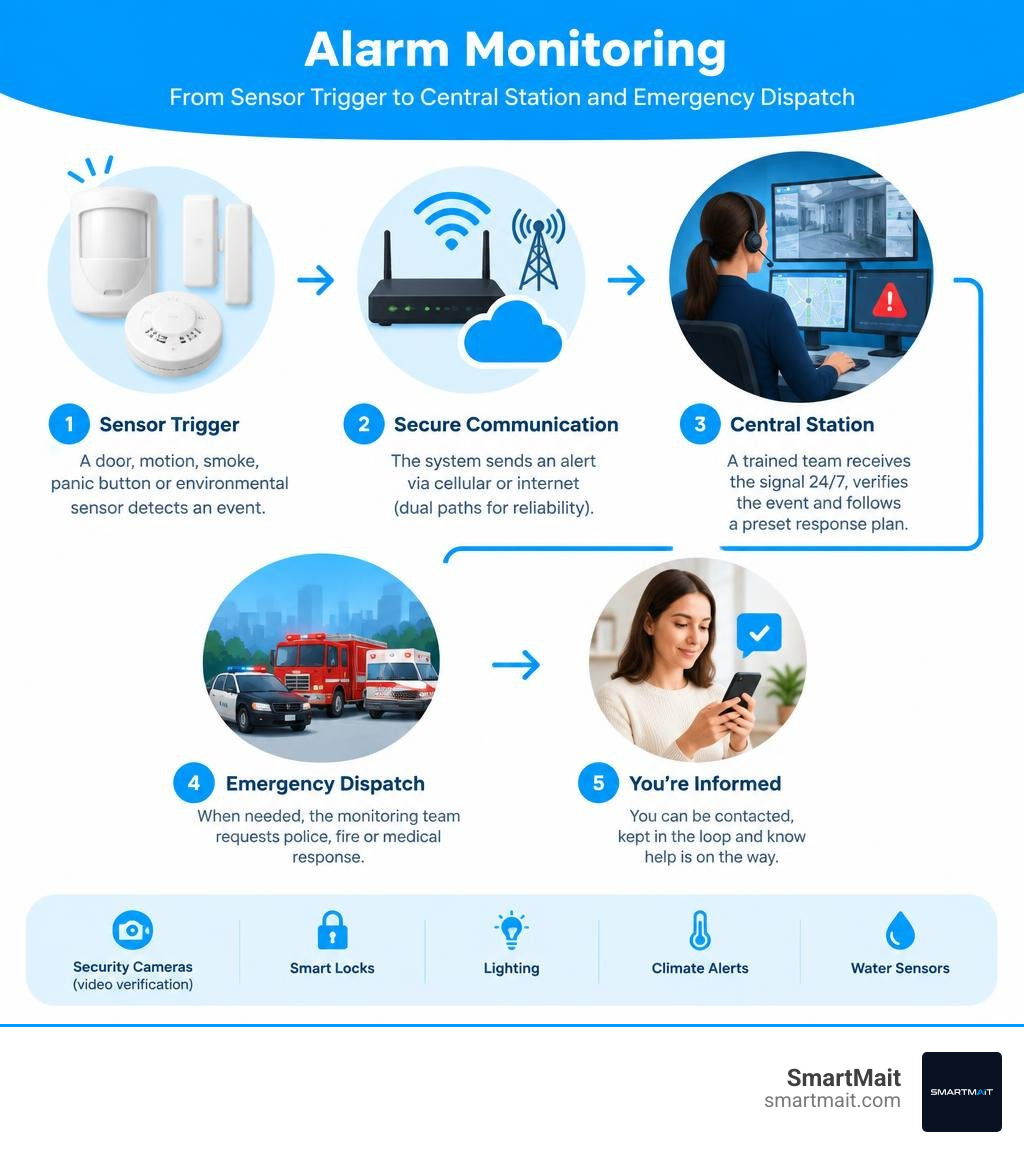
Essential alarm monitoring terms:
Understanding Modern Alarm Monitoring and Architecture
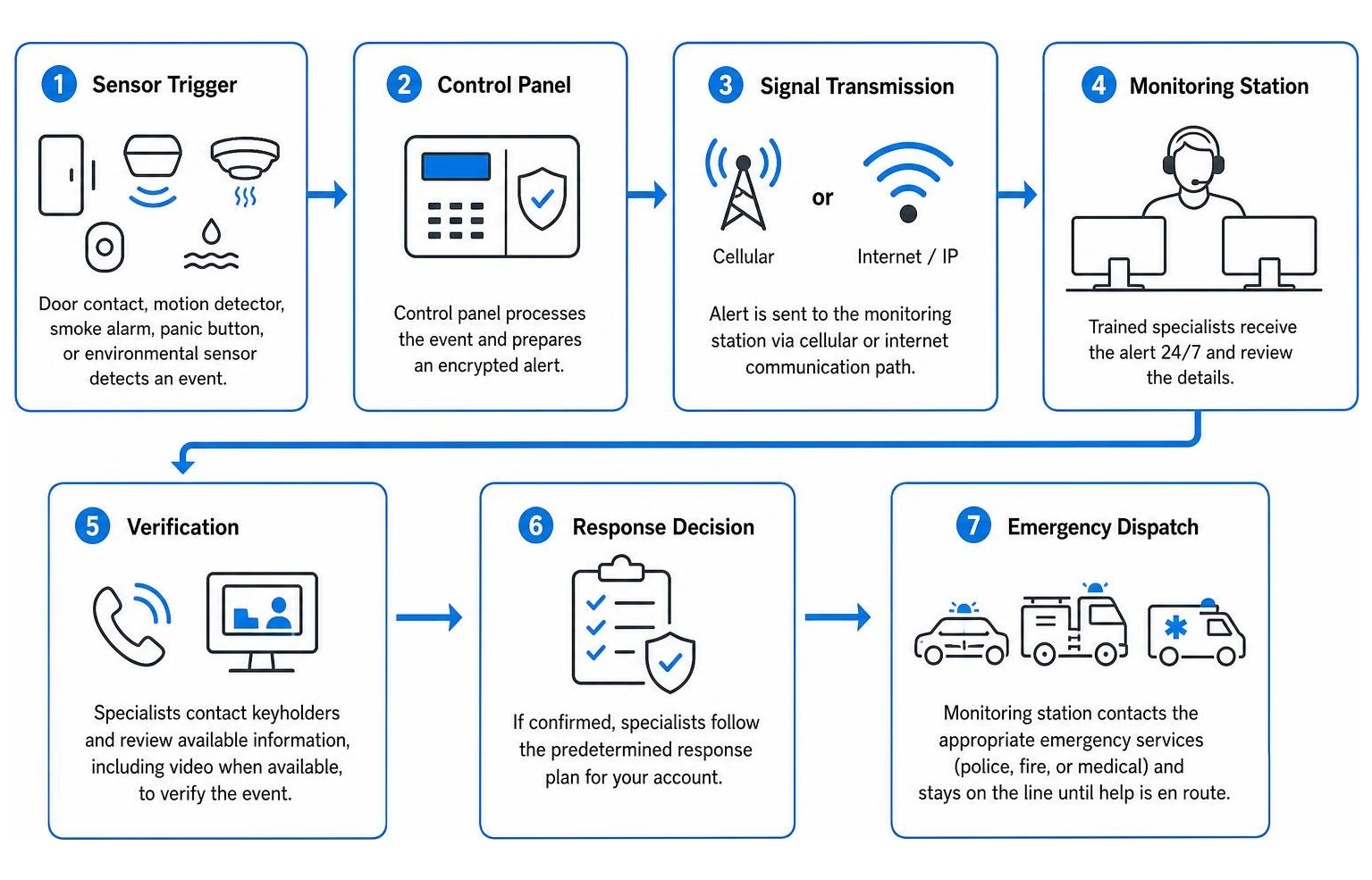
At its core, professional security monitoring bridges physical sensors to a dedicated emergency response facility. When an event occurs—such as a glass-break detector firing in a retail showroom or a magnetic door contact separating at an executive residence—the control panel translates that hardware trigger into an encrypted digital transmission.
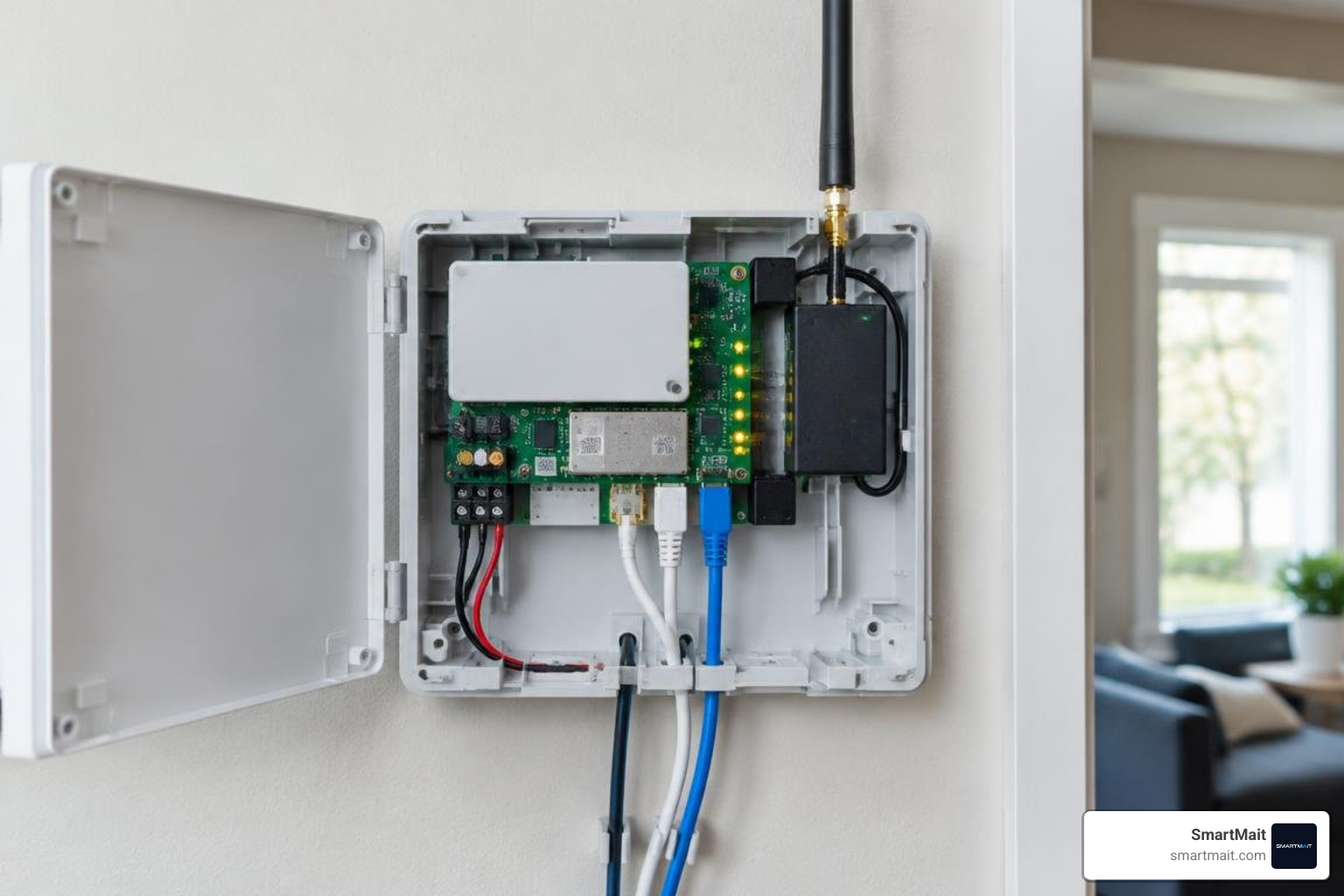
Understanding who is listening at a central station demystifies the entire protocol. When a signal reaches the station, automated routing software immediately pairs the incoming zone code with your account profile. Within seconds, a trained specialist reviews the signal priority, initiates phone contact with keyholders, and coordinates directly with local emergency dispatch agencies if an incident is confirmed.
Cellular, IP, and Redundant Signal Pathways
Legacy alarm platforms relied exclusively on copper telephone landlines. In 2026, landline systems are vulnerable to physical line tampering, weather disruption, and ongoing carrier phase-outs. Modern architectures implement dual-path transmission to eliminate single points of failure.
- Primary High-Speed IP / Wi-Fi: Carries daily operational data, continuous health-check telemetry, high-bandwidth video streams, and instant notifications through high-performance structured networks.
- Encrypted Cellular LTE Backup: Operates independently of local ISP connections or onsite power. If a power outage knocks out the fiber gateway or an intruder cuts external communication feeds, the panel switches to the cellular transmitter.
- Power-Failover Battery Support: Low-voltage panels use dedicated secondary battery backup systems, keeping the core radio and security perimeter fully operational throughout extended grid outages.
The Role of Video Verification in Alarm Monitoring
False alarms strain local municipal emergency resources and can lead to costly fines. Video verification addresses this challenge by pairing security sensors with edge-based commercial or residential IP cameras.
When an intrusion sensor activates, onboard artificial intelligence analyzes the event to classify movement into specific categories—such as individuals, vehicles, or animals. The system captures a secure video snippet and forwards it alongside the alarm packet.
This visual confirmation allows central station operators to verify a physical threat before contacting law enforcement. For high-density retail corridors, corporate offices, medical suites, and multi-tenant commercial facilities across Oakland County, verified alarms often receive higher dispatch priority from responding agencies compared to unverified sensor trips.
Professional Central Station vs. Self-Monitored Systems
Property owners often evaluate whether to rely on automated app alerts or invest in professional monitoring. The table below outlines how these two approaches operate during real-world incidents:
| Feature / Scenario | Self-Monitored System (App Alerts Only) | Professional Central Station Monitoring |
|---|---|---|
| Response Ownership | Property owner must manually view notification and call emergency services. | Trained operators manage verification, contact protocols, and municipal dispatch 24/7/365. |
| Handling Power & ISP Outages | Alerts fail to send if local network hardware goes offline and cellular backup is omitted. | Dedicated cellular communicators maintain redundant contact with the central station. |
| Response During Sleep / Travel | Alerts often missed due to Do Not Disturb modes, dead zones, or international travel. | Continuous coverage ensures immediate action regardless of the owner’s status or availability. |
| Verification & Accuracy | User must remotely open separate camera apps to confirm what caused the event. | Video-verified and cross-zoned alerts allow operators to confirm crimes in progress instantly. |
| Insurance Policy Eligibility | Rarely qualifies for formal premium discounts or risk-mitigation credits. | Qualifies for official central-station alarm monitoring certificates recognized by insurance providers. |
Choosing the best 24/7 alarm monitoring ensures your building remains protected even when you are unavailable.
Why Metro Detroit Businesses and High-Value Homes Require Professional Alarm Monitoring
High-asset properties, clinical practices, and corporate spaces house valuable physical inventory, sensitive records, and proprietary operational infrastructure. In regions like Birmingham, Bloomfield Hills, and Troy, commercial facilities face distinct security challenges when left unoccupied after hours.
Employing professional services helps with keeping intruders at bay with professional services by creating layered deterrence. The moment a perimeter sensor or glass-break monitor triggers, operators initiate 24-hour alarm response protocols, directly alerting designated keyholders and dispatching local authorities.
The Risks of DIY App Notifications
Relying entirely on smartphone push notifications introduces vulnerabilities during critical emergencies:
- Smartphone Focus & Do Not Disturb: Modern operating systems silence banner alerts and push notifications outside business hours, masking break-in alerts while you sleep.
- Cellular Dead Zones & Air Travel: Inflight Wi-Fi dead zones, subway travel, or poor reception areas delay notification delivery by minutes or hours.
- Escalation Latency: While a self-monitored user attempts to open an app, check camera feeds, verify their local address, and dial 911, crucial response time is lost.
Key Features of Architect-Grade Security and Automation
Modern property technology integrates life safety, physical intrusion monitoring, access control, and environmental management into a unified ecosystem.
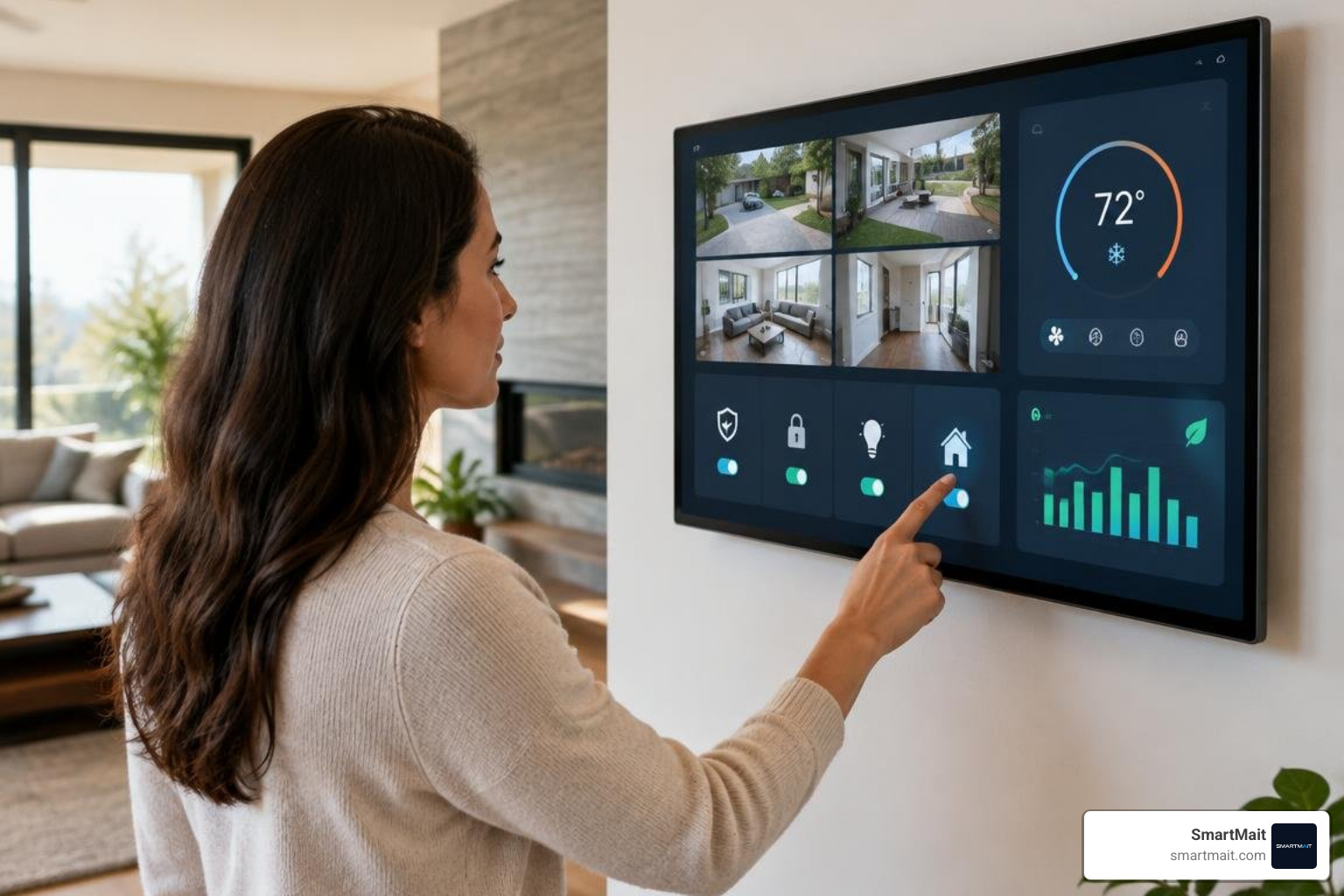
A comprehensive back to base monitoring guide highlights that central station connectivity is most effective when integrated with smart building controls rather than operating as an isolated system.
Z-Wave Ecosystems and Environmental Sensor Integration
For reliable device communication across medium-to-large floor plans, wireless mesh protocols like Z-Wave provide an interference-resistant, commercial-grade standard. Operating outside the crowded 2.4 GHz spectrum used by consumer Wi-Fi devices, Z-Wave networks prevent cross-band traffic congestion.
- Smart Locks & Commercial Access Control: Automatically lock perimeter portals upon system arming, generate temporary digital credentials for maintenance teams, and audit entry times across all doors.
- Environmental & Flood Mitigation: Low-voltage water sensors placed near water heaters, sump pumps, and plumbing risers can signal motorized shutoff valves to close the main water feed immediately, preventing extensive structural damage.
- Integrated Life Safety: Connected smoke, carbon monoxide, and temperature sensors transmit critical alerts directly to central operators, helping prevent localized property damage even during electrical failures.
Central Station Standards: UL Listing and Five Diamond Certification
Not all monitoring facilities operate to the same technical standard. When selecting an integration partner, verify the operational certifications of their monitoring centers:
- Underwriters Laboratories (UL 827 Listing): Ensures the monitoring station adheres to stringent infrastructure requirements, including backup power generators, secure data storage, structural building hardening, and geographic failover redundancy.
- The Monitoring Association (TMA) Five Diamond Certification: Granted to monitoring centers where 100% of operators complete rigorous training programs covering industry communications standards, false alarm mitigation, and emergency escalation procedures.
Insurance Benefits, Local Compliance, and Provider Transitions
Maintaining a professionally monitored and maintained alarm system provides documented risk reduction that insurance carriers recognize.
Local Ordinance Compliance in Oakland County and Metro Detroit
Municipalities across Metro Detroit enforce specific administrative and operational rules for security alarms:
- Permits and Registration: Jurisdictions such as Bloomfield Hills, West Bloomfield, and Troy may require residential and commercial property owners to register alarm systems to minimize unverified dispatches. Reviewing Oakland County building safety regulations alongside local municipal codes ensures initial installations comply with regional safety frameworks.
- False Alarm Management: Many local departments assess tiered administrative fines for repeat false alarms. Adhering to municipal requirements, such as Bloomfield Hills municipal alarm monitoring protocols, underscores why dual-path verification and system testing are essential for property managers.
- Code Considerations for Retrofits and New Construction: Low-voltage cabling for access control and fire safety components must meet National Electrical Code (NEC) standards and local building ordinances.
Reprogramming Existing Hardwired and Wireless Panels
Upgrading to an advanced monitoring platform does not always require replacing every physical sensor. During system retrofits:
- Hardwired Zone Takeover Modules: Existing low-voltage copper cabling for window contacts, motion detectors, and door sensors can be landed on modern translator boards, connecting legacy field wiring to modern control hardware.
- Wireless Frequency Translation: Multi-frequency receivers can integrate legacy wireless sensors with new central processors.
- System Health Audits: A thorough diagnostic evaluation identifies failing backup batteries, corroded zone boards, or unshielded wiring before transitioning your property to modern monitoring services.
Frequently Asked Questions
How does 24/7 central station response differ from self-monitoring?
Self-monitored systems deliver basic smartphone push notifications that require you to personally view the alert, evaluate the threat, and contact emergency services. A 24/7 central station provides round-the-clock professional coverage by trained specialists who follow standardized response protocols, verify sensor data, and coordinate emergency dispatches even if you are asleep, traveling, or unavailable.
Can alarm monitoring documentation help with homeowner or business insurance?
Yes. Most major property insurance carriers offer policy discounts for properties equipped with professionally monitored intrusion, fire, and flood detection systems. Upon installation and testing, a formal Certificate of Monitoring is issued to provide your underwriter with documentation of your central station connection.
Can existing control panels be taken over without replacing sensors?
In most cases, yes. Hardwired zone panels can be converted using modern interface modules, while legacy wireless sensors can be adapted using frequency translators. A professional low-voltage integrator can inspect your current field devices, test loop resistance, and integrate your functional hardware into an updated control and monitoring ecosystem.
Designing Seamless Low-Voltage Security with SmartMait
A dependable security system relies on quality hardware, precise engineering, clean structured wiring, and attentive ongoing service. At SmartMait, headquartered in Troy, Michigan, we design, install, and support unified low-voltage infrastructure for luxury residences, commercial office buildings, retail facilities, and medical suites across Oakland County and Metro Detroit.
Our team serves Birmingham, Bloomfield Hills, Royal Oak, Rochester Hills, West Bloomfield, Novi, Grosse Pointe, and Detroit. Beyond initial deployment, our SmartService concierge maintenance program provides scheduled health checks, firmware management, priority response, and ongoing system optimization—ensuring your security, access control, structured networking, and building automation function seamlessly as one integrated ecosystem.
Schedule a consultation with our team to evaluate your property’s security infrastructure and explore tailored alarm monitoring solutions.