Motorized Shades That Move on Schedule. & Hang Right.
Motorized shade projects go wrong in two places, and neither is the motor. The first is a pocket nobody framed, found the week drywall goes up. The second is a fabric picked off a phone screen that hides the view or lets the afternoon glare through anyway.
Both are decisions, not products, made long before anyone hangs a shade. We make them with you, in the room, with samples against your glass. Our own crews install. No shortcuts.
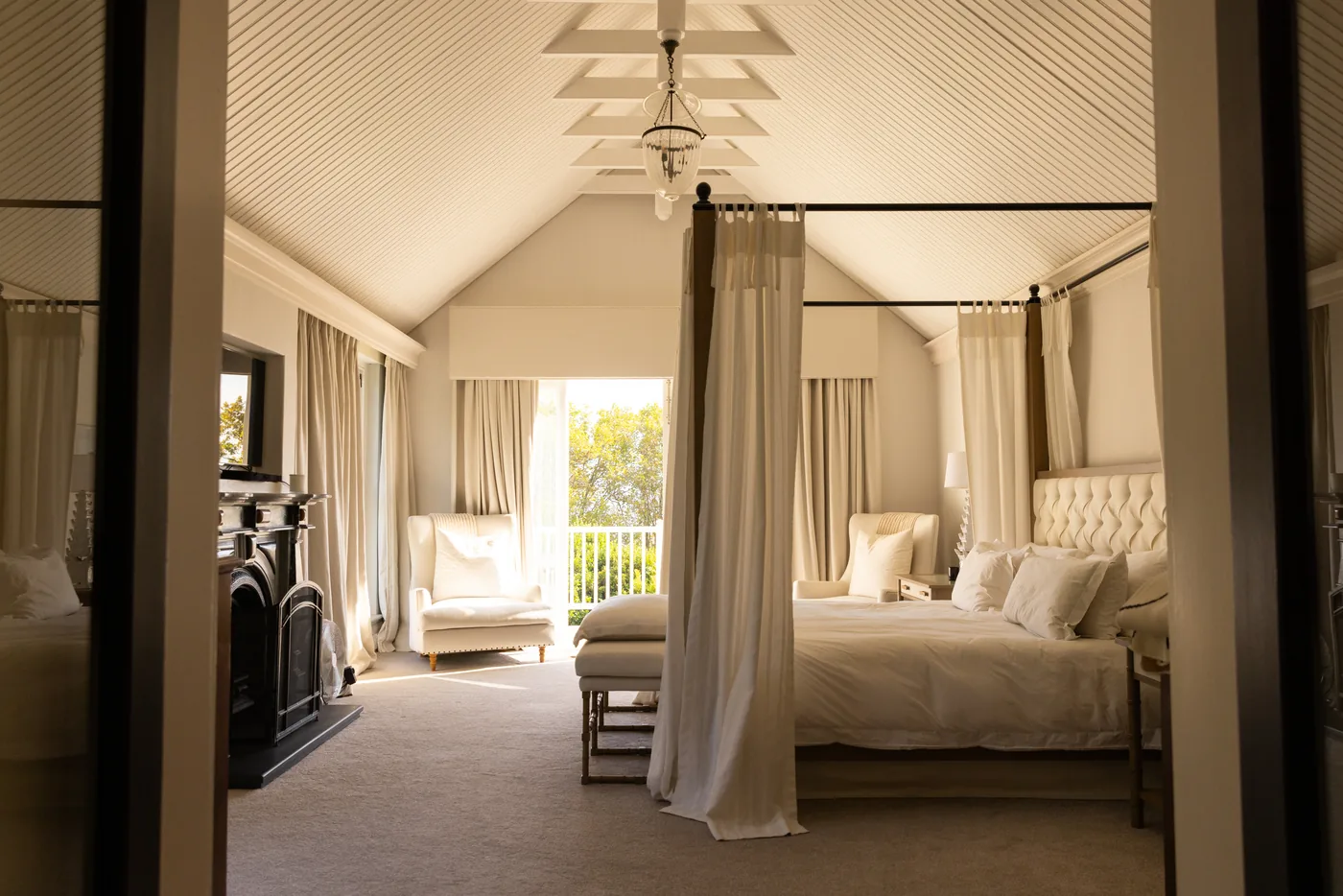
What You Are Actually Choosing
Four decisions: shade type, fabric, power, and where the hardware hides.
Roman Shades and Drapery Track
Roman shades give soft folds where a flat roller looks cold: dining rooms, libraries, powder rooms. Motorized drapery track moves real goods on a quiet carriage, which is what a 20-foot great room wall wants, usually over a screen shade.

Rollers
Solar Screen, Blackout, or Both?
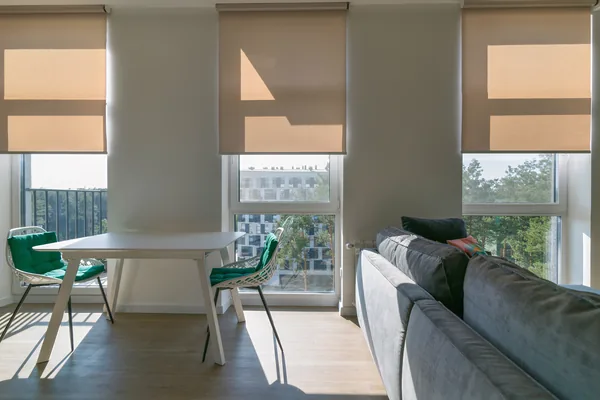
A solar screen roller is woven fabric that cuts glare and heat while keeping some view. A blackout roller is opaque. A dual roller stacks both on one bracket, screen in front for day, blackout behind for sleep. That is the right answer in almost every primary bedroom with a view.
Battery, Hardwired, or Plug-In
Battery motors run 2 to 4 years on a lithium pack at two cycles a day. They install in an afternoon, which makes them the honest retrofit answer. The tradeoffs are real: louder, slower, and somebody is on a ladder eventually. Hardwired DC motors are quieter, faster and never need service, and need the wire to be there.
Our rule: hardwire anything above ten feet, anything in a bedroom, and any wall of five or more shades that must align. Battery is fine everywhere else, and a plug-in transformer hidden in a pocket splits the difference where an outlet is reachable.

Skylights and Specialty Shapes
Skylights are the best argument for motorization: nobody is getting a pole out. Angled tops, arches and trapezoids all have solutions, and all need field measurement.


Openness Factor, and What Each Number Actually Does.
Openness factor is the percentage of the fabric that is holes: the most consequential spec on the quote, and the one most often left off it.
- 1 percent. Maximum glare control, daytime privacy, view heavily muted.
- 3 percent. The workhorse: legible view, most glare gone. Where we land on most west and south glass.
- 5 percent. View first. Real glare still gets through at a low sun angle.
- 10 percent. Essentially a screen door. View kept, glare unsolved.
Fabric color matters more than openness for view quality: a dark charcoal at 3 percent beats an ivory at 5, because light fabric hazes and reflects internally. Light rejects heat, dark sees better.
And no solar screen gives nighttime privacy. Dark outside, lit inside, the fabric reverses and people see in. Privacy after sunset means blackout or a dual roller.
Blackout Fabric Does Not Mean a Blackout Room
The fabric blocks all light. The shade does not. A standard roller leaves roughly three-eighths to one-half inch of gap on each side, and light comes down it like a strip light. True blackout needs side channels or a pocket with return details. We say that before you order, not after you call about the stripe on your bedroom wall.
Motor Noise, and Where It Matters
Motor noise is measured in dBA at one meter. Premium hardwired DC motors run about 32 to 38 dBA, roughly a quiet refrigerator down the hall. Battery motors run 40 to 45, a distinct whir, and quiet motors travel slower, about an inch per second.
In a great room nobody notices either. In a bedroom on a 6:45am schedule, or a theater, it is the whole project.
On a wall of windows, hembars should stop within an eighth of an inch of each other. That takes matched motors, limits set shade by shade, and group programming. Mix battery and hardwired on one elevation and they drift apart over a season, which cannot be fixed in software.
Pockets, Fascia, and the Drywall Deadline.
Three ways to hide hardware. A fascia is an aluminum face plate in front of the roll: simplest, cheapest. An outside-mount bracket is exposed and honest. A recessed pocket buries the shade in the ceiling plane, which is what every architect draws.
Pockets have to be framed, and sizing is not guesswork. A drop up to about eight feet fits a 4.5 by 4.5 inch opening. Ten feet or more, blackout fabric, or dual rollers need 6 by 6 or better, because the roll gets fatter as the drop gets longer. Pockets need power, blocking, and service access from below.
The deadline: pocket versus fascia, hardwired versus battery, and the wire path all get decided before drywall. After that a pocket means opening a ceiling. Even if shades are not in this year’s budget, run the wire and frame the pocket now.
Low Winter Sun.
Few shade companies write about this, and it is why fixed schedules fail.
At northern latitudes the sun sits about 71 degrees above the horizon at noon in late June and about 24 degrees in late December. In summer a two-foot overhang shades your south glass all day. In winter that same sun comes in nearly sideways, rakes fifteen to twenty feet across the floor, and lands on the hardwood, the rug and whatever hangs on the north wall.
Fading follows. Roughly 40 percent comes from ultraviolet, about 25 percent from visible light, about 25 percent from heat and humidity. Low-E glass handles much of the UV, which is why people assume new windows protect the floor. It does nothing about visible light, a quarter of the damage.
So scheduling has to be astronomic and seasonal, not clock-based. Sunset moves from about 9:15pm in late June to about 5:05pm in early December, so a shade set to close at 8:00pm is wrong ten months of the year. We build schedules on sunrise and sunset offsets with seasonal profiles.
January adds comfort. A wall of double-pane low-E glass sits around U-0.30, roughly R-3, and at 5 degrees outside it makes a cold downdraft you feel from the couch. An insulating cellular shade with side tracks lifts that to about R-5. Closing shades at sunset in winter is a heating decision, not just a privacy one.
Lead Times, Honestly.
Nobody in this category publishes real numbers. Ours:
- Standard fabrics from a domestic fabricator: 3 to 5 weeks
- Customer’s own material, fabric shipping to the workroom first: 8 to 14 weeks
- Architectural hardware in a specialty finish: 10 to 16 weeks
- Skylights and specialty shapes: 12 to 20 weeks
Order at drywall, not at trim. If your designer is still holding samples in month six of a nine-month build, the shades will be late. That is a calendar problem, not a supplier problem. Your builder gets the order deadline in writing.
How The Work Actually Goes.
Survey and design
We walk the rooms with samples, hold them against your glass at the hour that actually bothers you, and check orientation and ceiling detail. You get a shade schedule: opening by opening, type, fabric, openness, power, mount.
Designer coordination
Your designer specs the fabric. We spec the hardware and validate it will roll flat, because some beautiful goods are too soft or thick and telescope on the tube. We roll-test before ordering, a conversation you want in February, not August.
Rough-in
Wire pulled, pockets framed and blocked, power set, before insulation.
Field measure
After drywall and trim, never off the plan.
Install and commissioning
Brackets set, shades hung, limits set individually, groups aligned, scenes built with your lighting and climate so shades join Morning, Away and Movie rather than living in their own app.
Training and support
You finish knowing how to change a schedule yourself. If you are signed up for one of our 24/7/365 service plans, we can triage problems at night, not just during business hours. See our service plans.
New Construction vs. Retrofit
New construction. Shades are a framing conversation. Pocket or fascia, hardwired or battery, and the wire path get decided before drywall, and the shade schedule locks alongside the lighting plan so scenes make sense later. We work off the architect’s ceiling details.
Retrofit. Most retrofits are battery, fascia or inside mount, and go in without opening a wall. Pre-war homes bring plaster and lath, out-of-square openings and deep casings that eat your reveal, which is why we field measure every opening. Where an outlet is reachable, a hidden plug-in transformer buys quiet without demolition.
FREQUENTLY ASKED QUESTIONS
Questions We Get Asked.
Battery motors run 2 to 4 years on a lithium pack at two cycles a day and install without opening walls, which makes them the right retrofit answer. Hardwired DC motors are quieter, faster and never need a battery. We hardwire anything over ten feet, anything in a bedroom, and any wall of five or more shades.
The fabric does. The shade does not. A standard roller leaves roughly three-eighths to one-half inch of light gap on each side, plus a gap at the top. A genuinely dark room needs side channels or a recessed pocket with return details.
Standard fabrics from a domestic fabricator take 3 to 5 weeks. Customer’s own material takes 8 to 14 weeks, because the fabric ships to the workroom first. Architectural hardware in a specialty finish takes 10 to 16 weeks, and skylights or specialty shapes take 12 to 20. Order at drywall, not at trim.
It depends what you bought. Premium hardwired DC motors run about 32 to 38 dBA at one meter, a quiet whir you stop noticing. Battery motors run 40 to 45 dBA and are audibly present. Quiet motors also travel slower, about an inch per second. Spec quiet in bedrooms and theaters, save money elsewhere.
Call us. On our 24/7/365 service plans, after-hours calls are triaged that night, not queued as a ticket. Most faults are a battery, a lost pairing or a limit that drifted, and we fix those remotely. A failed motor is a warranty swap, scheduled first thing.
Need help? Visit our Service and Support page to explore our residential support plans.
One Site Visit.
Every Shade Priced.
We bring samples to your windows at the hour the glare bothers you, build the shade schedule opening by opening, and hand your builder a dated order deadline.