AV 101: Everything You Need to Know About Audio Visual Installation
Core Components of a Modern Audio Visual Installation
A modern audio visual installation relies on a tightly integrated hardware ecosystem. Rather than running standalone devices, professional integrators connect display, audio, control, and network systems into a single infrastructure.
At the core of any commercial or complex residential system is the control processor. This central unit translates user inputs—whether from an in-wall touch panel, a smartphone app, or a physical keypad—into commands sent across the entire network. Coupled with matrix switchers, control processors distribute high-bandwidth video signals from multiple sources to various displays without lag or loss of resolution.
In advanced audio setups, Digital Signal Processors (DSPs) act as the acoustic brain. A DSP manages equalizer settings, echo cancellation, gain levels, and crossover frequencies. For modern connected spaces, digital audio protocols like Dante have become the industry standard. Dante allows high-channel, uncompressed digital audio to travel over standard CAT6 ethernet cabling with virtually zero latency.
Underneath all these devices sits low-voltage cabling. High-grade copper network lines, fiber optics, and shielded speaker cables provide the backbone that keeps communications stable, preventing interference and eliminating the signal dropouts typical of consumer-grade wireless gear.
Display and Visual Processing Systems
Visual systems vary widely depending on space and function. In high-impact commercial venues, corporate lobbies, and large event spaces, fine-pitch LED video walls deliver seamless visual experiences without display bezels. These modular panels scale to fit massive architectural dimensions.
For ultra-high-definition applications, modern projection systems utilize 8K laser technology, producing exceptional clarity on massive surfaces without requiring the heavy structural reinforcement of large display panels.
In corporate boardrooms and educational settings, interactive whiteboards have become ubiquitous. These multi-touch displays bridge digital annotation with remote collaboration tools, typically costing between $1,500 and $15,000 depending on screen size, touch fidelity, and integrated computing power. Learn more about upgrading business technology in our commercial display guide.
Audio Infrastructure and Spatial Acoustics
Visual clarity is only half of the equation; high-quality audio is essential for clear communication and immersive entertainment. Achieving uniform audio coverage requires selecting the right loudspeaker architecture for the physical room dynamics:
- Line Arrays: Vertical speaker columns engineered to project focused sound across deep seating spaces while minimizing acoustic reflections off ceilings and floors.
- Subwoofers: Dedicated low-frequency enclosures designed to deliver full-spectrum sound in home theaters, worship spaces, and live performance venues.
- Microphone Arrays: Ceiling-mounted beamforming microphones that automatically track and capture active speakers across a meeting room while filtering out background HVAC noise.
- Acoustic Treatments: Sound-absorbent wall panels, ceiling baffles, and diffusive surfaces that reduce echo and manage reverberation times.
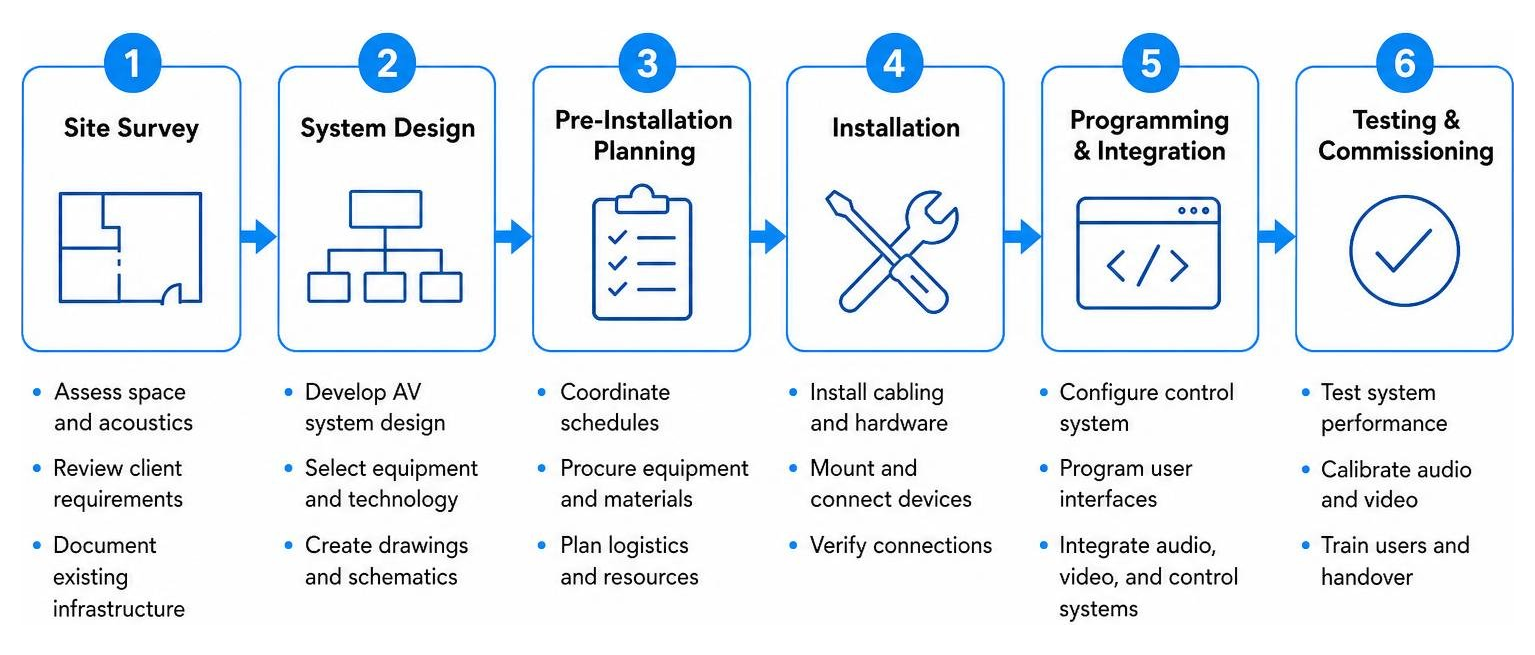
Key Phases of the Professional Installation Process
Executing a seamless audio visual installation requires a structured, multi-stage workflow. Skipping foundational steps during early planning often leads to costly retrofits, compromised acoustics, and unreliable performance down the road.
Site Survey and Architectural System Design
Before mounting a single bracket or running a foot of wire, integrators must perform a rigorous site survey. This initial step evaluates the structural, electrical, and environmental characteristics of the building:
- Structural Inspection: Verifying that wall studs, ceiling joists, and mounting surfaces can safely support heavy display panels, projectors, or suspended speaker arrays.
- Acoustic Mapping: Measuring background ambient noise levels, echo, and reverberation times to calculate exact loudspeaker placements and identify where acoustic treatment is needed.
- Electrical Load Calculations: Checking available circuit capacity to ensure amplification racks, high-power displays, and servers operate safely without tripping breakers.
- Lighting and Ambient Reflection Analysis: Assessing direct sunlight and architectural fixture placements to select displays with the appropriate brightness ratings (nits) or anti-glare coatings.
Integrating these architectural variables into early engineering diagrams prevents surprises during execution. Read our expert system design guide to learn more about early-stage planning.
Execution Steps for Commercial Audio Visual Installation
Once system designs are finalized, physical installation begins in coordinated phases:
- Conduit Deployment and Cable Routing: Low-voltage structured cabling, including CAT6, fiber optic, and speaker wire, is pulled through drop ceilings, wall conduits, or under-floor trenches. Cables are clearly labeled and color-coordinated at both ends to simplify future maintenance.
- Rack Integration: Equipment racks are pre-assembled and dressed. Media servers, Dante audio interfaces, power conditioners, and DSPs are secured in ventilated, lockable rack enclosures. Clean wire management prevents signal crosstalk and thermal buildup.
- Hardware Mounting: Video displays, interactive panels, line arrays, and projectors are anchored using structural brackets, safety cables, and custom articulating mounts.
- Remote Programming and DSP Tuning: Control systems are programmed to unite lighting, video, and audio under unified interfaces. Audio technicians configure DSP gain structures, tune room equalizers, and balance mic channels.
- Commissioning and User Training: The complete system undergoes stress testing. Integrators walk end-users through daily operation, establishing standard room presets for one-touch operation.
For detailed setup tips in professional environments, review our conference room wiring guide.
Venue-Specific AV Applications: From Houses of Worship to Smart Homes
Every environment poses distinct acoustic, spatial, and functional demands. A setup designed for a corporate boardroom will fail to meet the needs of a historic house of worship or a private residence.
Houses of Worship, Museums, and Commercial Venues
Houses of worship present unique architectural challenges. Large sanctuaries often feature high ceilings, hard stained-glass windows, and bare stone or brick walls. Without intervention, these reflective materials cause long reverberation times that make speech muddy and unintelligible.
Installing commercial-grade sound systems in churches typically starts around a baseline investment that scales based on sanctuary square footage, structural mounting constraints, and acoustic treatment requirements. Strategically positioning line-array speakers above head height directs audio straight toward congregation seating while avoiding reflective side walls. Learn how to update sanctuary media systems in our guide to modern church AV solutions.
Museums and gallery spaces demand targeted acoustic zoning. Visitors moving through different exhibits should experience focused sound without audio bleeding into adjacent displays.
Art installations frequently push visual limits. Projects like (IMJ-MoB) Version II – FRANZ FISCHNALLER illustrate how modern venues utilize 16×9 meter wall and floor projection surfaces. Operating at 8K resolution across 50 million pixels and paired with multi-layer spatial audio, these installations transform physical galleries into fully responsive, 3D sensory environments.
Designing a Residential Audio Visual Installation
In luxury homes across Oakland County—from Bloomfield Hills and Birmingham to Rochester Hills and Troy—residential clients expect commercial-grade performance paired with invisible, elegant design.
Key priorities for residential setups include:
- Whole-Home Audio Distribution: In-ceiling and in-wall architectural speakers installed flush against drywall to blend seamlessly with interior design while filling living spaces with clear sound.
- Z-Wave Ecosystem Integration: Integrating home entertainment, motorized shades, security, and mood lighting through dedicated Z-Wave mesh networks. Z-Wave operates on an interference-free frequency, delivering quick response times without bogging down household Wi-Fi networks.
- Dedicated Home Theaters: Custom cinema rooms built with acoustically transparent projection screens, hidden subwoofers, dynamic lighting presets, and acoustic insulation for true cinematic immersion.
- Weatherproof Outdoor AV: All-weather displays engineered to resist moisture and glare, paired with buried landscape subwoofers that project balanced audio across outdoor living areas without disturbing neighbors.
Explore whole-home technology strategies in our detailed residential AV setup guide-and discover how integrated Z-Wave smart controls streamline home entertainment.
Costs, Benefits, and Emerging AI Technologies in AV Integration
Understanding system costs helps home and business owners budget effectively across hardware, wiring, and ongoing support.
| AV System Category | Entry Level | Enterprise / Custom | Primary Cost Drivers |
|---|---|---|---|
| Virtual Conferencing Hardware | $250 / year (Basic Software) | $10,000+ (Telepresence) | Camera auto-framing, beamforming mic arrays, multi-screen processing |
| Interactive Whiteboards | $1,500 | $15,000 | Screen size, multi-touch precision, integrated PC modules |
| Video Walls | $2,000 (Basic LCD) | $50,000+ (Fine-Pitch LED) | Pixel pitch density, bezel width, video wall controllers |
| House of Worship Sound | Varies by space | Custom scaled | Acoustic treatment panels, digital mixers, suspended line arrays |
| Whole-Home Smart AV | Varies by space | Architecture grade | Z-Wave ecosystem controls, multi-zone audio, concealed cabling |
For a comprehensive breakdown of budgeting considerations, read our AV system cost analysis.
Interactive Art and Immersive Environments
Emerging technologies like generative artificial intelligence, real-time camera tracking, and adaptive spatial mapping are transforming dynamic audio-visual spaces.
Interactive generative systems alter how media is consumed. Experiential projects such as Life in Motion – CHI POHAO demonstrate how motion-tracking cameras and algorithms map real-time human movement directly to generative sound and visual displays, creating active, responsive environments.
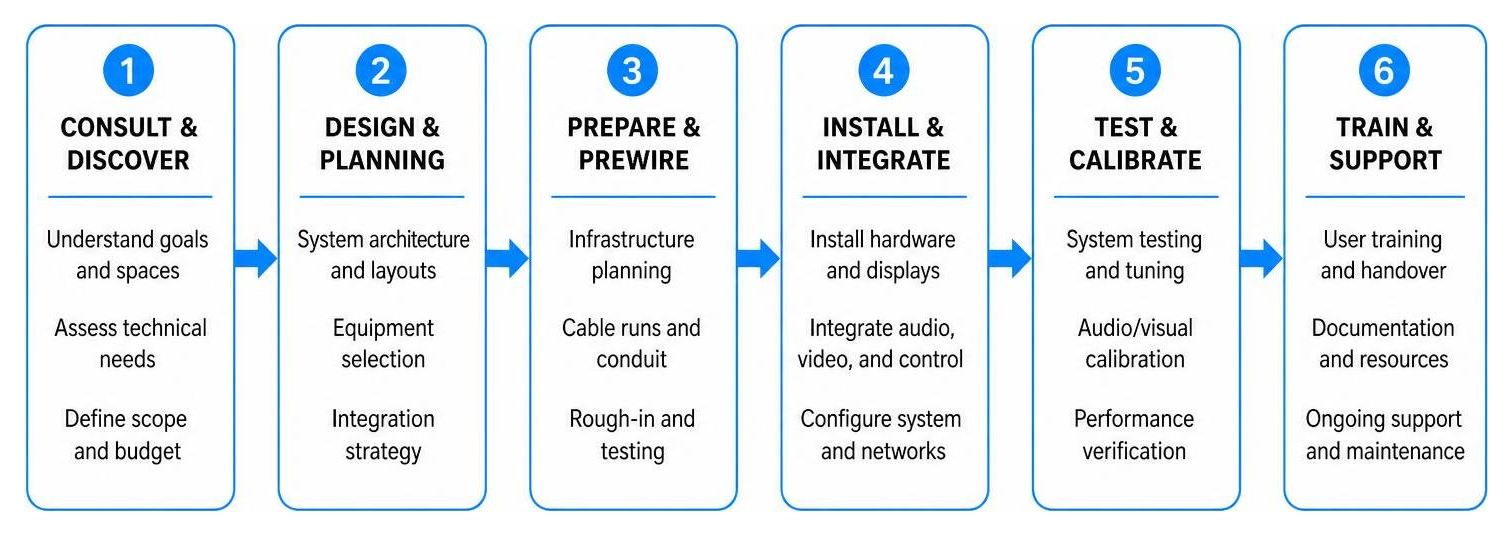
Large-scale permanent exhibitions also highlight these advanced system capabilities:
- Spatial Voice Mapping: Master works like Rafael Lozano-Hemmer – Kristallstimmen feature 3,000 suspended loudspeakers, each equipped with custom micro-controllers to trigger localized employee voice recordings in over 100 languages as visitors walk beneath them.
- High-Density Addressable LED Systems: Projects like Rafael Lozano-Hemmer – Undercurrents combine DANTE audio protocols with over 420,000 addressable light pixels, managing high-capacity power demands around 45,000 Watts to sync lighting dynamics with sound acoustics in subterranean architectural venues.
- Binaural Audio and Visual Meditation: Installations such as Holly Danger’s Let in, Let go show how video projection mapping combined with multi-channel binaural soundscapes can lower brainwave frequencies, turning physical rooms into tranquil sanctuaries.
Selecting a Long-Term AV Service Partner
Investing in commercial or residential technology requires choosing a partner capable of executing precise initial installations and supporting system health long after setup.
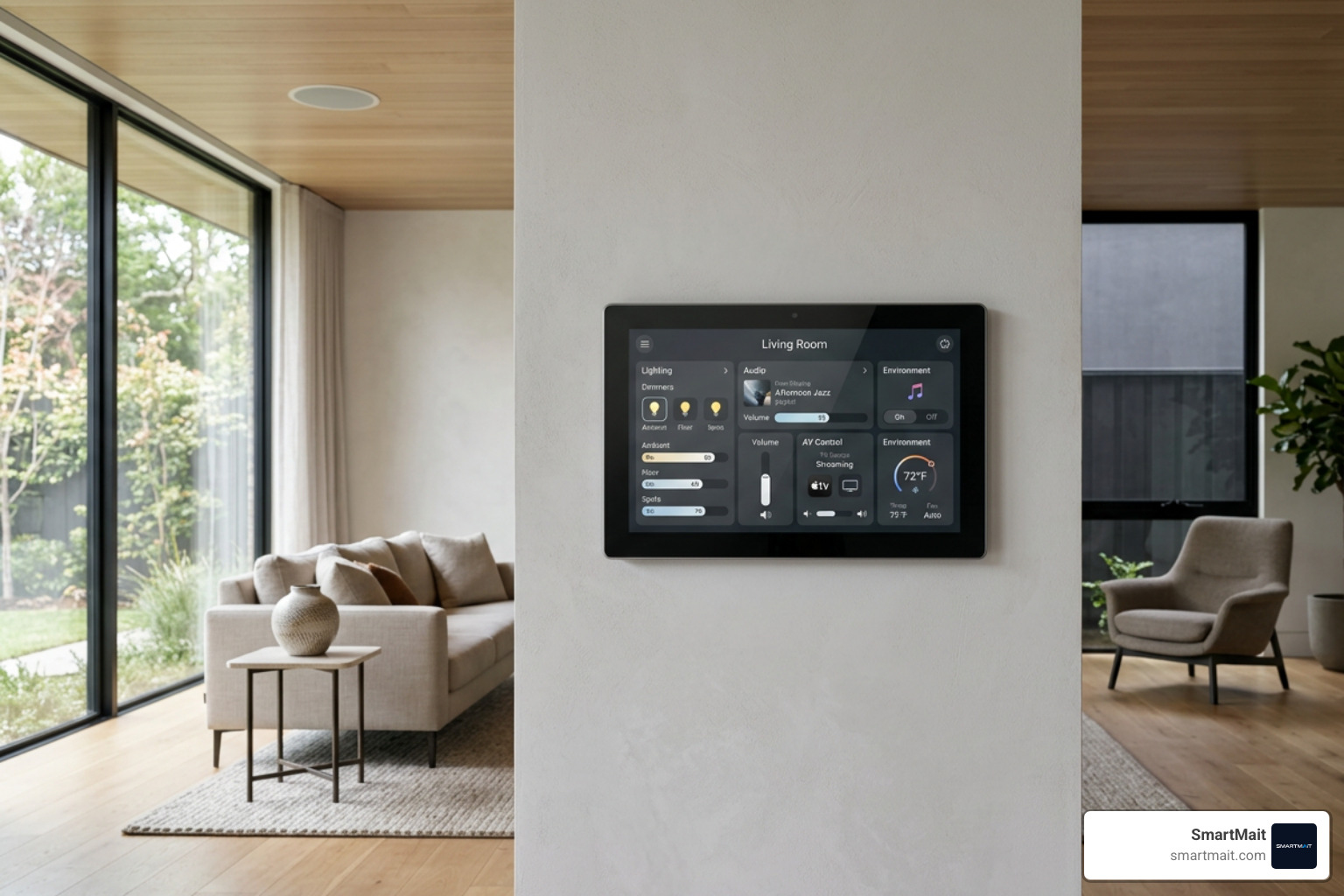
When evaluating installation providers, look for these critical service capabilities:
- Comprehensive Site Surveys: Integrators should evaluate structural framing, ambient acoustics, and electrical infrastructure before issuing equipment quotes.
- Full-Ecosystem Capability: A single point of contact handling networking, low-voltage wiring, lighting control, security, and AV avoids the headaches of managing multiple uncoordinated contractors.
- Dedicated Low-Voltage Expertise: Correct cable pulling, rack mounting, and network management ensure system longevity and keep setups clean and easy to service.
- Structured Maintenance Support: Traditional contractors often complete physical installs and disappear, leaving clients stranded when software updates or network glitches occur.
At SmartMait, we stand out across Southeast Michigan by offering our signature SmartService concierge maintenance program. Operating throughout Oakland, Macomb, and Wayne counties—including Bloomfield Hills, Troy, Rochester Hills, Farmington Hills, and Birmingham—we serve as ongoing technology partners. We provide continuous system monitoring, firmware updates, and local support to ensure your technology runs smoothly year after year.
Explore our breakdown on finding local specialists in our guide to navigating AV installation services.
Frequently Asked Questions about Audio Visual Systems
How much does a professional audio visual system cost?
System costs vary based on room dimensions, equipment specs, and structural requirements. Entry-level virtual conferencing software starts around $250 per year, while integrated corporate telepresence environments can exceed $10,000. Interactive touch displays range from $1,500 to $15,000. Display video walls start around $2,000 for standard LCD arrays and can top $50,000 for fine-pitch LED installations. Whole-home residential systems scale based on the number of audio zones and smart control integrations.
What steps are involved in the AV installation process?
The installation process begins with an on-site survey and architectural evaluation to assess room acoustics, wall structures, and electrical loads. Integrators then design the system topology, route low-voltage cabling through wall cavities or drop ceilings, mount display panels and speakers, integrate rack gear, and program control hardware. Finally, systems are calibrated, DSP levels are equalized, and end-users are fully trained on daily operation.
How do emerging AI technologies impact modern audio visual systems?
Generative AI, computer vision, and machine learning enhance real-time interactivity within modern systems. Beamforming microphone arrays use AI models to identify and track human voices while cutting out background noise. Generative visual software processes motion-tracking data to create dynamic screen imagery that responds directly to audience movement. These technologies transform passive viewing displays into engaging, interactive environments.
Conclusion
A successful audio visual installation seamlessly balances visual clarity, clear sound performance, and intuitive controls. Whether modernizing a corporate boardroom, creating an immersive gallery experience, or equipping a home in Southeast Michigan with high-end entertainment, solid planning and clean execution make all the difference.
At SmartMait, we provide complete residential and light commercial integrations across Oakland, Macomb, and Wayne counties—including local communities like Bloomfield Hills, Troy, Rochester Hills, Farmington Hills, and Birmingham. By combining professional Z-Wave ecosystem automation, low-voltage wiring, structured Wi-Fi, mood lighting, and whole-home sound with our dedicated SmartService concierge maintenance contracts, we make sure your systems perform reliably long after setup day.
Ready to transform your space with a custom, architect-grade audio visual system? Visit SmartMait Home Automation and Audio Visual Services to speak with our local integration team today.