Everything You Need to Know About Back to Base Alarms
What Is a Back-to-Base Alarm?
A back-to-base alarm sends an alarm signal to a professional monitoring center, where an operator follows an agreed response plan. It does more than sound a siren or send an app alert. But monitoring does not automatically connect your cameras and access control system; that takes planning and compatible equipment.
For an Oakland County business, the first step is to decide what needs to happen after an alert: who gets called, what footage can be reviewed, and whether the existing network can support it. SmartMait can assess the site and plan commercial access control and security integration around those needs. Schedule a consultation to discuss your building.
I’m Dominic Hesano, SmartMait’s owner. My hands-on work with security systems, structured wiring, and network problems across Southeast Michigan shapes how I assess whether a back-to-base alarm will fit with a building’s other security systems.
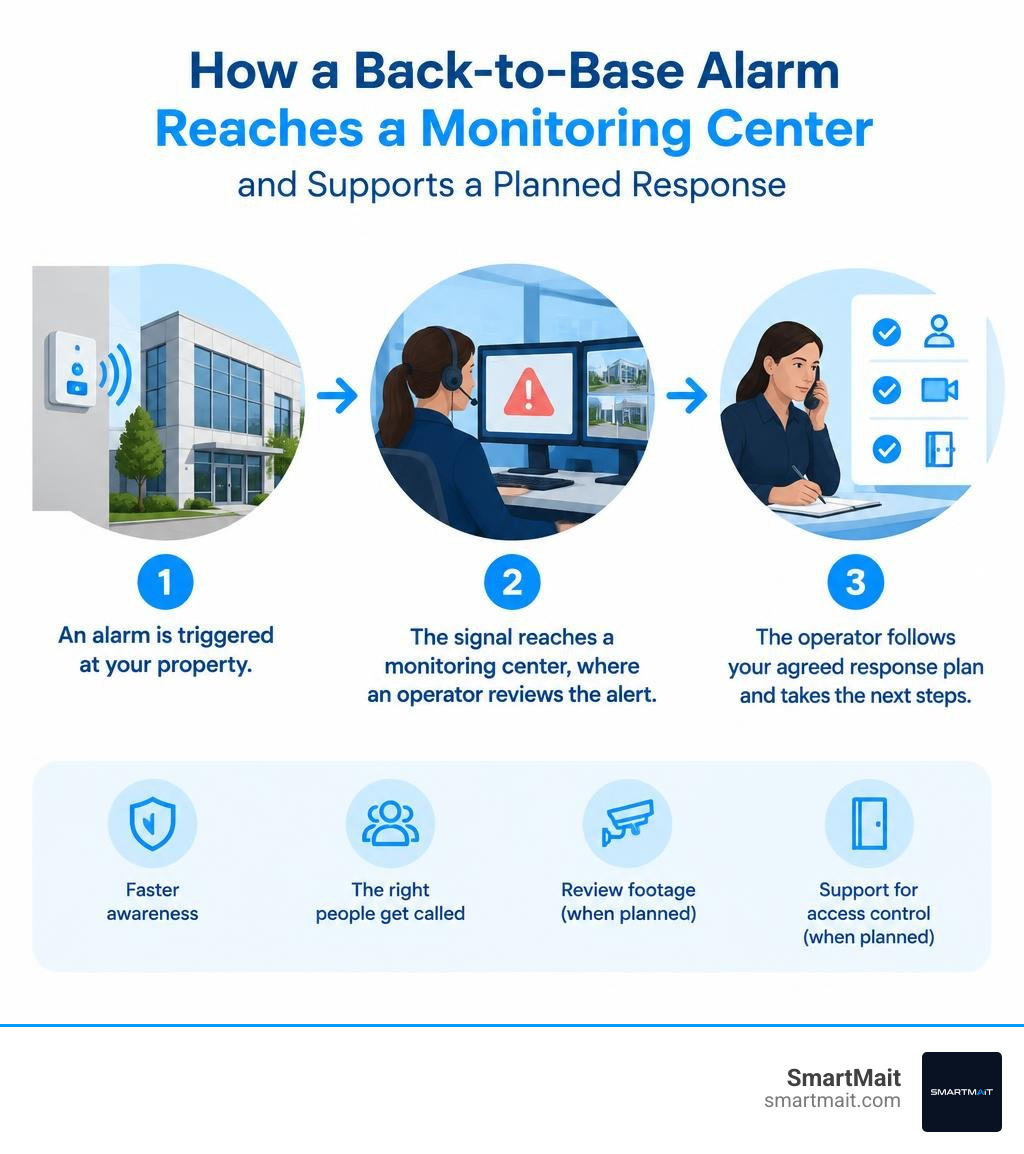
Key back to base alarm vocabulary:
For a broader technical overview of how monitored alarm signaling works, see the security alarm reference.
Commercial Video Surveillance and Access Control: What Does Integration Involve?

When business properties operate separate intrusion alarms, video surveillance cameras, and door locks, security remains reactive. True commercial integration links these individual disciplines into a coordinated infrastructure. Rather than checking multiple standalone apps or physical panels after an incident occurs, an integrated architecture allows each element to communicate in real time across a unified local network.
For commercial facilities throughout Southeast Michigan, combining access control with commercial video surveillance means every physical badge swipe, forced entry attempt, or schedule change is correlated with high-definition video evidence. Professional installation eliminates blind spots, configures proper network priority, and ensures security hardware meets local life safety and building codes across Oakland County jurisdictions.
Core Components of an Integrated System
A reliable commercial setup relies on several unified layers working together:
- Commercial Surveillance Cameras: High-resolution IP optical sensors positioned at ingress points, loading docks, interior hallways, and sensitive inventory rooms. These provide visual confirmation when an alert is triggered.
- Access Control Readers: Keycard readers, encrypted fobs, smart mobile credentials, or biometric touchpoints installed at exterior doors and interior restricted areas.
- Structured Network Infrastructure: Enterprise-grade Cat6/Cat6A structured cabling, Power over Ethernet (PoE) network switches, secure virtual local area networks (VLANs), and uninterruptible power supply (UPS) units that keep data flowing during power fluctuations.
- Centralized System Management: A central control platform that processes system events, assigns permission tiers, manages visitor schedules, and logs incident timelines on one screen.
How Access Events and Video Footage Work Together
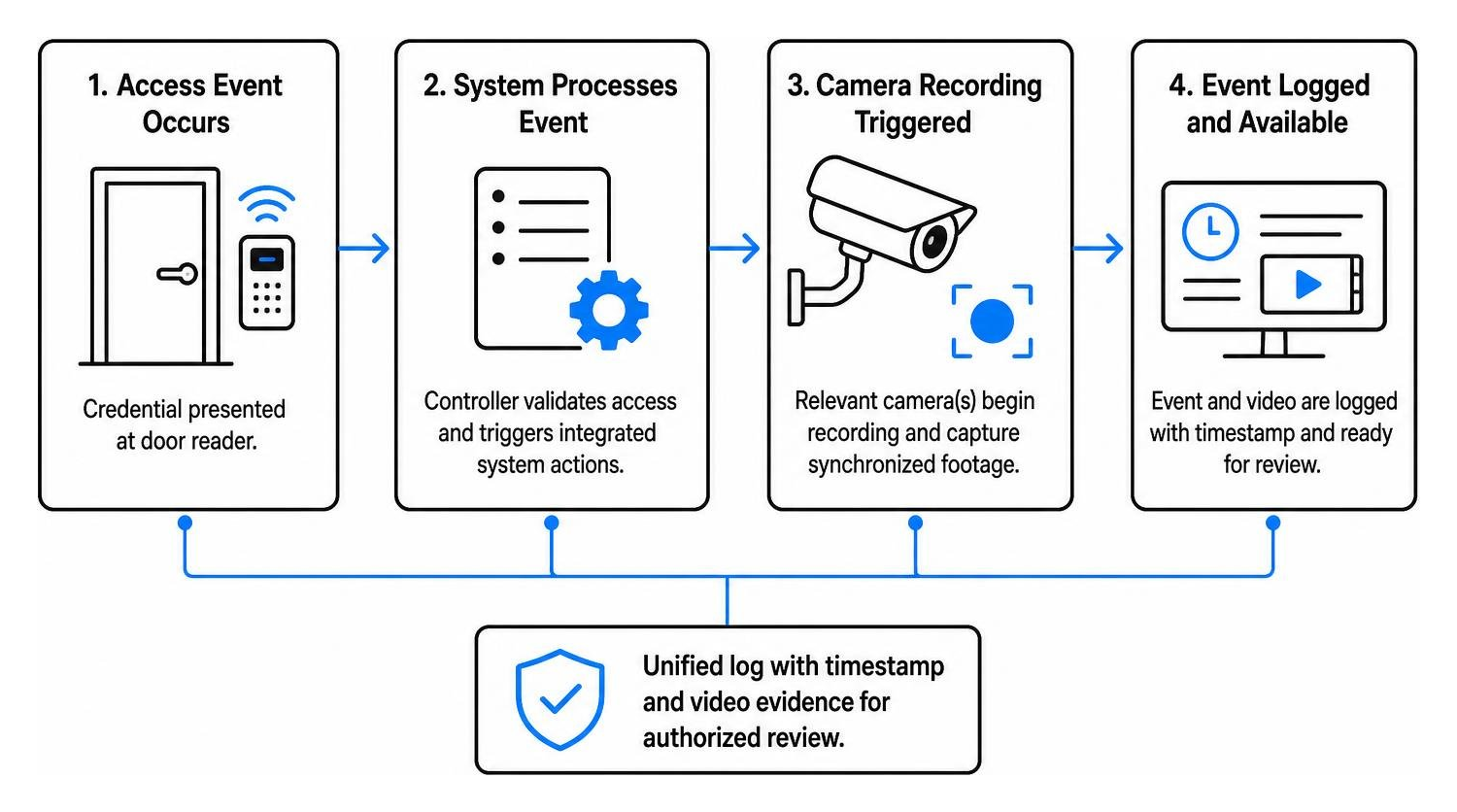
When an employee taps an authorized credential at a commercial doorway in a Troy corporate center or a Rochester Hills medical office, the access reader sends data to the controller. In an integrated system, that access event instantly tags the corresponding camera feed.
If an unauthorized person attempts to enter after hours, the controller logs the credential mismatch, captures a high-resolution snapshot, and flags the timestamp for authorized review. Should a fire door get propped open or an emergency exit breach occur, the system triggers local warnings, routes prioritized alerts to designated managers, and transmits status data over the monitoring infrastructure. This removes guesswork and provides facility directors with a verified chain of custody.
Communication Pathways and System Reliability
A monitored security network is only as dependable as the communication channels carrying its signals. Commercial properties require dedicated data pathways to ensure signals reach the central monitoring station without interference or packet loss.
Solid-copper structured cabling forms the backbone of reliable local integration. While wireless links provide convenient expansion options for sub-controllers or auxiliary sensors, primary commercial video streaming and access operations demand hardwired connections to prevent bandwidth congestion and signal degradation.
| Infrastructure Feature | Hardwired Network (Cat6/Cat6A) | Commercial Wireless Connections |
|---|---|---|
| Data Throughput | High bandwidth (Up to 10 Gbps) for 4K video streams | Variable bandwidth, susceptible to physical interference |
| Power Delivery | Direct PoE powering cameras and controllers | Requires dedicated local power or routine battery service |
| Signal Reliability | Zero RF interference from structural steel or brick | Subject to environmental noise, thick walls, and range limits |
| System Expansion | Scalable through patch panels and managed network switches | Limited by local wireless access point capacity |
| Maintenance Profile | Highly stable with predictable long-term performance | Requires regular signal strength audits and channel management |
Professionally Integrated Systems vs. Disconnected Equipment
Many commercial properties struggle with disconnected equipment: cameras from one provider, standalone keypads from another, and an isolated burglar dialer in a utility closet. This fragmentation leads to operational headaches, delayed incident responses, and higher maintenance expenses.
We design and deploy fully coordinated systems that unify access management and surveillance under a single operational umbrella. System expansion becomes straightforward when new doorways or cameras are added to existing network switches, while our SmartService concierge maintenance program provides regular firmware updates, health monitoring, and priority local service to keep critical equipment running smoothly.
Integration with Building Automation and Control
Modern commercial installations go beyond simple alarm triggers by interfacing with broader building automation and control systems. We integrate access hardware with automated lighting schedules, motorized shades, and environmental sensors across corporate offices and retail facilities.
When the last authorized employee arms the perimeter for the evening, the system can automatically adjust climate setpoints, secure motorized window coverings, verify that all magnetic locks are energized, and switch surveillance profiles to high-sensitivity after-hours analytics. In sensitive environments, climate and environmental monitoring devices can detect abnormal temperature spikes or water leaks before inventory or server hardware is compromised.
Commercial Security Integration in Southeast Michigan

Every commercial municipality across Metro Detroit presents distinct architectural and regulatory requirements. An office retrofit in Troy requires different cabling pathways than a boutique retail space in Birmingham, a mixed-use commercial footprint in Royal Oak, or a multi-tenant facility in Farmington Hills.
Planning a commercial installation requires an in-depth understanding of local Michigan electrical codes, emergency egress requirements (such as NFPA 101 Life Safety Code), and physical building constraints. In historic downtown retrofits, routing structured cabling through double-brick walls or open plaster ceilings demands specialized low-voltage installation techniques. For new construction in West Bloomfield or Novi, collaborating early with general contractors ensures conduit runs, backboxes, and server room power drops are placed correctly before drywall goes up.
Integrated Access Control and Surveillance for Local Businesses
Whether updating keycard access for an established firm in Southfield or planning structured wiring for a newly constructed tech office in Auburn Hills, low-voltage engineering must match the daily workflow of your staff.
We work directly with facility managers across Oakland, Macomb, and Wayne counties to design customized access schedules, multi-door interlocking systems, and high-definition video archives that scale seamlessly as your company grows.
Frequently Asked Questions About Commercial Security Integration
How can a business review access events and related footage?
Authorized administrators can review events through a secure, permission-controlled software interface on a local workstation or mobile dashboard. The system matches time-stamped access logs with the exact video feed recorded at that entrance. Administrators can filter events by door location, user profile, or alert category (such as forced door or invalid badge) to locate and export clip archives in seconds.
Can existing access control or camera hardware be integrated?
In many cases, yes. During an on-site facility assessment, we evaluate your existing cabling, power supplies, camera resolutions, and door hardware. Many legacy IP cameras, electric strikes, and magnetic locks can be brought onto a modernized open-platform controller, saving capital expense while upgrading software reliability and remote management capabilities.
What should a business consider when planning an installation?
Key factors include:
- Physical door counts and the structural materials around each portal (glass, aluminum, steel, or wood).
- Bandwidth capacity, network switch port availability, and server storage needs for video retention.
- Compliance with local emergency exit and life safety regulations for electrified hardware.
- Whether the property is an active commercial retrofit or a new construction build.
- The long-term maintenance and service plan needed to support firmware, credential changes, and system backups.
Conclusion
Coordinated commercial security relies on the seamless convergence of access permissions, high-definition video surveillance, and dependable communication infrastructure. A back-to-base alarm system provides essential professional monitoring, but integrating it with modern access controls and video verification transforms standalone hardware into an active, manageable security ecosystem.
As a low-voltage integration team headquartered in Troy, Michigan, we design, install, and support enterprise-grade systems tailored to the architectural demands of Oakland County businesses. Through our proactive SmartService maintenance programs, we ensure your building controls, security cameras, and network infrastructure remain reliable 24 hours a day, 365 days a year.
Visit the SmartMait home page to explore our integration solutions, or schedule a professional consultation with our engineering team today.