Gate Access Control Systems: A Buyer’s Guide to Better Security
Is Your Property as Secure as You Think?
A gate access control system is one of the most effective ways to protect your home or business from unauthorized entry — and choosing the right one can feel overwhelming.
Here’s a quick look at the top gate access control options to help you decide:
| System Type | Best For | Access Method | Key Benefit |
|---|---|---|---|
| Keypad Entry | Homes, small businesses | PIN code | Simple and affordable |
| RFID / Key Fob | Offices, apartments | Card or fob | Fast, hands-free entry |
| Mobile App | Smart homes, commercial | Bluetooth / NFC | Remote control, encrypted |
| Intercom | Gated communities | Voice / video | Visitor verification |
| License Plate Recognition | High-traffic sites | Camera AI | Hands-free vehicle access |
The threat is real. According to Security Magazine, 88% of security officers have reported a dramatic rise in physical security threats to US properties in recent years. Whether you’re protecting a family home or a commercial facility, a physical barrier with electronic authorization isn’t a luxury anymore — it’s a baseline.
Gate access systems do more than just lock a gate. They control who gets in, log every entry, and let you manage access from anywhere — including your phone.
This guide breaks down everything you need to make a smart buying decision: the components, gate types, access methods, and how to integrate it all into one seamless security setup.
What is a Gate Access Control System and Why is it Essential?
At its simplest, a gate access control system is a combination of physical barriers and electronic authorization. While a standard lock and key might work for a front door, gates require a more robust solution that can handle vehicles, pedestrians, and high-traffic volumes without forcing you to run outside every time the doorbell rings.
In our experience serving communities from Bloomfield Hills to Royal Oak, we’ve seen how these systems transform property safety. Research from the Crime and Justice Research Alliance highlights a powerful statistic: gated community security systems have been found to reduce burglaries by as much as 33% compared to non-gated areas.
But why is it so essential for your Michigan property?
- Crime Deterrent: A visible, motorized gate with a modern reader sends a clear message to would-be intruders: “This property is monitored.”
- Unauthorized Entry Prevention: Standard locks can be picked or keys duplicated. Electronic systems use encrypted credentials that are much harder to bypass.
- Vehicle and Pedestrian Management: Whether it’s a delivery truck in Troy or a guest at your home in Clarkston, you can manage traffic flow effectively.
- Property Value and Insurance: Installing a high-end residential security system often increases property value and can lead to lower insurance premiums because the risk of theft and vandalism is significantly reduced.
- Safety First: Automated gates equipped with sensors prevent the gate from closing on vehicles or people, ensuring that your security doesn’t become a safety hazard.
Core Components of a Modern Gate Access Control System
Building a reliable gate access control system is like putting together a high-tech puzzle. Each piece must work in perfect harmony to ensure you aren’t left sitting in your driveway during a Michigan snowstorm because a sensor failed.
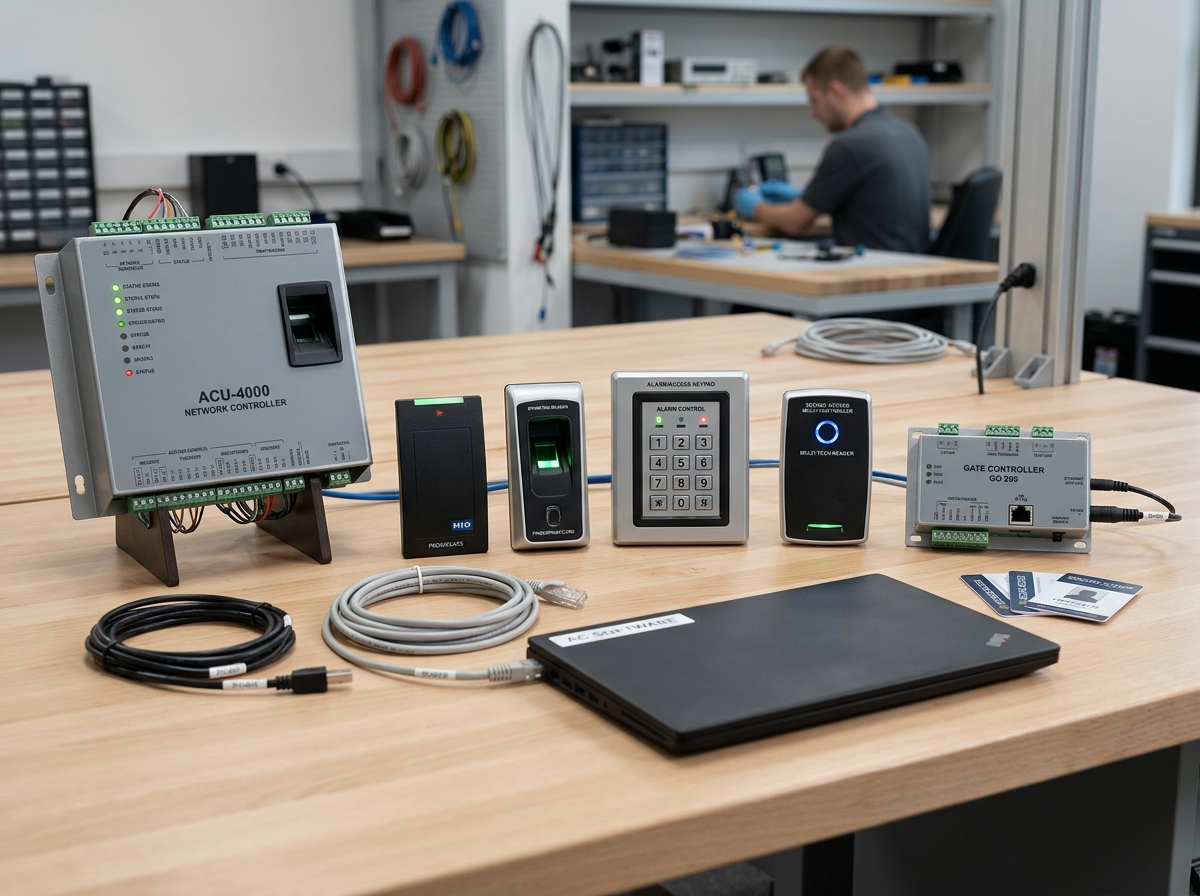
Here are the fundamental components we use to build these systems:
- Management Software: This is the “brain.” It stores the database of authorized users, sets schedules (e.g., the gate stays open during business hours), and records audit trails.
- User Credentials: These are the “keys” of the digital age. They can be physical items like RFID fobs and cards, or digital ones like a smartphone app or a unique PIN code.
- Gate Operators: These are the heavy-duty motors that physically move the gate. Depending on your setup, these could be swing, slide, or overhead operators.
- Electric Locks: Often referred to as “mag-locks” or electric strikes, these keep the gate physically secured until the controller sends a “release” signal.
- Access Controllers: The middleman. It receives the data from the reader, asks the software if the user is allowed in, and then tells the lock to open.
- Signal Readers: These are the devices mounted at the entrance (like a keypad or an RFID scanner) that “read” the user’s credential.
- Power Distribution: Ensuring the system has a steady power supply—and a battery backup—is vital. You don’t want to be locked out (or in) during a power outage in West Bloomfield.
Wired vs. Wireless: Which Should You Choose?
Deciding between a wired and wireless setup is one of the biggest choices you’ll make. Here is how they stack up:
| Feature | Wired Systems | Wireless Systems |
|---|---|---|
| Installation | Requires trenching and running cables | Faster; no major digging required |
| Initial Cost | Higher (due to labor and materials) | Lower (less labor-intensive) |
| Reliability | Extremely stable; no signal interference | Depends on WiFi/Cellular strength |
| Security | Harder to “hack” physically | Requires strong encryption/cybersecurity |
| Maintenance | Low maintenance once installed | May require battery changes or signal checks |
Choosing the Right Physical Gate and Access Method
Before we talk about the tech, we have to talk about the “metal.” The physical gate you choose depends heavily on your property’s layout and how much space you have.
Common Physical Gate Types
- Swing Gates: These open like a standard door. They look elegant and are popular for residential driveways in Birmingham and Franklin, but they require a large “swing path” clear of obstacles.
- Slide Gates: These slide parallel to the fence line. They are excellent for space-saving and are often used in commercial settings or properties with steep driveways where a swing gate wouldn’t work.
- Bi-Folding Gates: These fold in on themselves as they open. They are the “speed demons” of the gate world and are perfect for high-traffic areas or very tight spaces where neither a swing nor a slide gate will fit.
Selecting Your Access Method
How do you want to “talk” to your gate? The method you choose affects both convenience and security.
- Keypads: Reliable and simple. You give a code to the lawn service, the delivery driver, or your kids. However, codes can be shared, so we recommend using unique PINs for different people to keep a clean audit trail.
- RFID Fobs and Cards: These are standard for commercial office buildings. You tap and go. They are easy to deactivate if one gets lost.
- Mobile Credentials: This is the gold standard for modern homes. Using Bluetooth or NFC, your gate recognizes your phone as you approach. No more rolling down the window in the rain!
- Biometrics: Fingerprint or facial recognition. It’s the highest level of security because you can’t “lose” your finger, but it can be pricier to implement.
- License Plate Recognition (LPR): Using high-definition security cameras, the system reads your plate and opens the gate automatically. It’s hands-free and incredibly efficient for gated communities in areas like Farmington Hills.
- Intercom Systems: Essential for visitor management. A guest presses a button, and you can see and speak to them via a video link before “buzzing” them in from your kitchen or your office in Southfield.
Integrating Your Security Infrastructure for Maximum Efficiency
At SmartMait, we don’t believe in “standalone” gadgets. A gate access control system is most powerful when it talks to the rest of your property. This is where our expertise in Z-Wave and smart home integration shines.
The Power of Unified Security
Imagine this: A visitor pulls up to your gate in Livonia. They press the intercom. Your phone rings. You see a live video feed of the visitor. You recognize them, tap a button to open the gate, and simultaneously, your outdoor lights brighten and your home security system disarms. That is the power of a unified system.
- Video Verification: By integrating security cameras with your gate, you don’t just know when someone entered; you see who they were. Every entry event can trigger a short video clip sent straight to your phone.
- SmartMait Z-Wave Connectivity: We use Z-Wave technology to ensure your gate, locks, lights, and cameras all communicate on a secure, mesh network. This eliminates the “clutter” of having ten different apps for ten different devices.
- Remote Management & Audit Trails: Whether you are at work in Warren or on vacation, you can check the logs to see if the contractor arrived on time. You can also grant temporary access passes to guests that expire after a set time.
- Automated Lockdown: In the event of an emergency, a single command can lock every gate and door on your property, providing an instant shield for your family or employees.
Frequently Asked Questions about Gate Access Control
How do gate access control systems function?
It’s a quick four-step process. First, the user presents a credential (like a fob or phone) to the reader. Second, the reader sends that data to the controller, which checks it against a database to see if that person is authorized at that specific time. Third, if authorized, the controller triggers a relay that tells the gate operator to move and the electric lock to disengage. Finally, the system logs the event and can send a real-time alert to the property owner.
What are the benefits of a wireless gate access control system?
Wireless systems are a game-changer for existing properties in places like Farmington or Walled Lake where digging up a paved driveway for wires would be a nightmare. The main benefits include:
- Reduced Trenching: Saves thousands in labor and landscaping repair.
- Cloud Scalability: Easily add more users or gates via a web dashboard.
- Remote Updates: Software patches and security updates happen automatically over the air.
- Flexible Deployment: You can place readers exactly where they are needed without worrying about wire runs.
Can I open my gate with a smartphone?
Absolutely! Modern gate access control systems use mobile applications that connect via Bluetooth, NFC, or cellular data. You can “buzz” someone in from across the world, send encrypted temporary keys to visitors, and even use “Touch-to-Open” technology where the gate opens simply because your phone is in your pocket as you approach.
Conclusion
Securing your property shouldn’t be a headache. Whether you’re looking to protect a sprawling estate in Bloomfield Township or a busy commercial facility in Troy, a professionally installed gate access control system provides the peace of mind you deserve.
By focusing on high-quality components, choosing the right physical gate for your space, and integrating everything into a seamless smart platform, you’re not just installing a fence—you’re building a smarter, safer future.
Don’t leave your perimeter to chance. From initial design to professional installation and future-proof maintenance, we are here to help you navigate modern security. Secure your property with SmartMait and experience the convenience of a truly integrated home or business.