How to Choose the Right Church Audio Visual Companies
Choose an Integrator That Plans the Whole Worship Experience
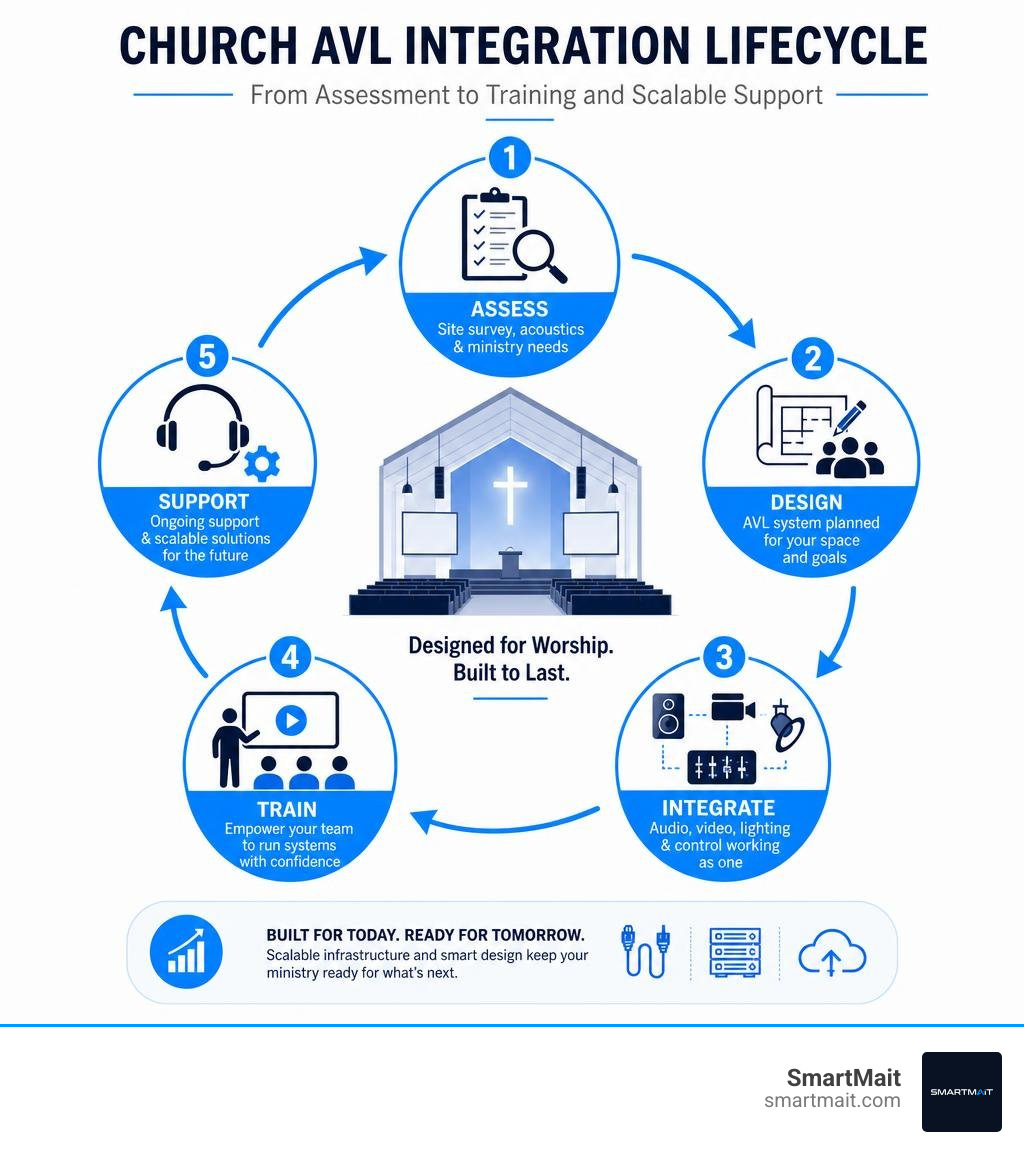
A successful church audio visual installation starts with a site survey, an acoustic assessment, and a clear list of ministry needs. Before choosing equipment, ask each AV company how it will:
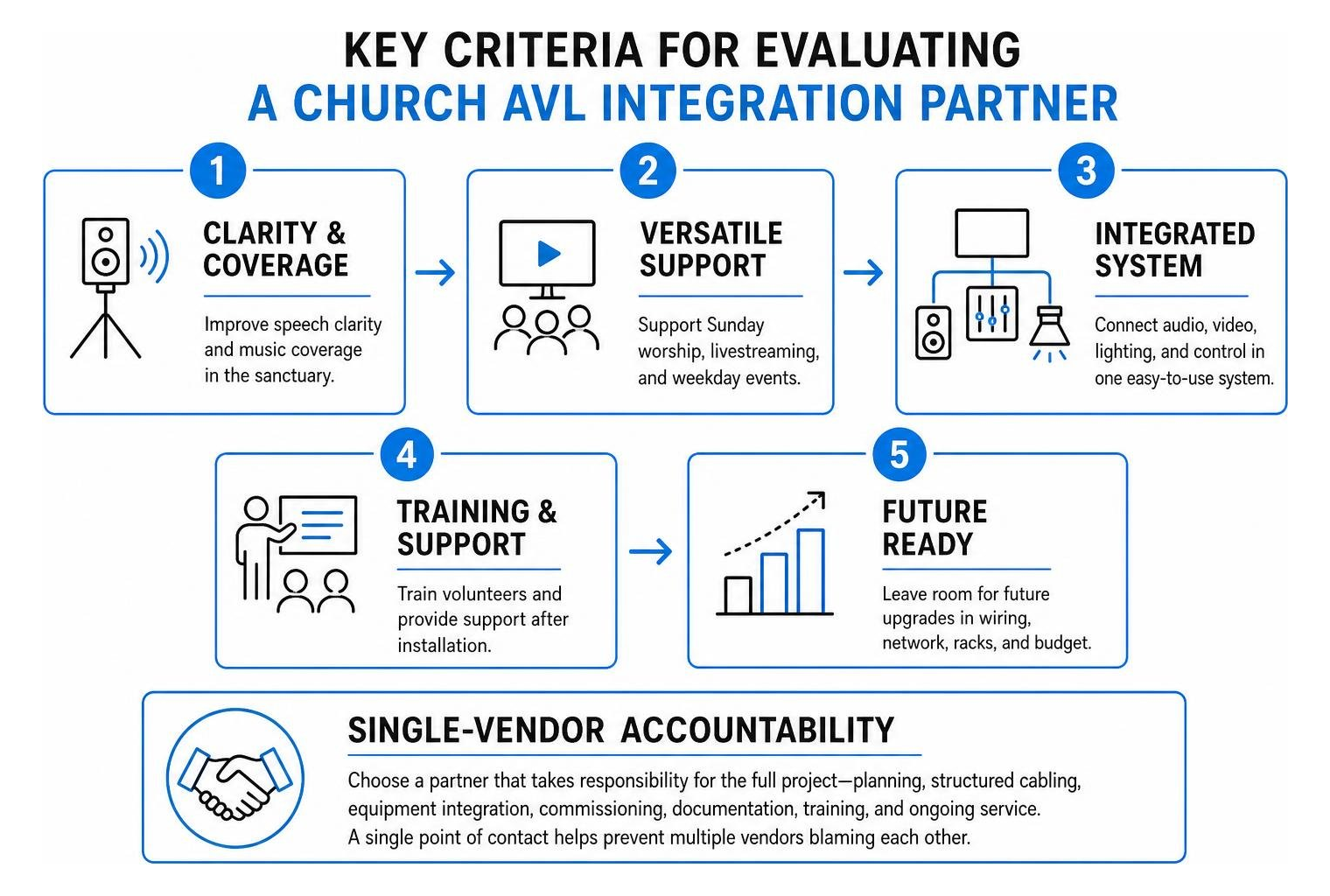
- Improve speech clarity and music coverage in the sanctuary.
- Support Sunday worship, livestreaming, and weekday events.
- Connect audio, video, lighting, and control in one easy-to-use system.
- Train volunteers and provide support after installation.
- Leave room in the wiring, network, racks, and budget for future upgrades.
The right church AVL partner does more than sell speakers, cameras, or screens. They design a complete system around the room, its acoustics, available light, worship style, volunteer skill level, and long-term goals. That matters because a bright display cannot solve poor sightlines, and more powerful speakers cannot fix a highly reverberant sanctuary or gym.
Look for a company that can take responsibility for the full project: planning, structured cabling, equipment integration, commissioning, documentation, training, and ongoing service. A single point of contact helps prevent the common problem of multiple vendors blaming each other when systems do not work together.
I am Dominic Hesano, founder of SmartMait, with hands-on experience in low-voltage installation, structured wiring, networks, and integrated technology systems across Southeast Michigan. That foundation is essential to church audio visual installation because reliable infrastructure and simple system design determine whether technology works when volunteers need it most.
Church audio visual installation vocab explained:
Core Criteria for Evaluating Church AVL Integrators
Selecting an AVL partner requires looking far beyond a line-item equipment quote. Technical capability, single-vendor accountability, and ongoing maintenance form the bedrock of any successful technology investment. In fact, research shows that 75% of church attendees view the overall audiovisual production as one of the primary elements they remember from a worship service. When technology operates seamlessly, the message takes center stage; when it fails, everything else grinds to a halt.
As highlighted in our best AV companies guide 2026, technical prowess must be paired with structured execution. Learning how to navigate the world of AV installation services means identifying integrators who balance engineering depth with structured volunteer training protocols. A high-end mixing console or 4K broadcast switcher is only as effective as the Sunday volunteer operating it.
Evaluating Engineering Expertise and Portfolio Track Record
When evaluating potential integrators, examine their portfolio for projects that share your architectural constraints. Historic sanctuaries, for example, feature stone walls, high timber ceilings, and stained glass—spaces where drilling conduit or cutting access holes requires extreme care.
Historic integrations demonstrate how high-performance audio, video, and architectural lighting can be introduced without disrupting sacred aesthetics. For instance, the monumental Notre-Dame cathedral audio restoration case study illustrated the necessity of deploying custom mounting brackets, advanced altimetry, and precise acoustic mapping to position 128 speakers across reverberant stone naves without compromising historic fabric.
Whether your room seats 150 people in Birmingham or 1,500 in Troy, your integrator should demonstrate mastery over:
- Engineered rigging and load calculations for line-array clusters.
- Low-profile cable pathway design that preserves visual aesthetics.
- Acoustic simulation software to predict room coverage before hanging a single cabinet.
Assessing Single-Source Integration vs Fragmented Vendors
One of the most frequent pitfalls houses of worship experience is vendor fragmentation. Hiring one vendor for microphones, another for projection screens, and a third for stage lighting routinely leads to finger-pointing when systems fail to communicate.
By choosing a unified partner, churches eliminate compatibility gaps. We explore this comprehensive strategy in our guide to modernizing your ministry with professional church AV installation. A single-source integrator takes complete ownership of:
- Centralized Accountability: One phone number to call for troubleshooting, warranty support, and routine maintenance.
- Unified Control Networks: Bridging audio DSPs, lighting controllers, and video matrices onto a shared, segregated network backbone.
- Structured Cabling: Standardized labeling, power sequencing, and clean rack architecture that simplify long-term servicing.
Essential Components of a Modern Worship AVL Ecosystem
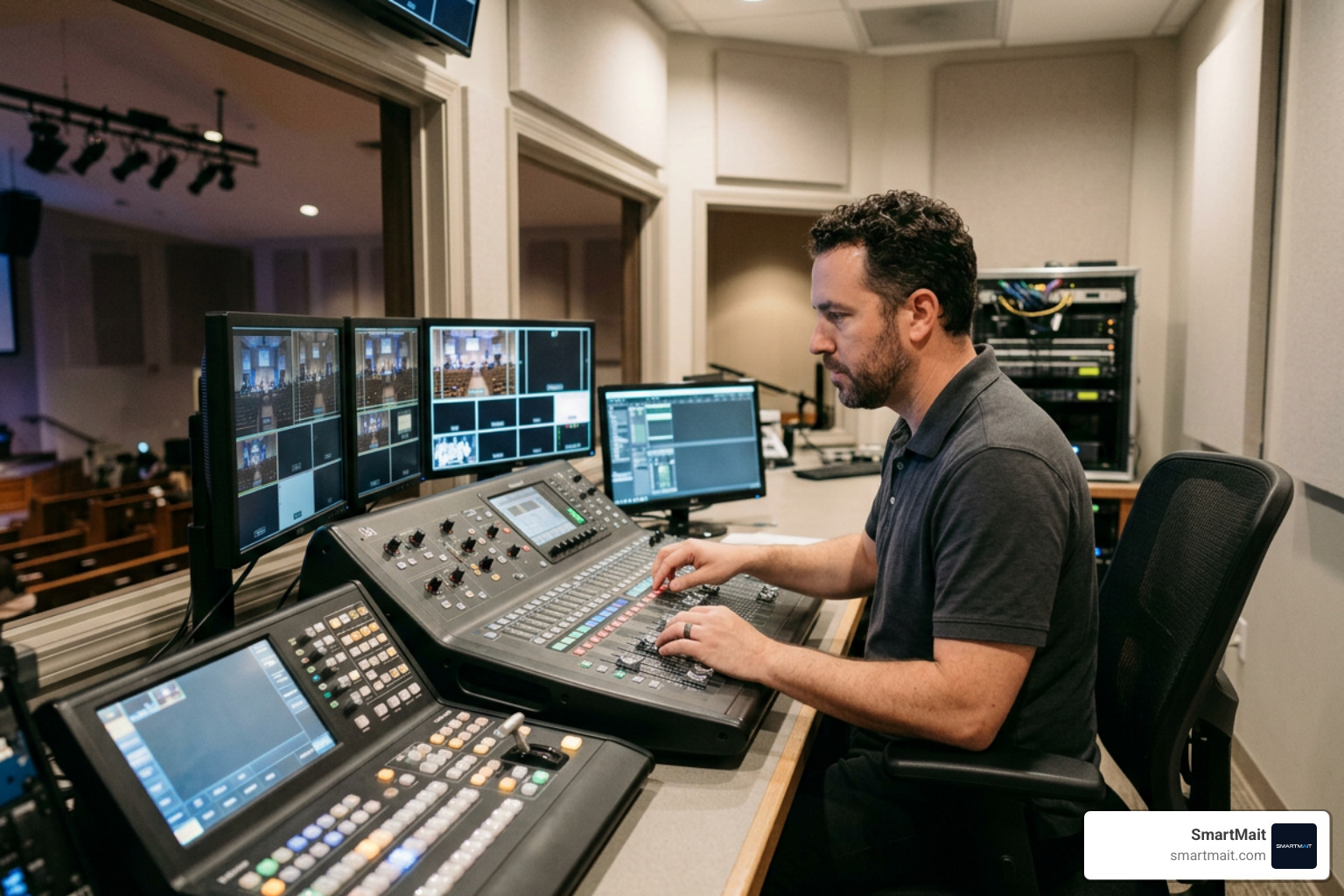
A truly cohesive worship space operates as an integrated ecosystem where audio, video, and theatrical lighting reinforce one another. Understanding how to master AV system design without the headache begins with breaking down how these core systems communicate.
| Feature / Criteria | Traditional Laser Projectors | Direct-View LED Video Walls |
|---|---|---|
| Ambient Light Rejection | Moderate; struggles against direct sunlight and stained glass | Exceptional; high nit brightness cuts through bright daylight |
| Contrast & Black Levels | Lower contrast; blacks appear washed out in ambient light | True deep blacks with independent pixel illumination |
| Maintenance & Lifespan | Periodic lens cleaning; 20,000-hour laser engine life | 100,000-hour module lifespan; front-serviceable magnetic tiles |
| Physical Footprint | Requires clear throw paths, ceiling drop poles, or rear booths | Flush-mounted to wall surfaces; zero shadow or throw obstruction |
| Capital Investment | Lower upfront hardware cost | Higher initial investment; significantly lower ongoing operating cost |
Audio Architecture, Line Arrays, and Personal Monitoring
Clear vocal intelligibility is non-negotiable. If the congregation cannot understand the sermon, the primary purpose of the gathering is compromised. Modern audio systems utilize digital consoles—such as the Allen & Heath SQ or dLive series—paired with Dante IP networking to route multi-channel audio over standard Cat6 cabling.
To achieve clean acoustic output, modern stage designs replace noisy floor wedge monitors with personal in-ear monitoring (IEM) systems like the Shure PSM series or Allen & Heath ME-500 mixers. Removing loud floor wedges cleans up open microphone bleed, drastically lowers onstage stage volume, and allows front-of-house engineers to deliver an articulate mix to both the room and the live stream.
Video Displays, PTZ Cameras, and Live Stream Production
Modern worship video encompasses both in-room visual support and online broadcast outreach. Direct-view LED video walls featuring fine pixel pitches (such as 2.6mm) have largely superseded traditional projectors in high-ambient-light sanctuaries.
For video production, remote-controlled PTZ (Pan-Tilt-Zoom) cameras paired with broadcast switchers like the Blackmagic ATEM Constellation streamline multi-camera capturing. Utilizing network protocols like NDI and Dante AV, video signals travel across standard network infrastructure with near-zero latency, allowing a single volunteer to operate smooth camera moves from a remote production desk.
Dynamic Stage and House Lighting Integration
Lighting sets the visual atmosphere for worship and ensures high-definition video capture. Stage lighting requires a careful balance of front key lighting (to illuminate speakers evenly for broadcast cameras) and saturated LED wash fixtures to bring depth to the stage. By integrating DMX-controlled architectural house lighting with the main production console, lighting cues can seamlessly transition the entire room from bright, welcoming fellowship lighting to an immersive worship environment at the touch of a button.
Key Phases of a Church Audio Visual Installation Project

Executing a flawless installation demands a phased, engineering-first approach. As detailed in our breakdown of everything you need to know about professional audio video installation, each phase builds upon the previous one to guarantee structural integrity, electronic safety, and intuitive operation.
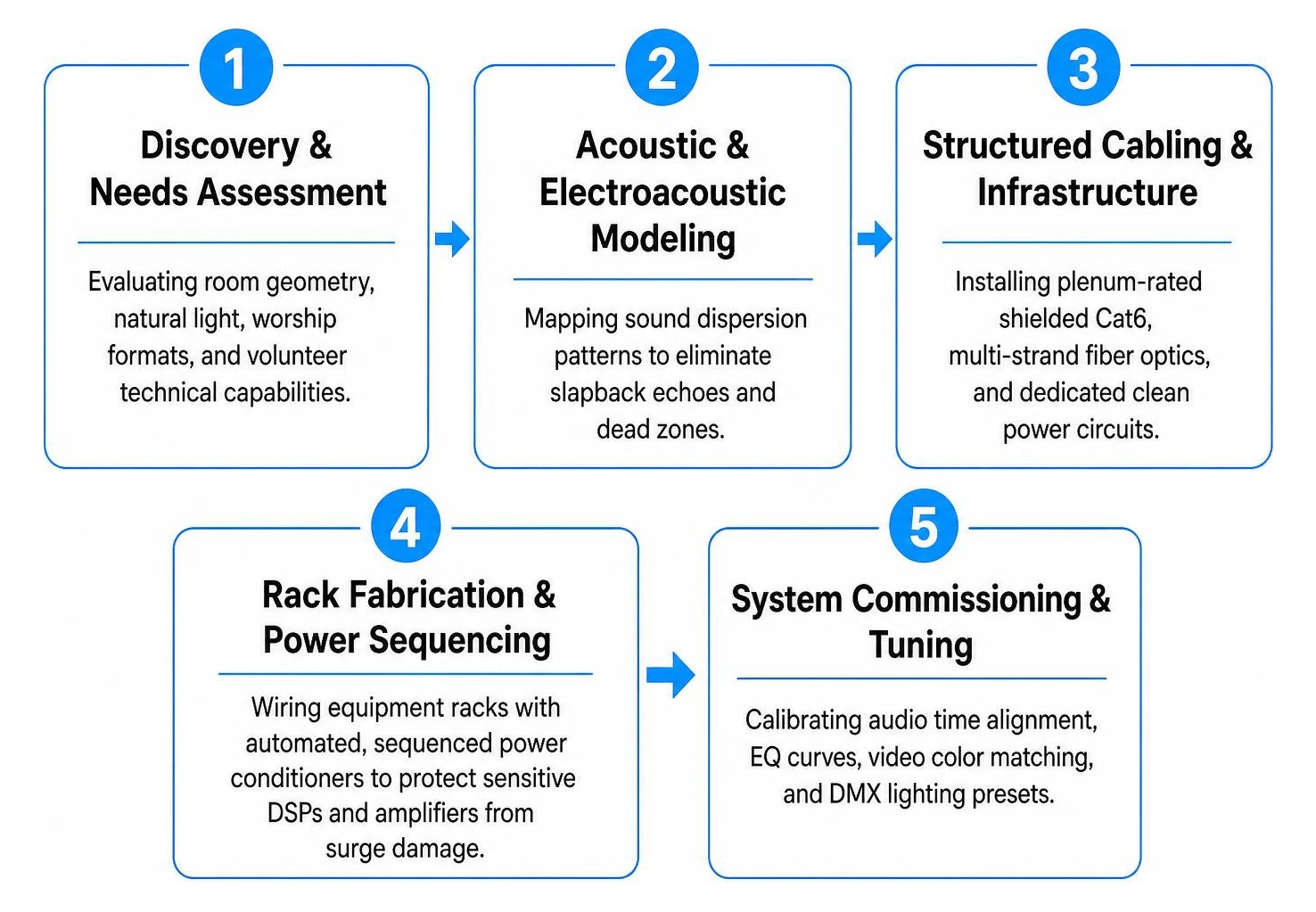
- Discovery & Needs Assessment: Evaluating room geometry, natural light, worship formats, and volunteer technical capabilities.
- Acoustic & Electroacoustic Modeling: Mapping sound dispersion patterns to eliminate slapback echoes and dead zones.
- Structured Cabling & Infrastructure: Installing plenum-rated shielded Cat6, multi-strand fiber optics, and dedicated clean power circuits.
- Rack Fabrication & Power Sequencing: Wiring equipment racks with automated, sequenced power conditioners to protect sensitive DSPs and amplifiers from surge damage.
- System Commissioning & Tuning: Calibrating audio time alignment, EQ curves, video color matching, and DMX lighting presets.
- Volunteer Training & Handoff: Conducting hands-on workshops with ministry staff and providing laminated quick-reference run sheets.
Acoustic Engineering in Church Audio Visual Installation
Before mounting premium speakers, the physical acoustics of the room must be addressed. Uncontrolled hard surfaces—such as drywall, glass, and polished floors—create excessive reverberation time (RT60), smearing consonants and rendering speech unintelligible regardless of how much was spent on sound gear.
Strategic acoustic engineering uses a combination of high-density absorption panels, corner bass traps, and ceiling-suspended acoustic clouds. For example, in our review of multipurpose worship space acoustic design, Capstone Church solved severe flutter echoes in their multipurpose facility by deploying 114 wall panels alongside 60 ceiling-suspended panels. This treatment tamed the room’s harsh reflections, allowing their sound reinforcement system to achieve crystal-clear speech intelligibility.
Designing Multipurpose and Hybrid Worship Facilities
Many congregations across Oakland and Wayne counties utilize gymnasiums, fellowship halls, or multi-use community spaces for their weekend services. These environments require versatile systems that switch quickly between Sunday worship and weekday activities.
To build an adaptable multipurpose space:
- Deploy “Simple Mode” Presets: Program wall-mounted touchscreens that allow non-technical staff to power on a single wireless microphone and background music without opening the main tech booth.
- Mobile Front-of-House (FOH) Stations: Utilize wall-recessed stage boxes with rugged multi-pin quick disconnects, allowing the mixing desk to roll into a storage closet during sports or community dinners.
- Life Safety Integration: Ensure the audio DSP ties directly into the municipal fire alarm control panel, instantly muting all stage audio and house music in the event of an emergency.
Balancing Budget, Scalability, and Ongoing System Support
Balancing capital constraints with technical longevity is an ongoing challenge for church leadership committees. Navigating how much does a professional AV system actually cost requires differentiating between immediate equipment purchases and long-term operating value.
Reviewing which AV system brands are worth the investment helps leadership steer clear of consumer-grade electronics that burn out under weekly continuous duty. Investing in professional-grade gear with modular expansion capabilities protects your initial investment.
Simplifying User Interfaces for Volunteer Tech Teams
A system that only an audio engineer can operate is a liability for a growing church. To prevent volunteer burnout, your integrator must build streamlined, layered user interfaces:
- Stream Deck & Companion Integration: Consolidate complex sequences—such as powering on projectors, setting stage lighting, and switching camera inputs—into single-button macros.
- Role-Based Access: Lock out deep DSP equalization menus and system limiter settings behind administrative passwords, leaving volunteers with clean faders and intuitive scene recalls.
- Visual Quick Guides: Provide clear, custom-printed operational workflows mounted directly inside the production booth.
Future-Proofing Your Church Audio Visual Installation
Future-proofing means designing system backbones that absorb tomorrow’s technology without tearing out walls. Installing oversized conduit paths, multi-strand single-mode fiber optic lines, and Dante-enabled audio infrastructure ensures your sanctuary can scale seamlessly.
Crucially, ongoing system health depends on regular maintenance. At SmartMait, our SmartService concierge maintenance program provides proactive firmware patching, automated remote monitoring, and on-site recalibrations. While many integrators complete a job and disappear, we maintain an ongoing partnership with churches throughout Bloomfield Hills, Troy, Rochester Hills, Farmington Hills, and Birmingham to keep their AVL production running without interruption.
Frequently Asked Questions about Church AVL Systems
What is the typical timeline for a complete worship AVL upgrade?
A full-scale sanctuary AVL installation typically spans 6 to 12 weeks from initial engineering consultation to final volunteer training. The physical on-site installation generally takes 1 to 2 weeks, during which technicians run structured cabling, hang displays, rig line arrays, and wire production racks. Integrators often schedule high-impact work between Monday and Friday afternoon to prevent disruption to mid-week services and Sunday morning worship.
How do LED video walls compare to traditional laser projectors in sanctuaries?
Direct-view LED video walls deliver far higher lumen brightness and contrast ratios than traditional projection systems. This makes them especially effective in worship spaces with large architectural windows or heavy ambient sunlight. While LED walls carry a higher upfront hardware cost, they eliminate ongoing lamp replacements, offer up to 100,000 hours of operating life, and can be maintained from the front without disturbing ceiling trusses.
Why should acoustic treatment be completed before buying new sound equipment?
Acoustic treatment addresses the physical physics of the sanctuary itself. If a room has reflective, parallel hard surfaces that bounce sound waves unchecked, buying a louder or more expensive sound system simply amplifies those acoustic distortions. Installing absorption and diffusion panels first controls reverberation, improves speech intelligibility, and enables your audio DSP and speakers to operate efficiently.
Conclusion
A successful audiovisual upgrade elevates every aspect of your ministry—turning distracted services into immersive worship experiences and bridging the gap between your in-person congregation and online community. Achieving this balance requires partnering with an integrator that views technology through the lens of stewardship, simplicity, and architectural respect.
At SmartMait, we provide complete, turnkey design, installation, and ongoing concierge support for houses of worship, luxury residences, and commercial facilities throughout Oakland, Macomb, and Wayne counties. Whether you are outfitting a historic sanctuary in Bloomfield Township or building a modern multipurpose worship space in Rochester Hills, we build reliable, architect-grade systems supported by our signature SmartService maintenance plans.
Explore our comprehensive smart automation and commercial AV solutions or contact us today to schedule an on-site technical consultation for your worship space.