Lock It Down: Is ADT the Right Choice for Your Business?
How to Evaluate Business Security in Metro Detroit
Start with the building, not the alarm package. For an office, shop, or medical practice, map who needs access, where cameras need clear views, and what happens if the internet or power goes down. Then ask an integrator whether the system can connect access control, video, and your network without leaving you with several apps and service contacts.
If you’re comparing a subscription with a custom installation, look beyond the monthly fee. Ask who owns the equipment, how footage is stored, what support covers, and what it would cost to add a door or camera later. SmartMait’s commercial security systems guide can help you frame those questions before you schedule a consultation.
I’m Dominic Hesano, and my hands-on work with low-voltage wiring, security systems, and network troubleshooting has taught me how much a reliable installation matters after the installer leaves. Here’s how to assess the whole setup for a business in Troy, Oakland County, or the wider Metro Detroit area.
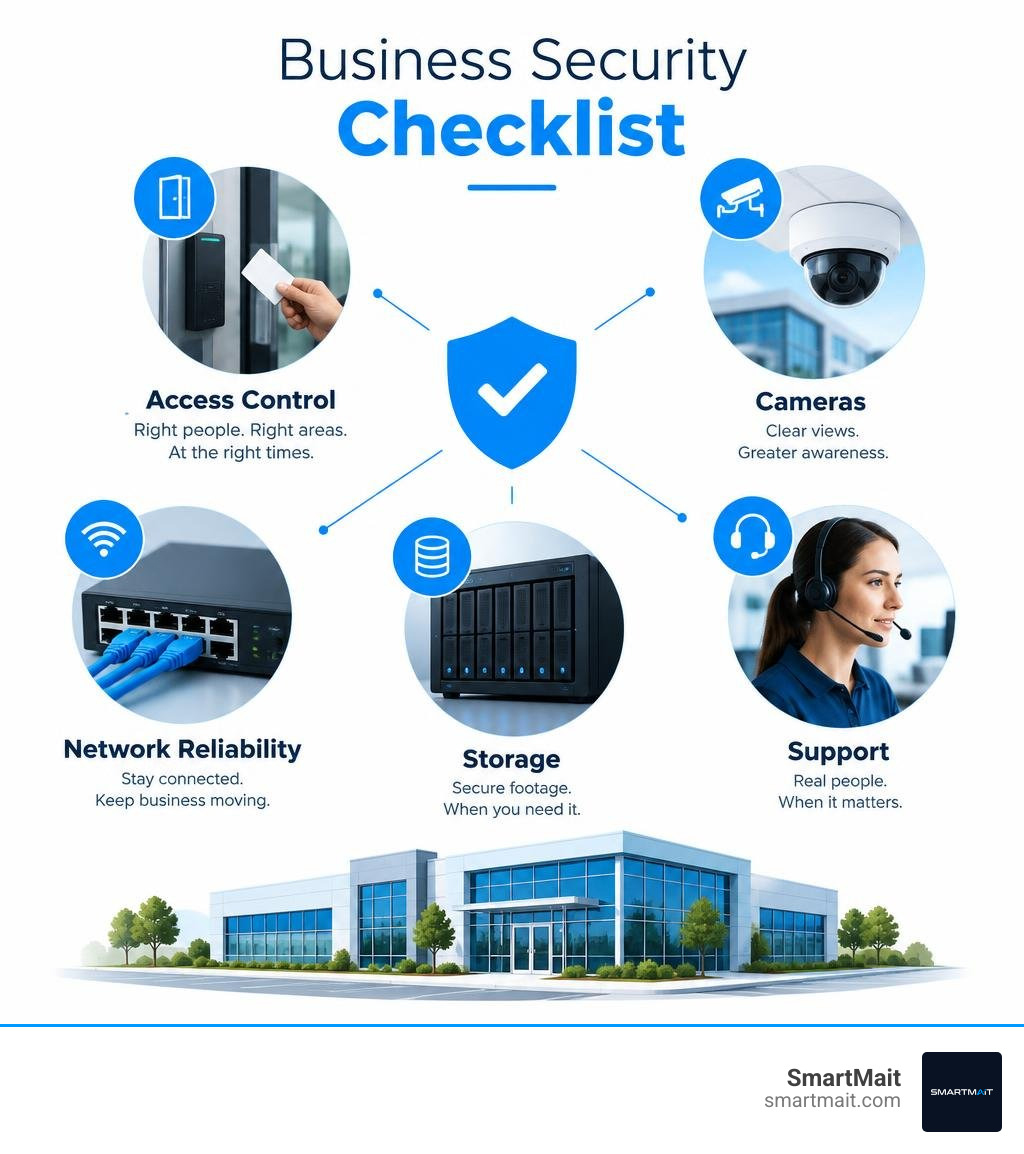
Business security word list:
Evaluating Commercial Security Services for Business Facilities
Securing a commercial property in Southeast Michigan requires moving away from the retail mindset of basic burglar alarms. Whether managing a medical clinic in Rochester Hills, a corporate office in Troy, or a boutique retail storefront in Birmingham, commercial facilities face operational demands that off-the-shelf bundles cannot handle. A complete defense requires evaluating response times, monitoring capabilities, and hardware reliability.
When evaluating commercial security systems for small business owners, the standard proposition often revolves around standard 24/7 central monitoring stations. These stations receive alarm triggers, verify alerts, and dispatch emergency personnel. However, operational efficiency depends heavily on physical infrastructure design. According to secondary analysis of commercial security deployments, fragmented installations that lack centralized power backups, structured cabling, or automated health monitoring suffer from higher rates of unverified alarm calls.
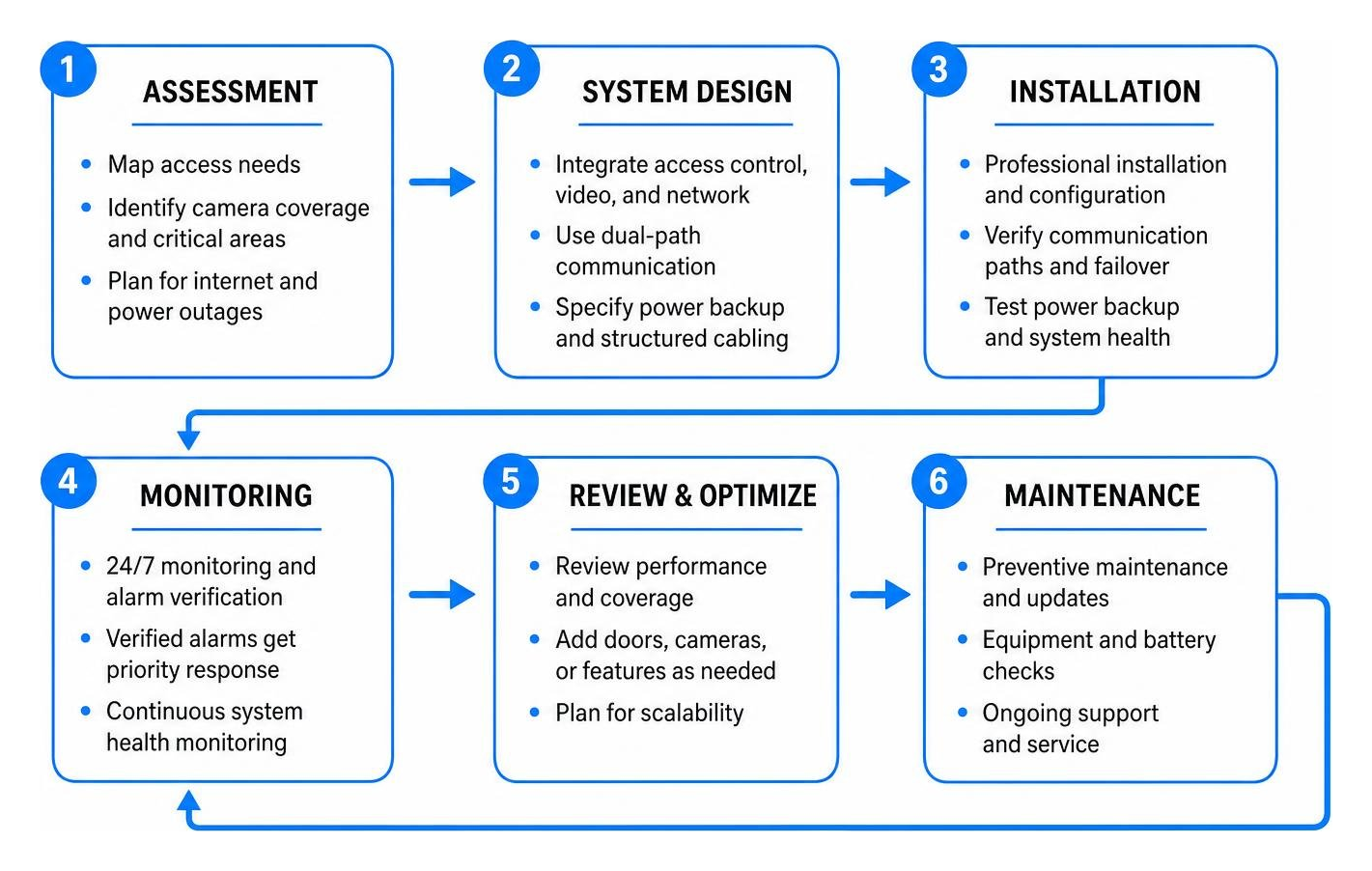
In Oakland County, municipal emergency departments prioritize verified alarms. An unverified motion trigger often results in delayed dispatch times or substantial false alarm fines. Professional integrators eliminate this risk by deploying dual-path communication systems—combining hardwired fiber connections with cellular failovers—ensuring continuous signal transmission even during severe weather or localized grid disruptions.
Core Vulnerabilities and Limitations of Subscription-Based Security
Off-the-shelf and subscription-heavy models present structural hurdles for growing enterprises. The most pressing challenge is proprietary hardware lock-in. When a facility installs closed-architecture components, upgrading a single reader or adding an exterior camera requires replacing the entire head-end controller.
Furthermore, standard subscription bundles often fail to integrate cleanly with modern door entry systems for business. Multi-tenant office buildings in West Bloomfield or corporate suites in Southfield need granular permission management. Subscription systems usually charge escalating monthly fees for each user credential, mobile key pass, or administrator seat, rapidly driving up overhead costs.
Latency is another technical hurdle. When door access, motion detection, and video feeds route through distant third-party cloud servers before returning a command to an electric door strike, users experience delays. High-traffic commercial facilities require local controller processing to ensure door latches open in milliseconds, regardless of internet bandwidth conditions.
Video Surveillance Storage and Smart Detection Features
Video surveillance forms the visual backbone of commercial security. Today, 1080p high-definition and 4K optical sensors are standard requirements for forensic identification. However, the critical design choice lies in storage architecture: cloud storage versus on-premise Network Video Recorders (NVRs).
While cloud-only video storage simplifies offsite viewing, it consumes significant upstream internet bandwidth. For a facility running twelve to thirty-two 1080p or 4K streams simultaneously, cloud bandwidth saturation can degrade internal office network performance.
Modern deployments benefit most from hybrid setups using on-premise NVR appliances paired with smart edge video analytics, as detailed in our guide on business video surveillance strategies. Optical sensors with built-in analytics distinguish between vehicles, pedestrians, and wildlife, virtually eliminating false motion alerts. Dome cameras with vandal-resistant ratings protect interior corridors, while exterior turret and bullet cameras with infrared night illumination secure parking structures and loading docks.
Building a Unified Low-Voltage Security Ecosystem
A dependable commercial defense cannot operate in silos. Disconnected burglar alarms, separate access panels, and standalone camera apps complicate daily operations and introduce security gaps. We design unified low-voltage ecosystems where every subsystem communicates seamlessly across a shared physical and logical network.

In commercial retrofits across Bloomfield Hills and Farmington Hills, unified infrastructure starts with enterprise-grade structured cabling. Shielded Cat6 and Cat6A Ethernet runs eliminate electrical interference, deliver Power over Ethernet (PoE) to endpoints, and supply the clean data paths required for cloud-managed access control and high-throughput video.
Access Control and Commercial Door Hardware
Access control regulates physical movement throughout your facility, protecting sensitive assets, server rooms, and executive suites. Modern systems replace easily duplicated physical brass keys with encrypted credentials, mobile smartphone passes, and biometric verification.
When outfitting entryways, deploying robust badge access door systems provides administrators with real-time audit trails and instant credential revocation. Commercial door hardware must balance perimeter integrity with emergency life-safety compliance:
- Electrified Mortise Locks: Provide heavy-duty latching for exterior doors while maintaining a clean architectural appearance.
- Electromagnetic Locks (Maglocks): Deliver high holding force for interior glass doors and heavy vestibules.
- Fail-Safe vs. Fail-Secure Configurations: Fail-safe hardware unlocks automatically during a power outage to ensure safe egress, while fail-secure hardware remains locked to maintain security on server rooms and records vaults.
Perimeter Defense and Building Automation Integration
Commercial security extends beyond perimeter doors to encompass environmental and automation management. Integrating security sensors with commercial building automation simplifies daily operations and cuts energy costs.
By linking intrusion sensors with smart Z-Wave lighting relays, an alarm trigger after hours can immediately illuminate all interior and exterior floodlights, deterring intruders and providing clear visibility for camera systems. Similarly, our installations at perimeter checkpoints utilize gate access control systems integrated with automated vehicle loops and long-range RFID tag readers.
Environmental monitoring adds another layer of asset protection. Environmental sensors track server room temperatures, detect water leaks in plumbing risers, and alert facility managers to HVAC failures before physical inventory or network infrastructure suffers damage.
Engineering Reliability: Preventive and Predictive System Maintenance
Electronic security systems are complex mechanical and digital assemblies. Sensors degrade, backup batteries lose capacity, and network switches collect dust. Relying on a reactive maintenance model—waiting for a camera to go dark or a magnetic lock to fail before placing a service call—creates operational risk.
Applying maintenance engineering principles, such as Reliability-Centred Maintenance (RCM) and digital twin modeling, helps commercial managers optimize uptime. Based on predictive framework research for mission-critical systems, tracking asset telemetry and calculating the Mean Time Between Failures (MTBF) of critical security hardware prevents sudden failures.
| Maintenance Factor | Reactive “Break-Fix” Approach | SmartService Predictive Maintenance |
|---|---|---|
| Response Model | Emergency service calls after a breach or failure | Scheduled condition checks and early component replacement |
| Downtime Impact | System offline during diagnostic and part ordering | Minimal disruption via proactive sensor health tracking |
| Cost Predictability | High, unpredictable emergency repair fees | Predictable, fixed recurring maintenance investment |
| Audit Logs | Incomplete, fragmented paperwork | Automated CMMS logs for compliance and insurance |
| System Longevity | Premature hardware replacement from neglect | Extended operational lifespan through proactive care |
Our SmartService concierge maintenance program bridges this gap for enterprises throughout Rochester Hills and the wider Oakland County region. Rather than abandoning clients after initial activation, we maintain ongoing monitoring of hardware health, firmware patches, and power levels.
Upgrading from Basic Subscription Security to Professional Integration
Transitioning from a basic subscription package to an integrated low-voltage ecosystem is an investment in business continuity. A professionally engineered system delivers:
- Computerized Maintenance Management: Automated work orders for battery replacements and lock recalibrations before an outage occurs.
- Sensor Health Telemetry: Active monitoring of voltage stability and wireless signal integrity across all Z-Wave and hardwired nodes.
- Unified Local Support: A single, responsive point of contact in Metro Detroit for access control, structured cabling, video monitoring, and network infrastructure.
Frequently Asked Questions about Commercial Security
How do turnkey alarm subscriptions compare to custom low-voltage integration?
Turnkey alarm subscriptions rely on standardized hardware bundles designed for rapid, basic installations. These packages often come with closed firmware, long-term monitoring contracts, and restricted expandability. In contrast, custom low-voltage integration utilizes open-platform controllers, enterprise-grade structured cabling, and non-proprietary hardware. This approach gives you complete ownership over your system, allows effortless scaling from a single door to multi-building campuses, and eliminates escalating per-user licensing fees.
Why is ongoing predictive maintenance critical for business security hardware?
Security hardware operates continuously and experiences environmental wear, voltage fluctuations, and component aging. Relying on reactive repairs means vulnerabilities are often discovered only after an unauthorized intrusion or during a failed emergency egress. Predictive maintenance tracks battery life, monitor door latch alignment, updates device firmware, and cleans optical camera lenses on a set schedule. This approach prevents false alarms, ensures regulatory compliance, and extends the operational lifespan of your hardware.
What local Michigan permits and codes apply to commercial access control in 2026?
Commercial access control installations in Michigan must comply with strict life-safety, building, and electrical codes. All electrified locking hardware must adhere to NFPA 101 Life Safety Code requirements, ensuring free egress during emergencies through integrated fire alarm release relays and auxiliary power drops. In Oakland County and Wayne County, low-voltage wiring requires licensed electrical contractors to pull low-voltage electrical permits. Professional integrators ensure that magnetic locks, emergency exit buttons, and crash bars comply fully with local municipal building inspections.
Conclusion
Securing your commercial enterprise requires a dependable, long-term strategy. Off-the-shelf security packages may offer a quick fix, but modern facilities need the stability, performance, and scalability of an engineered low-voltage infrastructure.
At SmartMait, we provide complete, architect-grade solutions across Troy, Birmingham, Bloomfield Hills, and the broader Metro Detroit area. From high-capacity access control and enterprise video surveillance to structured networking and building automation, we design systems that protect your team and assets. Through our dedicated SmartService program, we stay by your side long after installation to keep your hardware running smoothly.
Contact our team today to explore professional integrated commercial security solutions and schedule an on-site facility consultation.