See Every Detail with These Top Quality Security Cameras
What the Best Quality Security Cameras Let You See
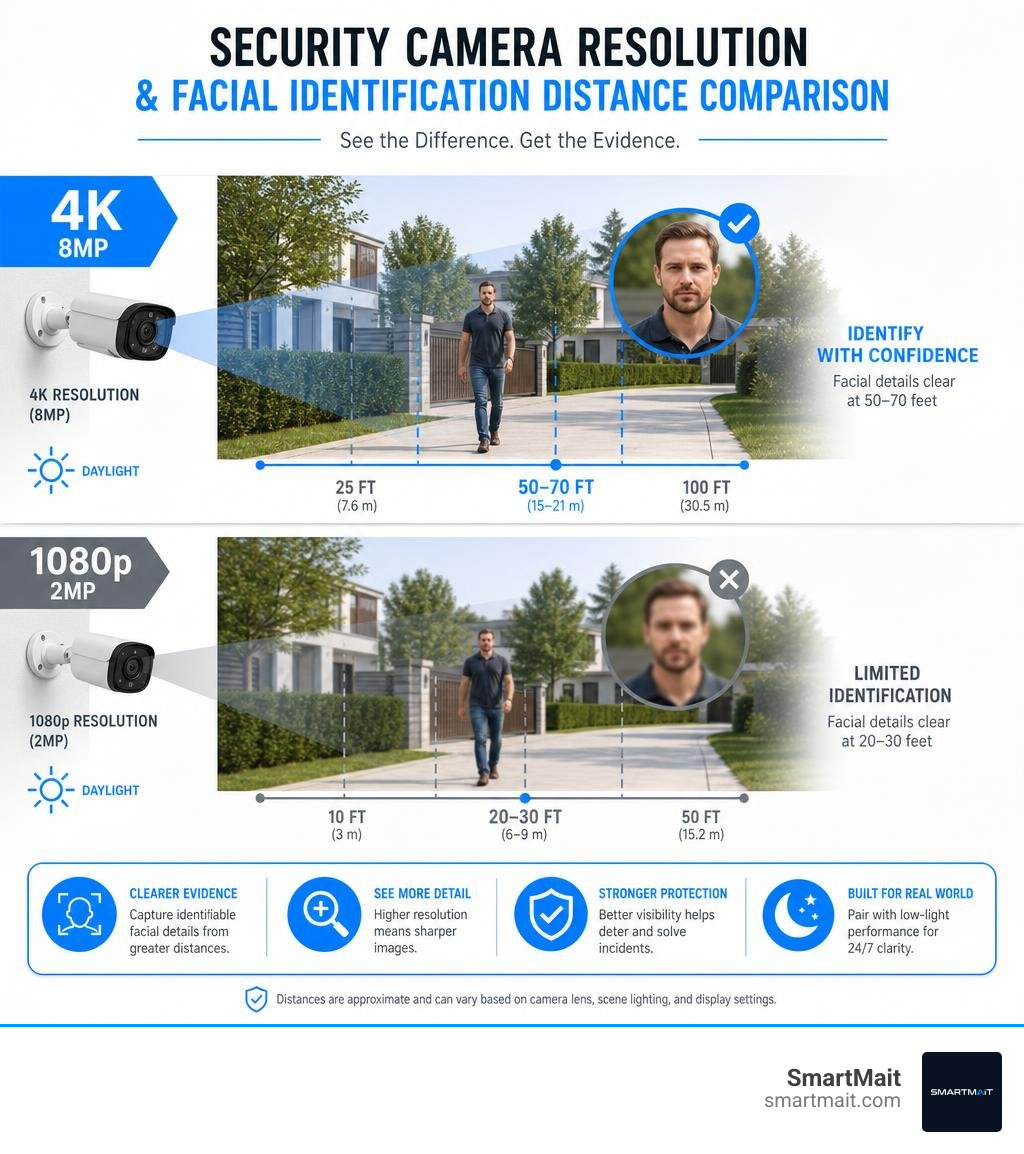
The best quality security cameras use true 4K sensors, strong low-light performance, AI person and vehicle detection, and reliable recording. For the clearest evidence, choose hardwired PoE cameras with local NVR storage at driveways, doors, gates, and other key entry points. A well-placed 4K camera can capture facial detail at roughly 50 to 70 feet in daylight, while 1080p cameras are generally limited to about 20 to 30 feet.
Image quality is not just about a large number on the box. Look for a native 8MP sensor, optical zoom where distance matters, wide dynamic range for bright Michigan snow or headlights, and color-capable night vision. Visible cameras also matter: homes with visible security cameras experience 60% fewer break-ins than homes without them.
I’m Dominic Hesano, founder of SmartMait. I’ve spent years installing structured wiring, networks, and security systems across Southeast Michigan, helping homeowners select and deploy the best quality security cameras without creating another unreliable app-based system.
Best quality security cameras terms made easy:
- cctv cameras for house
- best house cameras outdoor
- cameras for inside the house
Resolution Standards: True 4K vs. Upscaled 4K Video Quality
When you begin researching high-resolution surveillance, you will quickly find that the market is saturated with marketing labels that do not always match physical hardware capabilities. The difference between crisp, actionable forensic evidence and a blurry digital smudge often comes down to pixel density and sensor engineering. If an incident occurs on your property, law enforcement needs to distinguish distinct facial markers, clothing patterns, or vehicle registrations—not guess at pixelated blocks.
Many budget-friendly cameras claim “4K” recording, but achieve that output through software interpolation. In interpolated cameras, a cheaper 4-megapixel or 5-megapixel physical image sensor captures the footage, and onboard software artificially multiplies the pixels to create a 3840×2160 video file. While the file output technically reads as 4K, zooming into the frame instantly reveals severe digital artifacting and softness. In contrast, true 4K surveillance utilizes a native 8.3-megapixel sensor where every single pixel represents authentic light captured through the glass lens.
For a complete breakdown of planning out these hardware requirements, check out The Ultimate Guide to Building a Home Security Camera Setup.
| Specification | True 4K Ultra HD | 2K Quad HD (QHD) | 1080p Full HD |
|---|---|---|---|
| Pixel Resolution | 3840 × 2160 pixels | 2560 × 1440 pixels | 1920 × 1080 pixels |
| Megapixel Rating | 8.3 Megapixels (Native) | 4.0 Megapixels | 2.0 Megapixels |
| Daytime Facial ID Range | 50 to 70 feet | 35 to 45 feet | 20 to 30 feet |
| Digital Cropping Ability | High (maintains fine detail) | Moderate | Low (quickly pixelates) |
| Standard Video Bitrate | 8 Mbps – 16 Mbps | 4 Mbps – 8 Mbps | 2 Mbps – 4 Mbps |
| Primary Deployment Zone | Driveways, entry gates, wide perimeters | Side yards, patios, interior living zones | Tight hallways, small utility rooms |
Choosing the Best Quality Security Cameras with True 4K Optical Sensors
To get the full advantage of true 4K resolution, you need physical optical hardware that can capture sufficient light. A native 8MP sensor requires a physically larger surface area—such as a 1/1.8-inch progressive scan CMOS sensor—to gather light efficiently across its dense pixel grid. Pairing high pixel count with a tiny physical sensor leads to high digital noise and muddy night captures.
In addition to sensor size, dynamic range plays a critical role in video quality. Outdoor surveillance environments deal with harsh backlighting, intense glare from direct sun, and high-contrast night scenes. Hardware-based 120 dB True Wide Dynamic Range (WDR) captures multiple exposures simultaneously to balance dark shadows and bright highlights. Whether you are reviewing footage on an expansive residential property or evaluating high-end panoramic models like the [Official] Reolink Argus 4 Pro – 4K 180° Wireless Solar Security Camera, having the right optical foundation ensures that faces and license plates remain legible regardless of challenging outdoor lighting.
Optical Zoom vs. Digital Cropping for Long-Range Identification
Even the highest-resolution fixed wide-angle lenses have physical limits when monitoring subjects at a distance. If an uninvited vehicle parks at the end of a 100-foot driveway, relying solely on digital zoom simply enlarges the existing pixels, resulting in distortion.
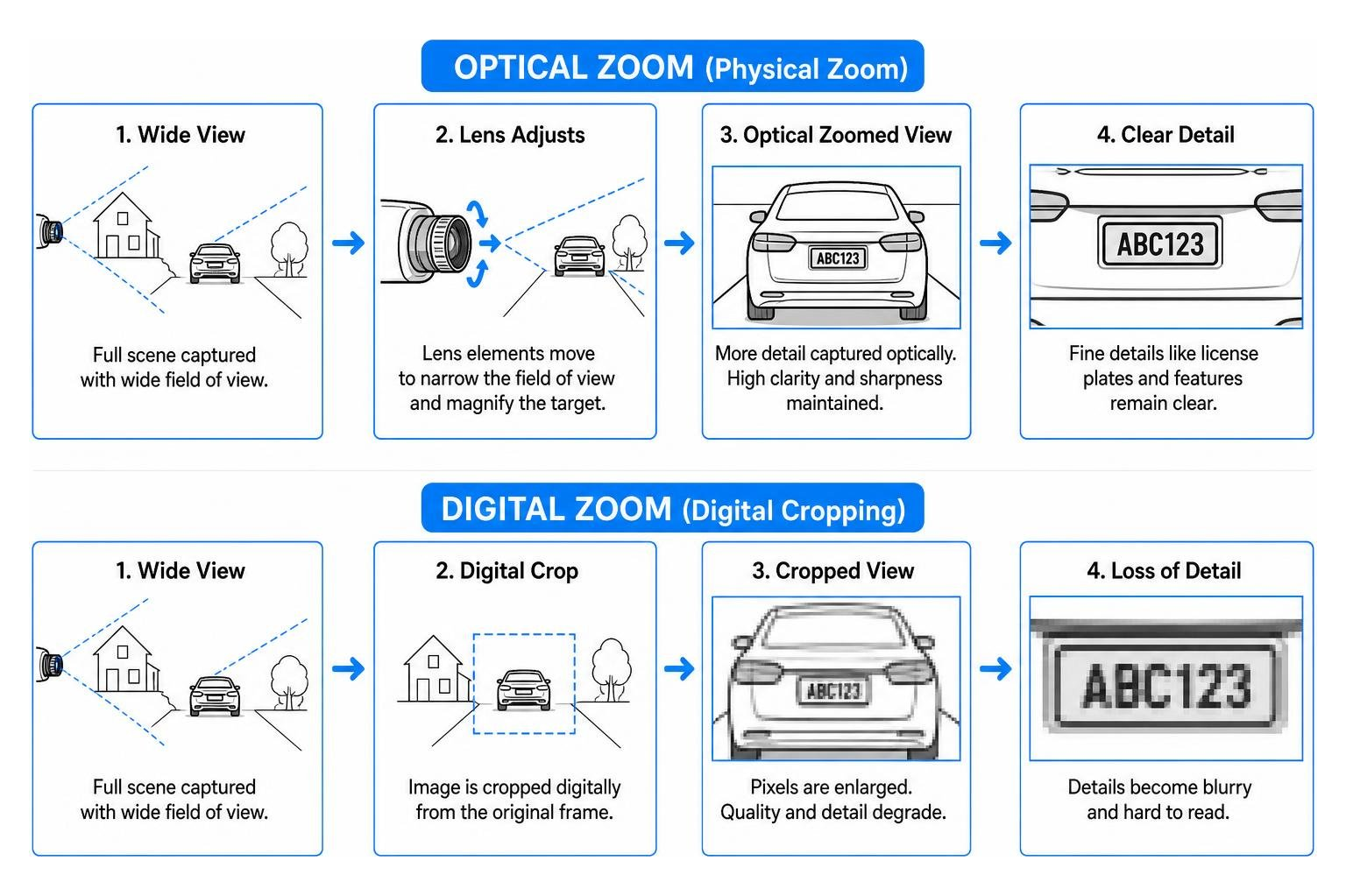
This is where motorized optical zoom lenses (such as 2.8mm–12mm varifocal optics) change the equation. Instead of using software to crop into an image, motorized lenses physically shift glass elements to narrow the field of view, magnifying the target optically.
- Fixed-Lens Wide Cameras: Best for broad contextual awareness (110° to 180° field of view) within 30 to 50 feet.
- Motorized Varifocal Optics: Allow precise focal length tuning during installation to lock onto gates or choke points up to 150 feet away without losing pixel density.
- PTZ (Pan-Tilt-Zoom) Auto-Tracking: Actively rotates and zooms its optical lens to follow moving subjects across expansive yards while maintaining high-resolution framing.
Key Features Defining the Best Quality Security Cameras in 2026
Modern security architecture has evolved from passive video recording into active, automated perimeter intelligence. The top surveillance systems in 2026 rely on local, edge-based artificial intelligence to process visual streams instantly, distinguishing between environmental noise and genuine security risks. If you are comparing exterior protection options, you can read our review of the Top Expert Recommended Outdoor Cameras for 2026.
Modern facial recognition algorithms consistently achieve accuracy rates over 99 percent, rivaling biometric fingerprint scanners for access verification. By shifting this computation directly onto the camera hardware or a local on-premises recorder, response times drop to milliseconds while preserving total data privacy.
AI Motion Detection and Intelligent Perimeter Protection
Legacy motion sensors rely on basic pixel-change detection, which means a passing cloud, a swaying tree branch, or a moth fluttering in front of the lens triggers a false alert. True high-performance cameras replace this with multi-layered detection technology:
- Radar + PIR Fusion: Combining millimeter-wave radar detection with passive infrared thermal sensors ensures that objects are measured by physical mass and velocity before waking the imaging subsystem.
- Digital Tripwires and Intrusion Boundaries: Property owners can draw virtual perimeter lines across driveways, property borders, or pool gates. AI algorithms analyze directionality, alerting you only when a person or vehicle crosses inward.
- Cross-Camera Target Tracking: Advanced multi-camera systems synchronize over local networks. When an individual walks past a front gate camera, adjacent perimeter cameras automatically pick up the target, ensuring uninterrupted tracking without blind spots.
Active Deterrence Hardware for Intrusion Prevention
Capturing clear footage of a crime is helpful for insurance and police reports, but preventing a break-in entirely is the primary objective. Homes with visible cameras experience 60 percent fewer break-ins, and active deterrence hardware capitalizes on this psychological barrier.
When an unauthorized subject breaches a calibrated tripwire, active deterrence cameras immediately react:
- High-Intensity Strobe Lighting: Ultra-bright white spotlights or red-and-blue warning strobes illuminate the subject, removing the cover of darkness and forcing their gaze toward the camera for a clear facial capture.
- Audible Sirens and Custom Voice Prompts: Built-in speakers deliver piercing 105 dB sirens or automated vocal warnings (“Warning: You have entered a restricted perimeter”).
- Two-Way Audio Verification: Integrated noise-canceling microphones isolate human speech from wind noise up to 20 feet away, allowing homeowners or live monitoring agents to confront trespassers in real time.
Wired PoE vs. Wireless Architecture for Maximum Image Reliability
A 4K camera is only as good as the network backbone carrying its video stream. While completely wireless battery cameras offer quick installation, they operate under severe physical constraints. To conserve battery life and prevent overheating, wireless cameras rely on aggressive video compression, lower frame rates (often 15 fps), and wake-up latencies that can miss the first critical seconds of an event.
Power over Ethernet (PoE) runs standard Cat6 copper cabling directly to each camera location, delivering high-voltage DC power and high-speed data across a single line up to 328 feet (100 meters). This dedicated hardwired link eliminates Wi-Fi dead zones, prevents RF jamming attacks, and allows uninterrupted high-bitrate video transmission. If you are preparing to run infrastructure around your home, check out our guide on How to Handle Your Outdoor Security Camera Installation Like a Pro.
Networking and Storage Architecture for Best Quality Security Cameras

High-resolution surveillance produces substantial data volume. A four-camera 4K setup recording 24/7 generates hundreds of gigabytes per day. Relying on cloud storage for multiple 4K streams can saturate residential internet upload bandwidth, leading to dropped frames, network lag, and costly monthly cloud subscription fees.
A professional architecture routes all camera feeds into an on-premises Network Video Recorder (NVR) housed in a central equipment rack. By utilizing high-efficiency H.265+ video compression, video storage requirements drop by 70 to 80 percent compared to legacy codecs without degrading image sharpness.
Systems like the ANNKE H800X Advanced 4K 8 Channel 2 Bullet & 1 Turret Cameras PoE Security System- ANNKE Store leverage high-capacity surveillance-grade hard drives (expandable from 2TB up to 16TB). This setup provides weeks of continuous 24/7 video retention, absolute data ownership, and zero monthly fees.
Hybrid Deployments: Balancing Wired Perimeters and Wireless Convenience
While hardwired PoE represents the gold standard for external perimeter protection and primary access points, hybrid deployments can offer flexibility for finished interior spaces or detached structures where running Cat6 is structurally impractical.
For interior surveillance, privacy-focused wireless cameras equipped with motorized mechanical privacy shutters provide peace of mind, physically covering the lens when the system is disarmed. When wireless cameras are necessary for exterior detached areas (such as a garden shed or remote fence line), pairing high-efficiency solar harvesting panels with dual-band Wi-Fi 6 (802.11ax) transceivers ensures low latency and steady power without manual battery swaps.
Advanced Low-Light Performance and Night Vision Technologies
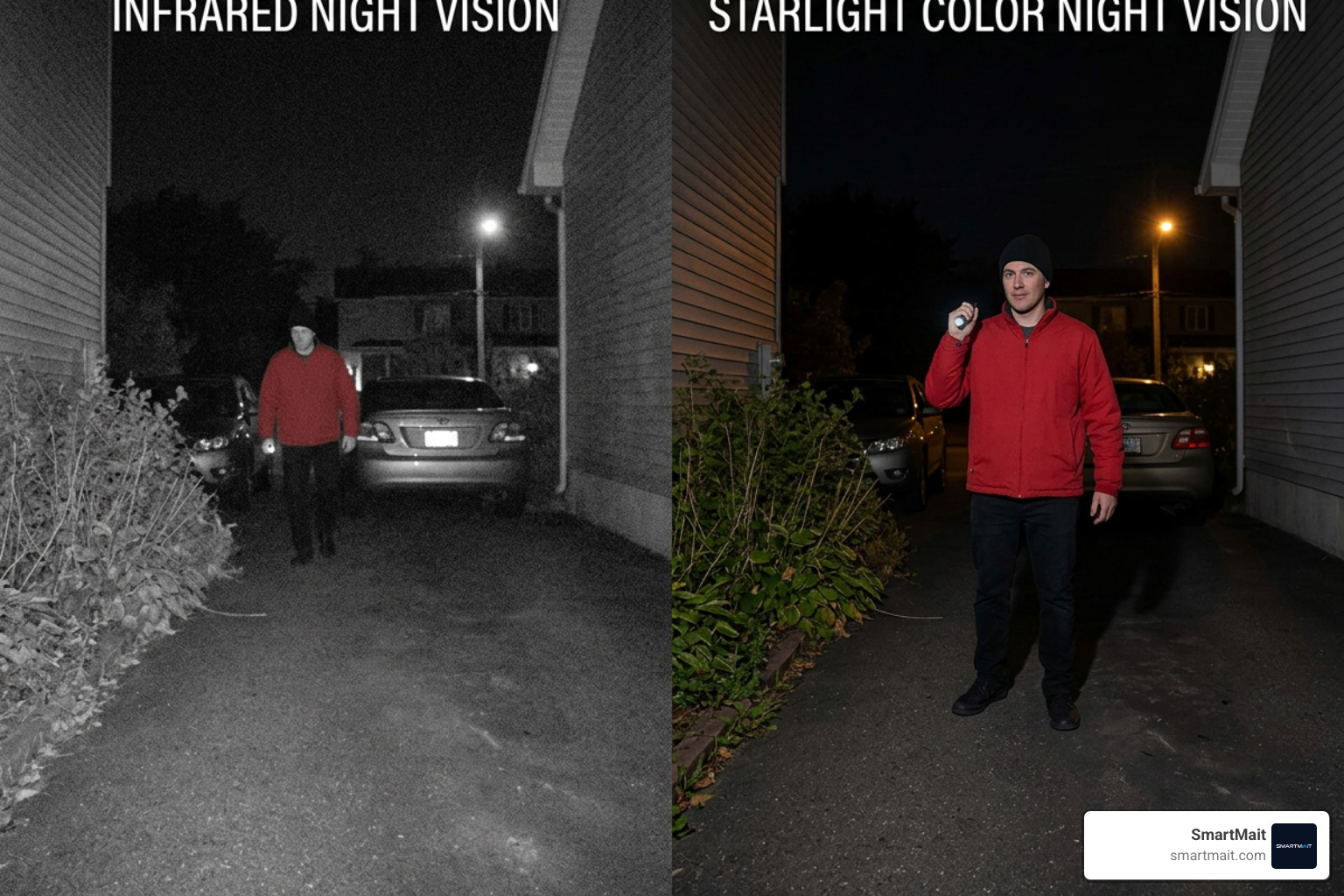
Criminal activity disproportionately occurs under the cover of darkness, making night imaging performance a crucial metric for evaluating surveillance cameras. Traditional security cameras rely on standard infrared (IR) night vision, which bathes the scene in invisible 850nm light. While IR provides basic monochrome visibility, it creates severe limitations: it washes out facial details at close range, flattens depth perception, and strips away critical forensic color evidence such as clothing tone and vehicle paint color.
Starlight Sensors and Large Apertures
To maintain full-color video in near-pitch darkness, high-end cameras combine ultra-sensitive image sensors with specialized wide-aperture lenses.
- Large Sensor Pixels: A 1/1.8-inch Back-Illuminated (BSI) CMOS sensor features individual pixels large enough to capture faint photons that standard sensors miss entirely.
- Fast Apertures (f/1.6 to f/1.0): An f/1.6 or wider lens gathers up to 400 percent more ambient light than a standard f/2.2 security lens, allowing the camera to generate vivid color images in lighting conditions as low as 0.003 Lux without relying on bright visible spotlights.
- Advanced Image Signal Processors (AI-ISP): Hardware-level 3D Digital Noise Reduction (3D-DNR) removes graininess from low-light video streams, ensuring that license plates and movement remain sharp rather than blurred by motion lag.
Weatherproofing and Build Quality Standards
Exterior surveillance equipment must withstand extreme seasonal weather swings—from sub-zero winter freezes and heavy snowdrifts to intense summer heat and driving rainstorms. Consumer-grade plastic enclosures degrade quickly under continuous UV exposure and moisture ingress.
Professional hardware utilizes heavy-duty aircraft-grade cast aluminum housings engineered to rigorous environmental specifications:
- IP67 Ingress Protection: Fully sealed against dust, sand, and moisture, capable of withstanding direct high-pressure water jets and temporary submersion.
- IK10 Vandal Resistance: Impact-rated polycarbonate domes and reinforced metal bodies resist physical tampering, blunt strikes, and thrown objects.
- Broad Operating Temperature Range: Internal thermal dissipation designs ensure continuous operation across extremes ranging from -22°F to 140°F (-30°C to 60°C) without internal lens fogging or hardware lockups.
Frequently Asked Questions About High-Resolution Security Systems
What is the difference between true 4K and upscaled 4K in security cameras?
True 4K cameras feature a native image sensor with at least 8.3 million physical photodiodes (3840 × 2160 pixels). When you pause and digitally zoom into true 4K footage, fine details such as license plate characters, facial features, and text remain sharp and legible. Upscaled 4K systems use a cheaper 4MP or 5MP sensor and employ software interpolation to artificially inflate the pixel count to 4K dimensions. While the file properties read 3840×2160, digitally cropping into the footage reveals blurry, pixelated artifacts that are rarely admissible as forensic evidence.
Do high-quality 4K security cameras require a monthly subscription?
No. While many mass-market consumer brands lock advanced features like person detection and video history behind recurring monthly subscriptions, professional-grade systems do not. By deploying an on-premises Network Video Recorder (NVR) with local hard drive storage or using cameras with high-capacity onboard microSD memory, you can record continuously 24/7, run edge-AI analytics locally, and access live remote viewing without paying ongoing monthly subscription fees.
How far can a 4K security camera clearly identify a human face?
Under optimal daytime conditions, a fixed wide-angle true 4K security camera can clearly identify an unfamiliar human face at a distance of 50 to 70 feet (compared to only 20 to 30 feet for standard 1080p cameras). If the camera is equipped with a motorized optical varifocal zoom lens, that facial identification range extends up to 150 feet. At night, facial identification range generally decreases by roughly 15 to 25 feet depending on ambient lighting levels and the camera’s low-light sensor capabilities.
Conclusion
Building a high-performance surveillance system requires balancing native sensor resolution, precision optical glass, resilient networking, and edge artificial intelligence. A visible network of true 4K cameras provides measurable crime deterrence, reducing break-in risks by 60 percent while ensuring that any captured footage serves as clear forensic evidence.
At SmartMait, we deliver architectural-grade smart home automation, security integration, and structured cabling across Southeast Michigan—including Birmingham, Bloomfield Hills, Rochester Hills, Troy, and Farmington Hills. Rather than installing fragmented consumer gadgets that rely on fragile Wi-Fi connections and ongoing subscriptions, we design unified systems built on commercial-grade PoE networks, local NVR storage, and reliable Z-Wave ecosystems.
Through our dedicated SmartService concierge program, we stay by your side long after installation with proactive maintenance, remote system health monitoring, and priority support. Connect with SmartMait today to schedule a comprehensive property security consultation and see every detail with total confidence.