Why Your Home Needs a 24/7 Alarm Company Watching Your Back
Why Every Second Counts: The Case for 24/7 Professional Monitoring
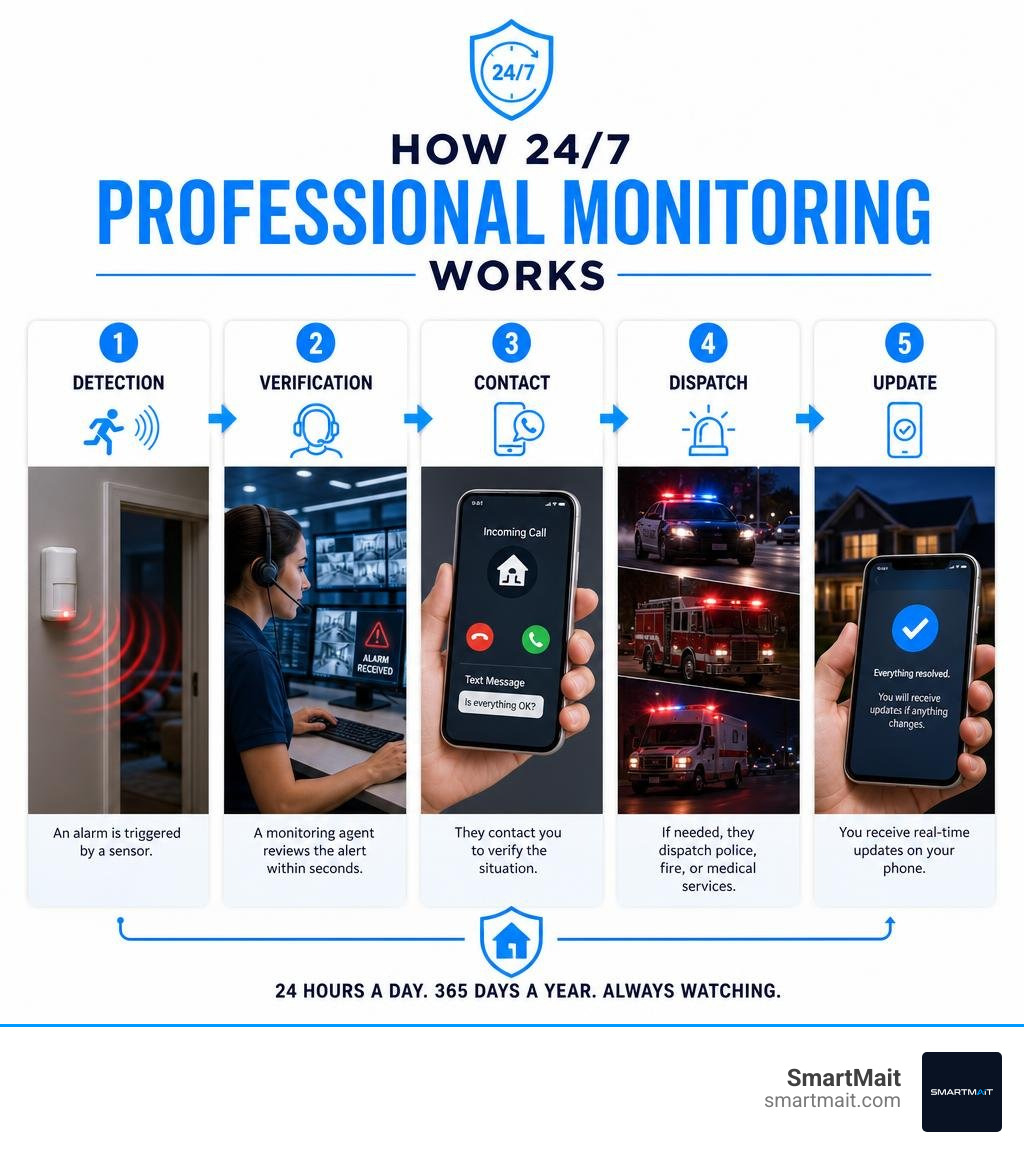
24/7 professional monitoring means trained security agents are watching over your home around the clock – and when something goes wrong, they act immediately, even if you’re asleep, traveling, or simply unreachable.
Here’s what it means in plain terms:
- An alarm triggers – a door sensor, motion detector, smoke alarm, or CO detector sends a signal
- A monitoring agent is notified – within seconds, a real person reviews the alert
- They contact you – via text or phone call to verify the situation
- If you don’t respond – or confirm a real emergency – they dispatch police, fire, or medical services on your behalf
- You get updated – in real time, through your phone
This happens 24 hours a day, 365 days a year – whether you’re home or not.
Think about what that actually means. A siren going off might scare away an opportunist. But it won’t call the fire department when your family is asleep and the smoke detector triggers at 2 a.m. It won’t dispatch police when you’re on vacation and someone trips your window sensor. It won’t do anything if your Wi-Fi goes down or your phone is on silent.
That’s the gap professional monitoring fills – and it’s a gap that matters more than most homeowners realize until it’s too late.
I’m Dominic Hesano, founder of SmartMait, and I’ve spent years designing and installing security systems across southeast Michigan homes – which means I’ve seen what separates a system that just looks like security from one that delivers 24/7 professional monitoring that actually performs when it counts. In the sections below, I’ll walk you through everything you need to know to make the right call for your home.
24 7 professional monitoring basics:
What is Professional Security Monitoring and How Does It Work?
To truly appreciate the value of a monitored home, it helps to understand what happens behind the scenes when a sensor is tripped. Professional security monitoring is not just a loud siren on the side of your house; it is an active, living network of technology and human expertise working in tandem to protect your property.
When we install a professional-grade security system, every sensor—whether it is a Z-Wave door contact, a glass break detector, or an environmental sensor—is linked directly to a central monitoring station. These stations are highly secure, redundant facilities staffed by certified security professionals 24 hours a day, 365 days a year. These facilities must meet strict industry standards, such as being Underwriters Laboratories (UL) listed and holding a “Five Diamond” designation from The Monitoring Association (TMA), which represents the gold standard in customer service and operational redundancy.
To learn more about who handles these critical signals, read our guide on Who is Listening A Guide to Alarm Central Monitoring.
Unlike basic DIY setups that simply send a push notification to your phone and hope you are awake to see it, a professionally monitored system acts independently. The moment an alarm is triggered, the control panel transmits an encrypted data packet via a secure cellular or dual-path network directly to the monitoring center. This ensures that even if an intruder attempts to destroy the control panel upon entry (a tactic known as a “crash and smash” attack), the initial signal has already been sent and cannot be canceled by physical destruction of the hardware.
For a deeper dive into how these systems operate around the clock, check out our comprehensive article on Everything You Need to Know About 24 Hour Home Security.

The Step-by-Step Emergency Response Process
What actually happens when an alarm is triggered? Let’s break down the precise step-by-step sequence that occurs in real time:
- Detection (0 to 2 Seconds): A sensor is breached (e.g., a window is opened while the system is armed). The Z-Wave mesh network immediately routes the signal to the main control panel, which transmits the alarm to the central monitoring station.
- Signal Verification (2 to 10 Seconds): The central station receives the signal. Advanced software instantly routes the alert to an available, certified operator who reviews the specific sensor data (e.g., “Living Room Motion” or “Basement Flood”).
- Homeowner Contact (10 to 30 Seconds): The operator initiates a verification protocol. This typically involves sending an instant text alert via a secure messaging platform or calling the primary contacts on file. This step is crucial for filtering out false alarms caused by a family member entering the wrong passcode.
- Emergency Dispatch (30 to 60 Seconds): If the homeowner confirms the emergency, or if the operator cannot reach anyone on the contact list after multiple attempts, the operator immediately contacts local emergency services.
- ASAP-to-PSAP Routing (Immediate): High-end systems utilize Automated Secure Alarm Protocol (ASAP) to Public Safety Answering Point (PSAP) technology. This direct digital link bypasses traditional voice-call queues, sending critical data directly to the local police or fire dispatch computer screens, shaving minutes off first responder arrival times.
How Video Verification Speeds Up First Responder Times
One of the most significant advancements in modern home security is video verification. In many municipalities across Oakland, Macomb, and Wayne counties, local law enforcement agencies face a high volume of false alarms. Because of this, unverified alarms are often given a lower priority dispatch status.
Video verification changes the game entirely. When an alarm is triggered, the system temporarily links live outdoor camera feeds or recorded event clips to the central monitoring agent. This data is handled through a secure “data lockbox” to protect your privacy, ensuring agents can only access the cameras during an active alarm event.
When an agent can look at a feed and tell the police dispatcher, “I have visual confirmation of an active intruder on the property,” the call is upgraded from an unverified alarm to a verified crime in progress. This priority dispatch classification can reduce police response times from 30 minutes or more down to just a few minutes, drastically increasing the likelihood of preventing property damage or apprehending suspects.
To explore professional-grade options in our region, homeowners should look for systems that integrate seamlessly with local emergency dispatch protocols and meet the highest national standards for response reliability.
Why 24 7 Professional Monitoring is Superior to Self-Monitoring
Many homeowners wonder if they can save a few dollars a month by choosing a self-monitored system. In a self-monitored setup, you are the monitoring agent. When a sensor triggers, your phone buzzes. If you are in a business meeting, on a flight over Lake Huron, sleeping with your phone on “Do Not Disturb,” or playing a round of golf in Birmingham, you will miss that notification.
Self-monitoring places an immense psychological and legal burden on the homeowner. If a fire breaks out while you are out of cell service, no one is coming to save your pets or your home. Furthermore, if you accidentally trigger your alarm and fail to disarm it quickly, you have no professional buffer to cancel the dispatch, which can result in steep municipal false alarm fines.
Here is a direct comparison of how these two approaches stack up:
| Feature | Self-Monitoring | 24/7 Professional Monitoring |
|---|---|---|
| Emergency Dispatch | You must call 911 yourself (and explain the situation) | Automatic dispatch by certified operators |
| Response Reliability | Dependent on your phone’s signal, battery, and status | 100% uptime with redundant power and cellular backups |
| Environmental Protection | App alerts only; no automatic fire department routing | Automated dispatch for smoke, heat, flood, and carbon monoxide |
| False Alarm Management | High risk of municipal fines due to delayed cancellation | Professional verification via text or call before dispatch |
| Insurance Discounts | Generally ineligible for premium reductions | Up to 20% discount on homeowner’s insurance |
| System Health Monitoring | Self-managed; easy to miss low battery or sensor failures | Continuous supervision with automated service alerts |
Choosing between these paths is a critical decision. To understand the differences in installation and long-term management, read our Professional Alarm Installation vs DIY What You Need to Know guide.
For those looking to balance high-quality protection with smart financial decisions, we have also compiled a guide on How to Get Professional Security Monitoring on a Budget.
The Core Benefits of Round-the-Clock Security
The primary benefit of 24/7 professional monitoring is peace of mind. Knowing that a dedicated team is watching your back allows you to enjoy your life, whether you are relaxing at home with your family or traveling halfway across the world.
Beyond the obvious safety advantages, a professionally monitored system offers tangible financial benefits. Most premier home insurance companies offer up to a 20% discount on annual premiums for properties equipped with a certified, professionally monitored security system that includes both intrusion and environmental protection. Over time, these savings can offset a significant portion of your monitoring costs.
To learn more about selecting the right services for your home, explore our article on the Best Alarm and Monitoring Services to Keep Intruders at Bay.

How 24 7 Professional Monitoring Handles Power and Wi-Fi Outages
A common concern for homeowners in Southeast Michigan—where summer storms and winter ice can easily knock out power lines—is what happens to their security system during an outage.
A professional-grade system is built with physical and digital redundancies to handle these exact scenarios:
- Battery Backup: The main control panel and all Z-Wave sensors feature dedicated backup batteries. In a power outage, the main panel will run seamlessly on battery backup for at least 24 hours.
- Cellular Redundancy: If your home Wi-Fi goes down or physical internet lines are cut by an intruder, the system automatically switches to an internal LTE cellular communicator (operating on secure AT&T or Verizon networks) to transmit alarm signals.
- Local Storage Backup: Advanced security cameras continue to record and store footage locally during an internet outage, uploading the clips to the cloud once connectivity is restored.
- Dual-Path Communication: By combining high-speed broadband with cellular backup, your system maintains an uninterrupted connection to the monitoring center.
To keep your system running at peak performance through every season, read our guide on how to Keep Your Alarm Alert with Professional Servicing.
Protection Against Fire, Flood, and Carbon Monoxide
While most people associate home security with preventing break-ins, environmental threats are often far more destructive. A pipe burst in a multi-story home in Troy or Rochester Hills can cause hundreds of thousands of dollars in water damage in a matter of hours. A silent carbon monoxide leak can be fatal before anyone realizes there is a problem.
By integrating environmental sensors into your Z-Wave ecosystem, your 24/7 professional monitoring plan covers:
- Smoke and Heat Detection: Monitored smoke detectors trigger an immediate fire department dispatch, even if you are away and unable to respond.
- Carbon Monoxide Monitoring: Protects your family from the “silent killer” by alerting the monitoring center the moment CO levels rise.
- Water Leak Sensors: Placed near water heaters, sump pumps, and washing machines to catch leaks before they turn into catastrophic floods.
- Freeze Sensors: Alerts you if your home’s temperature drops below a safe threshold, preventing frozen and burst pipes during brutal Michigan winters.
For local environmental issues or municipal concerns, residents can also reference the 24-Hour Environmental Hotline for Wayne County.
Navigating Contracts, Permits, and Costs
Selecting the Best 24 7 Professional Monitoring Plan for Your Home
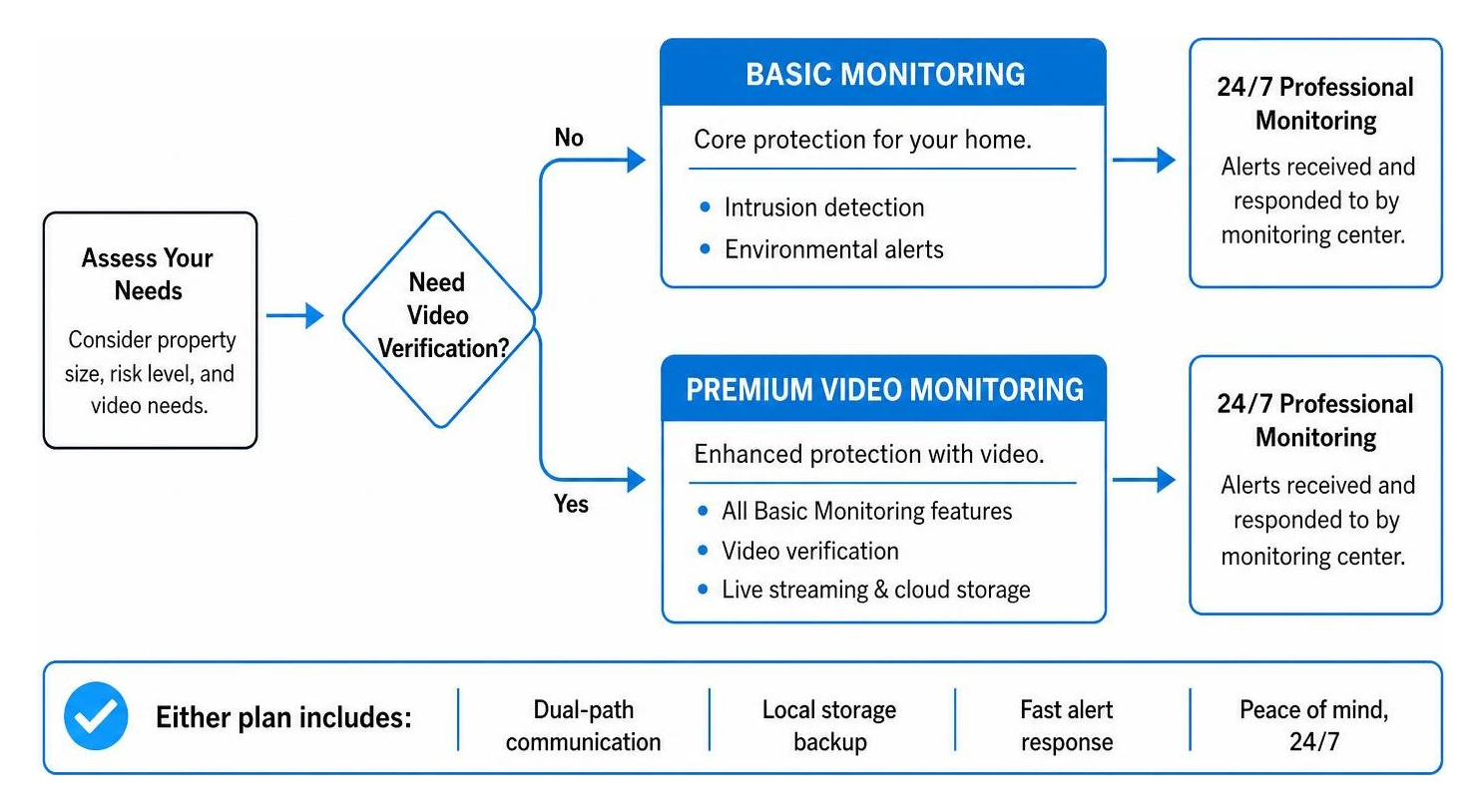
When choosing a monitoring plan, it is important to match the level of service to your lifestyle and property size.
- Basic Monitoring: Covers standard intrusion detection (door/window sensors, motion detectors) and basic environmental alerts. This is an excellent, cost-effective option for smaller properties or those focused purely on core security.
- Premium Video Monitoring: Adds video verification, real-time live streaming, and cloud storage for security cameras. This plan is highly recommended for larger estates in Bloomfield Hills or Birmingham, where visual confirmation of threats is essential for rapid police response.
- Smart Home Automation Integration: Unifies your security system with Z-Wave smart locks, lighting controls, and climate systems, allowing you to arm your system, lock the doors, and dim the lights with a single command.
To learn more about tailoring your monitoring plan to your budget, check out our guide on How to Get Professional Security Monitoring on a Budget.
Understanding Alarm Permits and Local Regulations
Before activating your 24/7 professional monitoring service, it is critical to understand local municipal regulations. Many cities and townships across Oakland, Macomb, and Wayne counties require homeowners to register their alarm systems and obtain an official alarm permit.
For example, municipalities like Bloomfield Hills, Birmingham, and Troy have specific ordinances regarding monitored alarms. Operating a system without a permit can result in municipal fines, and in some jurisdictions, police dispatchers may refuse to respond to an unpermitted alarm unless it is physically verified by a neighbor or guard.
To ensure your system is fully compliant with local laws, consult with a professional who understands regional guidelines and municipal permit requirements. You can also check out local services such as the 24-Hour Environmental Hotline for Wayne County to stay informed about regional safety and environmental guidelines.
Frequently Asked Questions About Alarm Monitoring
Can monitoring agents see my camera feeds at all times?
No. Your privacy is protected by strict encryption protocols and user-defined access controls. Monitoring agents cannot access your live camera feeds or stored video clips under normal circumstances. Agents are only granted temporary, secure access to your camera feeds during an active alarm event, and only if you have explicitly opted into video verification. Every single instance of agent access is logged in an unalterable audit trail for your security.
Do I need a long-term contract for professional monitoring?
While some traditional security companies require 36-month or 60-month monitoring agreements, modern systems offer incredible contract flexibility. Depending on your installation preferences and whether you choose to finance your hardware, you can opt for convenient month-to-month monitoring plans that allow you to pause or cancel service without penalty.
What is the typical response time for a monitored alarm?
The industry standard response time for high-quality central monitoring stations is under 30 seconds. By utilizing advanced text-based verification systems and ASAP-to-PSAP routing, premier monitoring networks can reduce response times to as little as 10 seconds from the moment a sensor is triggered to the moment dispatch protocols are initiated.
Conclusion: The SmartMait Difference
When it comes to protecting your home, your family, and your peace of mind, a one-size-fits-all, DIY approach simply isn’t enough. Standard consumer-grade Wi-Fi setups are prone to interference, dropouts, and missed notifications.
At SmartMait, we do things differently. We design and install custom, architect-grade security systems built on the Z-Wave ecosystem—the professional standard for reliable, interference-resistant smart home communication. We serve affluent suburbs across Oakland, Macomb, and Wayne counties, including Bloomfield Hills, Troy, Rochester Hills, Farmington Hills, and Birmingham.
What truly sets us apart is what happens after the installation. While most integrators install your system and disappear, our exclusive SmartService concierge maintenance program ensures an ongoing relationship. We are always here to maintain, update, and optimize your system, ensuring your home remains completely secure year after year.
Ready to experience the ultimate in home security and automation? Secure your home with SmartMait today.