Is an ADT Home Monitoring System Right for Your Castle?
Is a Home Monitoring System Worth It? Here’s What You Need to Know First
A home monitoring system is a professionally monitored security platform that connects sensors, cameras, and smart devices in your home to a monitoring network staffed around the clock.
Quick answer for busy readers:
| Question | Short Answer |
|---|---|
| What is it? | A 24/7 professionally monitored home security system |
| How does it work? | Sensors trigger alerts routed to monitoring agents who contact emergency responders when needed |
| Main options | Professional installation, self-setup, or custom smart home integration |
| Monthly cost | Varies by monitoring level, equipment, and service model |
| Equipment cost | Depends on the size of the home, number of entry points, cameras, and automation devices |
| Contract required? | Some providers require contracts; custom integrators may offer different service structures |
| Smart home support | Yes, depending on the platform and integration design |
| Backup during outages? | Many monitored systems support cellular backup and battery backup |
Professional monitoring can be a powerful layer of protection, but scale alone does not automatically mean a system is the right fit for your home.
If you own a high-value property in a community like Bloomfield Hills or Rochester Hills, the question is not just whether the system works. It is whether the system is sophisticated enough, reliable enough, and integrated enough to match how your life actually runs.
This guide breaks down everything: how monitoring infrastructure works, what equipment you may need, what costs to expect, and where traditional systems excel versus where a more custom approach may serve you better.
Home monitoring system terms to learn:
Evaluating a Home Monitoring System: How It Works
At its core, a home monitoring system relies on a simple loop: detection, verification, and dispatch. When a window sensor, motion detector, glass break sensor, or environmental sensor is triggered, it transmits a signal to your central base station or control panel. The system then sends an alert through the available communication path to the monitoring platform.
What happens next is what separates professional monitoring from self-monitored setups where you simply get a smartphone notification. To get a deeper sense of how professional-grade systems stack up, check out our guide on top-rated home security systems for ultimate peace of mind.
The Infrastructure Behind 24/7 Professional Monitoring
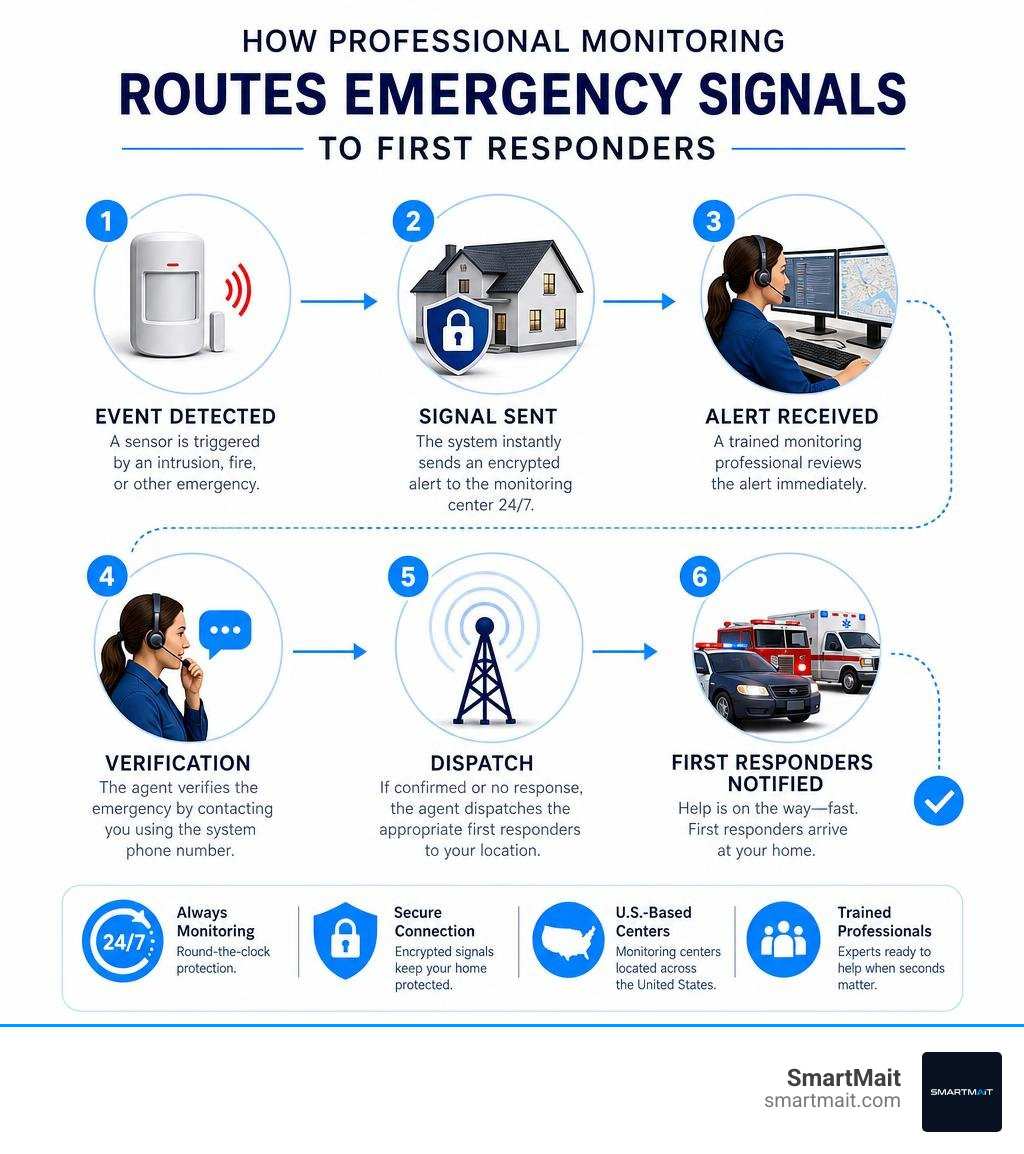
Professional monitoring is designed around redundancy, speed, and human review. When an alarm triggers, the process usually follows a sequence like this:
- Signal Received: The alarm event is sent from the home system to a monitoring platform.
- Verification: The system may use app alerts, text notifications, phone calls, sensor data, or camera clips to help determine whether the alarm is likely to be real.
- Agent Action: If the alarm is not canceled or if an emergency is confirmed, a trained monitoring agent follows the proper dispatch protocol.
- First Responder Dispatch: Emergency services are contacted when the event requires police, fire, or medical response.
For homeowners with complex properties, the bigger issue is often not the monitoring center itself. It is whether the system was designed correctly in the first place. Sensor placement, camera coverage, network reliability, access control, lighting automation, and whole-home connectivity all affect real-world performance.
For those looking for local, customized alternatives in Southeast Michigan, you can discover premium smart home integration services designed to bypass mass-market limitations.
How the System Handles Power Outages and Wi-Fi Failures
One of the most common worries for homeowners in areas prone to summer storms or winter ice, like West Bloomfield or Clarkston, is what happens when the power goes out.
Many modern monitored systems are built with outage protection:
- Battery Backup: If your home loses electrical power, the base station or control panel can continue operating for a limited period using backup battery power.
- Cellular Backup: If your home Wi-Fi or broadband connection goes down, supported systems can switch to an integrated cellular connection so alarm signals can still reach the monitoring platform.
- Network Planning: In larger homes, structured Wi-Fi and properly designed networking can improve camera reliability, app responsiveness, and smart device communication.
For general emergency preparedness, the federal government also publishes practical guidance on power outages.
Equipment, Packages, and Smart Home Integrations
To build an effective shield around your home, you need the right hardware. A strong system usually combines entry sensors, motion detection, environmental monitoring, cameras, access control, and the network infrastructure required to keep everything connected.

Equipment Packages for Your Home Monitoring System
Most home security systems can be grouped into three broad tiers. The right fit depends on your property layout, risk profile, smart home goals, and whether you want a basic alarm or a fully integrated whole-home platform.
| Feature/Equipment | Core Security | Smart Automation | Video + Automation |
|---|---|---|---|
| Professional Monitoring | Optional or included, depending on provider | Optional or included, depending on provider | Optional or included, depending on provider |
| Intrusion Monitoring | Yes | Yes | Yes |
| Cellular Backup | Often available | Often available | Often available |
| Smart Home Automation | Limited | Yes | Yes |
| Live Video & Storage | Limited or optional | Optional | Yes |
| Smart Camera Support | Optional | Optional | Yes |
| Integrated Access Control | Optional | Yes | Yes |
- Door/Window Sensors: These low-profile sensors protect your primary entry points. Placing them on all first-floor windows and external doors is a security best practice.
- Motion Sensors: These help detect movement inside the home and can often be configured to reduce false alarms from pets.
- Glass Break Sensors: These are ideal for rooms with large sliding glass doors, window walls, or multiple exposed panes.
- Environmental Sensors: Smoke, carbon monoxide, water, and temperature sensors alert you to internal hazards before they cause catastrophic damage.
- Smart Locks and Access Control: Integrated locks, keypads, and access schedules can help manage family members, guests, housekeepers, dog walkers, and small business staff.
If you are planning to build out a comprehensive camera network, read our guide on the ultimate guide to building a home security camera setup to understand how to optimize camera placement.
Smart Automation and Controlled Access
For modern homes, security must blend seamlessly with daily life. The right mobile app or control interface should allow you to arm or disarm your system, view live camera feeds, lock or unlock doors, adjust lighting scenes, and manage compatible smart home devices.
This is where professional Z-Wave ecosystem integration matters. Z-Wave is widely used in professional smart home environments because it is designed for reliable, low-power device communication without relying solely on crowded Wi-Fi channels.
For example, a homeowner in Birmingham might want a dog walker to receive secure access only between 4:00 PM and 5:00 PM. A properly integrated system can unlock the appropriate door, adjust the alarm state, notify the homeowner, and then re-secure the property after the visit.
To explore more ways to keep your home’s exterior secure, read our guide on how to secure your perimeter with top alarm systems and monitoring
Understanding the Costs, Contracts, and Installation Options
When choosing a home monitoring system, you must decide between several different paths: self-setup, standard professional installation, or a custom-designed smart home integration.

Professional vs. Custom Setup for Your Home Monitoring System
A self-setup system can work for smaller properties or straightforward needs. However, many homeowners choose professional installation because proper placement, wiring, network design, and software configuration can make a major difference in daily reliability.
- Standard Professional Installation: A technician installs the selected hardware, mounts sensors, configures the app, and confirms that the system communicates correctly.
- Custom Smart Home Integration: A specialist designs the security system as part of the entire home technology environment. This may include smart access control, whole-home audio, custom mood lighting, enterprise-grade structured Wi-Fi, surveillance cameras, and automation scenes that work together instead of operating as separate islands.
Residents in Oakland County can discover premium smart home integration services that offer this level of unified, luxury automation.
For a detailed breakdown of monthly subscription costs, read monthly alarm system costs that won’t break the bank.
Contract Terms, Guarantees, and Cancellation Policies
Before committing to any monitored system, read the agreement carefully. Contract terms can vary significantly by provider, equipment financing, promotional pricing, monitoring level, and installation model.
Key items to review include:
- Contract Length: Some providers require multi-year monitoring agreements, while others offer more flexible arrangements.
- Early Termination Fees: If you cancel early, you may owe a portion of the remaining balance, especially if equipment was financed.
- Equipment Ownership: Confirm whether you own the equipment outright or whether it is tied to an active service agreement.
- Service and Maintenance: Ask who handles updates, troubleshooting, network changes, and device replacements after installation.
The maintenance question is especially important for larger homes. A system can be well designed on day one but gradually become unreliable if nobody manages firmware updates, network changes, device failures, or new access requirements.
Pros and Cons of Professional Home Security
Before signing a long-term agreement or investing in a custom system, it is helpful to weigh the advantages and drawbacks of professional home security.
Pros:
- 24/7 Oversight: Professional monitoring adds a human response layer when you are asleep, traveling, in a meeting, or away from your phone.
- Faster Emergency Escalation: Verified alarms and clear dispatch protocols can help emergency responders receive better information.
- Outage Resilience: Systems with battery backup and cellular backup can continue sending alarm signals even when power or internet service is disrupted.
- Smart Home Integration: A well-designed system can connect security, access control, lighting, cameras, audio/visual systems, and networking into a single experience.
- Support for Larger Properties: Custom design is especially valuable for estates, new construction, detached garages, guest houses, and light commercial spaces.
Cons:
- Ongoing Monthly Cost: Professional monitoring and maintenance add recurring expense.
- Possible Contract Lock-In: Some providers require long-term agreements or charge early termination fees.
- Equipment Complexity: The more devices you add, the more important professional configuration and support become.
- Limited Customization in Basic Packages: Mass-market systems are built for broad appeal. They often lack the specialized integration required for luxury homes with complex networking, lighting, and dedicated access control systems.
For alternative ways to secure your home, you can review our list of the best alarm and monitoring services to keep intruders at bay.
Frequently Asked Questions About Home Security
Can I use my security system without a monthly subscription?
In some cases, yes. A self-monitored system may still provide local alarms and app alerts without professional dispatch. However, if you cancel professional monitoring, you may lose emergency response coordination, cellular backup, cloud video features, remote support, or other services depending on the equipment and provider.
For high-value homes, self-monitoring is usually a compromise. If your phone is off, out of service, or ignored during a meeting or overnight, there may be no one actively responding to the alarm.
How does video verification reduce false alarms?
When a camera-equipped system triggers an alarm, a verified video clip or live view can help determine whether an actual intruder, fire, package theft, or other event is occurring. Better verification can reduce false dispatches and provide emergency responders with more useful information.
False alarms are not just inconvenient. In many communities, repeated false dispatches can lead to fines or slower response priority. Proper system design, sensor placement, and user training all help reduce those events.
What happens to my security system during an internet outage?
If the system includes cellular backup, alarm signals can still reach the monitoring platform when home internet service is down. If the system also includes battery backup, the control panel or base station can continue operating for a limited period during a power outage.
Heavy bandwidth tasks, such as live camera streaming, may be limited until Wi-Fi or broadband service is restored. That is why networking, cellular backup, and power protection should be planned together rather than treated as separate pieces.
Conclusion: Tailoring Security to Your Castle
A professionally monitored home security system can offer meaningful peace of mind when it is designed, installed, and maintained correctly. For many homeowners, it is a reliable, set-it-and-forget-it shield.
However, if you reside in the affluent suburbs of Southeast Michigan, such as Bloomfield Hills, Troy, Rochester Hills, Farmington Hills, or Birmingham, you may find that a standard, mass-market security package feels like a compromise.
At SmartMait, we believe your home security should not exist in a silo. We design, install, and maintain fully integrated smart home ecosystems across Oakland, Macomb, and Wayne counties. By utilizing the professional, interference-resistant Z-Wave ecosystem standard, we unify your security, smart access control, high-end audio/visual systems, structured enterprise-grade Wi-Fi, and custom mood lighting into a single, cohesive experience.
What truly sets us apart is what happens after the installation. Through our exclusive SmartService concierge maintenance program, we build ongoing relationships with our clients. While many installers disappear the moment the hardware is mounted, we stay to manage updates, troubleshoot network changes, and ensure your home runs flawlessly year after year.
Ready to elevate your home security into a unified, architect-grade smart home system? Discover premium smart home integration services with SmartMait today, and let’s build something extraordinary together.