Outdoor Motion Sensors That Won’t Bark at Every Squirrel
Outdoor Motion Sensors That Won’t Bark at Every Squirrel
Why the Best Outdoor Motion Sensor Light with Alarm Is a Smarter Security Choice
The best outdoor motion sensor light with alarm does two things at once: it floods your property with light and sounds an alert the moment someone enters your space. Here’s a quick look at the top options to consider:
Top Outdoor Motion Sensor Lights with Alarm:
| Product Type | Best For | Siren Volume | Brightness | Power Source |
|---|---|---|---|---|
| Solar siren floodlight (e.g., Tuya-style) | Wire-free installs | Up to 100dB | 1,000-3,000 lumens | Solar + battery |
| Hardwired dual-head floodlight | Max brightness & reliability | External siren add-on | 2,000-7,000 lumens | Hardwired |
| Battery-powered PIR alarm light | Flexible placement | 80-100dB | 400-1,800 lumens | Battery |
| Smart floodlight camera with alert | App monitoring + light | Push notification | 2,000+ lumens | Hardwired/Wi-Fi |
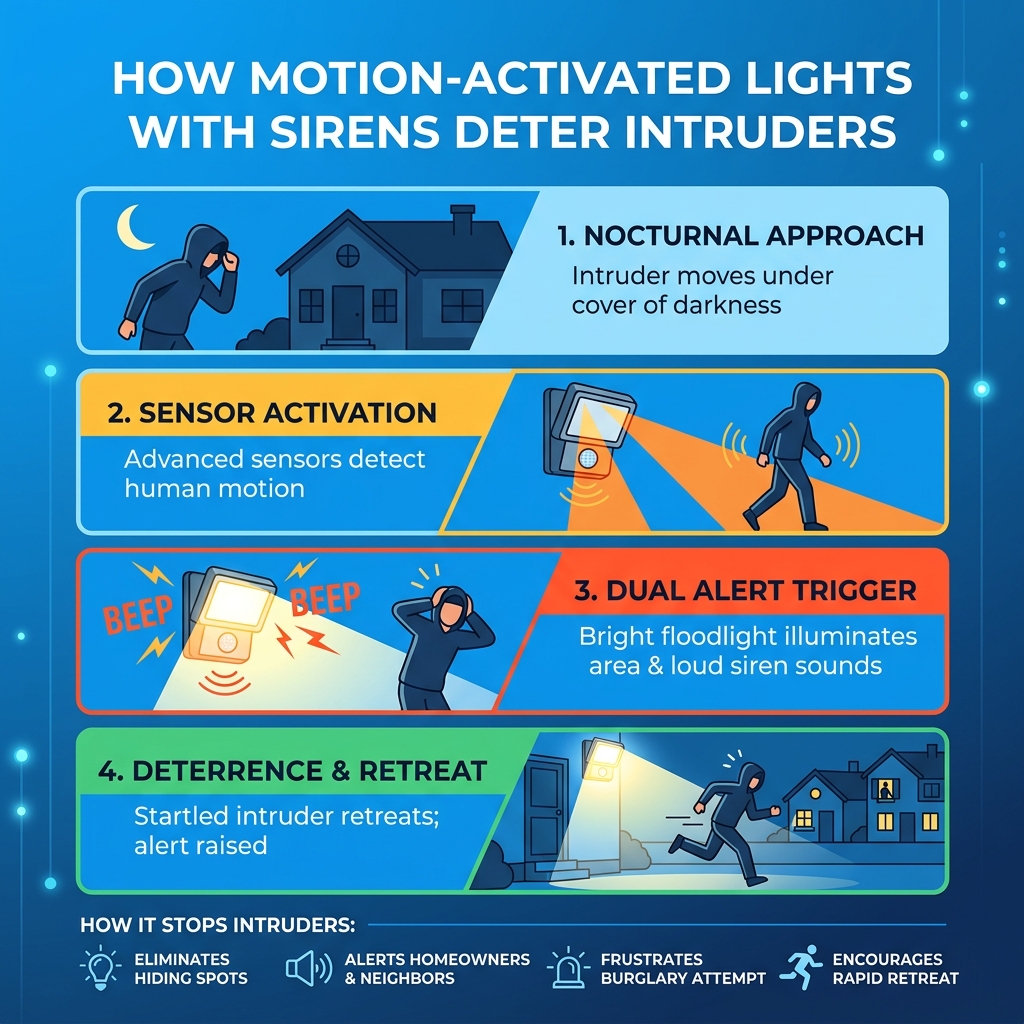
Standard motion sensor lights turn on when they detect movement. That’s useful. But a light that also triggers a loud siren? That stops an intruder in their tracks before they even reach your door.
The problem most homeowners run into isn’t finding a motion light — it’s finding one that won’t blast an alarm every time a squirrel runs across the yard. False alarms drain batteries, annoy neighbors, and train you to ignore your own security system.
That’s the balance this guide is built around: strong detection, smart filtering, and real deterrence — without the drama of constant false triggers.
Key Features of the Best Outdoor Motion Sensor Light with Alarm
When we look for the best outdoor motion sensor light with alarm, we aren’t just looking for a bright bulb. We are looking for a cohesive security tool. In places like Oakland County or Troy, Michigan, where we deal with everything from heavy snow to inquisitive deer, the hardware needs to be robust.
PIR vs. Microwave Sensors
Most of the lights we recommend use Passive Infrared (PIR) technology. These sensors detect heat signatures. A human walking up your driveway has a much larger heat signature than a blowing leaf or a stray cat. Some high-end models use microwave sensors, which send out pulses to measure distance. While microwave sensors can “see” through thin walls or glass, they can sometimes be too sensitive for residential use in Michigan. For most homes in Bloomfield Hills or Farmington, a high-quality PIR sensor with adjustable sensitivity is the gold standard.
Lumens and Decibels
Brightness is measured in lumens. For a standard pathway, 700 to 1,300 lumens is usually enough to see where you’re going. However, for security, we often recommend “beasts” like the SANSI models that hit 7,000 lumens. That is bright enough to make an intruder feel like they’ve stepped onto a movie set.
The “alarm” part of the equation is measured in decibels (dB). A 100dB siren is roughly as loud as a jackhammer or a lawnmower. It’s designed to be uncomfortable. If you’re in a tighter neighborhood like Royal Oak or Ferndale, you might want a unit where you can adjust that volume or set it to a “chirp” instead of a full-blown scream for late-night triggers.
Weatherproofing and IP Ratings
Michigan weather is no joke. From the humid summers in Warren to the freezing slush in Rochester Hills, your gear needs an IP (Ingress Protection) rating. We look for at least IP65, which means the unit is dust-tight and can handle water jets (like a heavy rainstorm) from any direction.
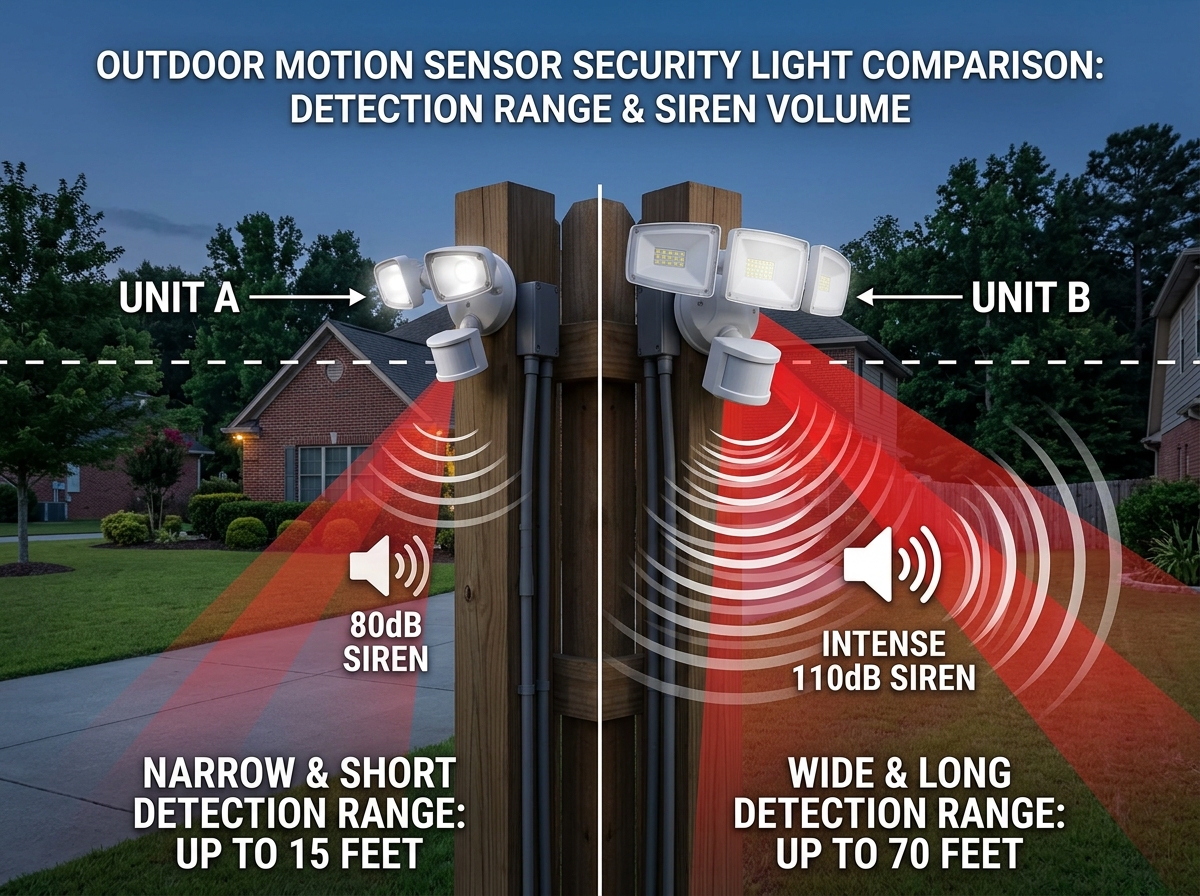
| Feature | Low-End Range | High-End/Pro Range |
|---|---|---|
| Detection Distance | 10 – 15 feet | 60 – 70 feet |
| Brightness | 200 – 800 Lumens | 3,000 – 7,000 Lumens |
| Siren Volume | 80 dB | 110 dB |
| Detection Angle | 120 Degrees | 240 – 270 Degrees |
Top-Rated Motion Security Options for Every Home
Finding the best outdoor motion sensor light with alarm means matching the technology to your specific property layout. A sprawling backyard in West Bloomfield needs a different setup than a compact porch in Oak Park.
Choosing the Best Outdoor Motion Sensor Light with Alarm for Solar Power
Solar power has come a long way. Models like the Luna Pro-3000 offer a staggering 3,000 lumens of light without a single wire. These are perfect for detached garages or sheds in Walled Lake where running electrical conduit would be a nightmare.
- The “Brainy” Solar Option: Some Tuya-compatible solar sirens (like the MOES model) offer 100dB alarms and smart app linkage. They use a high-efficiency solar panel to keep a 18650 rechargeable battery topped off.
- Dusk-to-Dawn Intelligence: We love lights that feature a “dim” mode at night that kicks into “full blast + siren” when motion is detected. This saves battery and provides consistent ambient lighting for your property.
- Capacity Matters: Look for units that can operate for 48-72 hours on a single charge. This ensures your security doesn’t take a night off just because it was a cloudy day in Michigan.
Hardwired vs. Wireless: Finding the Best Outdoor Motion Sensor Light with Alarm for Your Property
If you have the option, hardwired is almost always the “best” for reliability. You never have to worry about a battery dying in the middle of a January cold snap in Commerce.
- The Heavy Hitters: The Leonlite LED Motion Sensor Floodlight is a favorite because of its massive detection range (up to 69 feet). While it doesn’t have a built-in “screamer” siren in the base model, it can be integrated into a smart home system to trigger an internal or external siren.
- The Integrated King: The Ring Floodlight Cam Wired Plus is often cited as the best outdoor motion sensor light with alarm because the siren is built directly into the unit and can be triggered automatically or manually via your phone. With 2,000 lumens and 1080p HD video, it’s a comprehensive security hub.
- Quick-Connect Systems: Brands like Enbrighten offer quick-connect wiring that makes swapping out an old, “dumb” light for a new security floodlight a 15-minute job.
Installation and False Alarm Prevention
We’ve all seen it: a neighbor’s light that flickers on and off all night because of a low-hanging tree branch. Proper installation is the difference between a helpful security tool and a neighborhood nuisance.
The 30-Degree Rule
Expert testers and pros like Hooman Shahidi suggest angling your light heads about 30 degrees downward. This focuses the light on the ground where the intruder is, rather than blinding your neighbors or wasting light into the night sky.
Sensitivity and Animal Masking
If you live in a wooded area like Bloomfield Township or Franklin, you’re going to have deer. Lots of them. The best outdoor motion sensor light with alarm options include “sensitivity knobs” or app settings to adjust the PIR sensor.
- Range Settings: Most quality units allow you to toggle between 10ft, 30ft, and 60ft detection.
- Pet-Friendly Modes: Some sensors (like those from Yale) have a “pet-friendly” physical mask or digital filter that ignores movement below a certain height or weight.
Strategic Placement
Mounting height is crucial. We recommend 8 to 10 feet off the ground. This is high enough to prevent someone from simply reaching up and unscrewing the bulb, but low enough that the PIR sensor can accurately track heat signatures. Focus on entry points: the garage door, the back deck, and any side gates.
For those looking to go beyond just lighting, integrating these sensors with Security Cameras allows you to verify why the alarm went off before you go running outside in your pajamas.
Smart Home Integration and the Z-Wave Advantage
This is where we at SmartMait really see the magic happen. A standalone light is good, but a “Smart” light integrated via Z-Wave is a game-changer for Michigan homeowners.
Why Z-Wave?
While Wi-Fi lights are popular, they can clog up your home network and often fail if the signal is weak near the exterior of your house. Z-Wave creates a “mesh” network. Every device (like a smart plug or another light) acts as a repeater. This is incredibly reliable for large homes in Rochester Hills or Birmingham.
Automated Scenes
Imagine this: Your outdoor motion sensor detects movement at 2:00 AM. Instead of just one light turning on, your Z-Wave system triggers:
- All outdoor floodlights to 100% brightness.
- The smart siren in your hallway to “chirp” to wake you up.
- The indoor “mood lighting” in your living room to turn on, making it look like someone is awake and moving inside.
- A real-time alert to your smartphone.
The Power of App Control
With systems like the Yale Home app or Philips Hue Bridge, you can customize your security on the fly. If you’re hosting a backyard BBQ in Livonia, you can “snooze” the alarm feature with one tap so your guests don’t set off the siren while playing cornhole.
Frequently Asked Questions
How do motion sensor lights with alarms differ from standard lights?
Standard motion lights only provide illumination. A “light with alarm” includes an audible component—either a high-decibel siren built into the fixture or the ability to trigger a separate alarm system. The goal of a standard light is visibility; the goal of an alarm light is active deterrence.
How reliable are sensors in preventing false alarms from animals?
It depends on the technology. PIR sensors are quite good at ignoring small animals, but a large buck in West Bloomfield might still trigger them. To prevent this, look for lights with “adjustable sensitivity” and “detection zones.” You can often “mask” certain areas (like a tree line) so the sensor ignores movement in that specific spot.
What is the typical battery life for wireless models?
For battery-only models (like Beams), you can expect 6 to 12 months of life based on 8-10 “activations” per night. For solar-hybrid models, the battery can last indefinitely as long as the solar panel receives a few hours of direct or indirect sunlight daily. In Michigan winters, you may need to occasionally wipe snow off the solar panel to keep it charging.
Conclusion
Securing your home shouldn’t be a DIY headache that results in a siren barking at every squirrel. By choosing the best outdoor motion sensor light with alarm for your specific needs—whether it’s a hardwired powerhouse for your driveway in Troy or a solar-powered unit for a shed in Clarkston—you’re adding a powerful layer of protection to your property.
At SmartMait, we specialize in making these technologies work together seamlessly. From Z-Wave integration to professional camera placement, we help Michigan residents create homes that are not just “bright,” but truly smart.
Ready to upgrade your home’s perimeter defense? Visit us at https://smartmait.com/ to see how we can help you build a comprehensive, integrated security system that gives you real peace of mind.