The Future is Hands-Free with Automatic Door Entry Systems
Why Automatic Door Entry Systems Are Replacing Traditional Entrances
Automatic door entry systems are electronically powered entrance solutions that open and close without physical contact, using sensors, access credentials, or activation devices to control who enters a space.
Quick answer — here’s what you need to know:
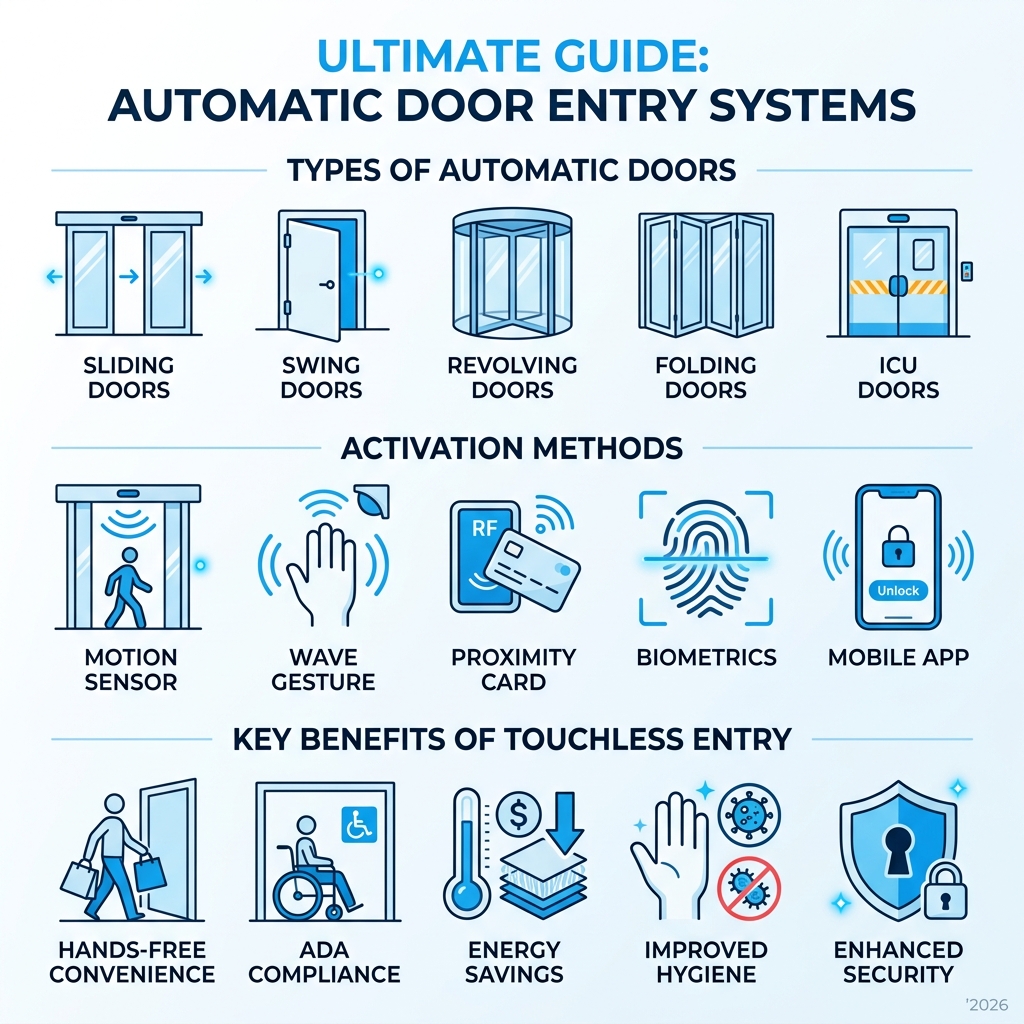
- Types available: Sliding, swing, revolving, folding, and ICU doors
- How they activate: Motion sensors, wave gestures, proximity cards, biometrics, or mobile apps
- Best for: Retail, healthcare, offices, airports, residential buildings, and more
- Key benefits: Hands-free convenience, ADA compliance, energy savings, improved hygiene, and enhanced security
- Integration: Works with access control systems, smart building tech, intercoms, and alarms
- Cost factors: Door type, operator system, installation complexity, and added security features
The way we enter buildings is changing fast. Door handles are one of the most frequently touched surfaces in any property — and that’s a problem. It’s no surprise that around 75% of managers and employees now rank health and safety as their top workplace priority.
At the same time, 98% of consumers say they prefer automatic doors over manual ones. That’s not just a preference — it’s a signal that hands-free access has become an expectation, not a luxury.
Whether you’re securing a small business, upgrading a commercial property, or future-proofing a smart home, the right automatic door entry system can do a lot more than just open and close. It can manage traffic, reduce energy costs, improve accessibility, and integrate with the rest of your security ecosystem.
This guide reviews the leading automatic door entry solutions on the market so you can find the right fit for your space and needs.
Basic automatic door entry systems glossary:
Understanding Automatic Door Entry Systems and How They Work
At their core, automatic door entry systems are a blend of mechanical engineering and smart electronics. But how do they actually “know” when to open? It isn’t magic; it’s a coordinated sequence of events managed by a microprocessor “brain.”
The process begins with an activation signal. This signal is typically triggered by motion sensors (using microwave or infrared technology) that detect an approaching person. Once the sensor trips, it sends a message to the door operator—the electromechanical drive unit mounted above the door. This operator contains a motor and a gearbox that physically move the door panels.
Safety is the highest priority in these systems. Modern doors use sophisticated signal processing and safety beams to ensure the door doesn’t close while someone is standing in the threshold. According to Scientific research on workplace safety, around 75% of managers and employees prioritize health and safety above all else. This is why high-quality systems include presence sensors that “scan” the door’s path, preventing contact with pedestrians.
For we who live and work in Michigan—from the busy corridors of Troy to the residential streets of Clarkston—reliability is key. Whether it’s a heavy-duty motor designed for 22-hour-a-day mass transit use or a quiet, low-energy operator for a local office, these systems are built to handle thousands of cycles with minimal downtime.

Core Types of Automatic Doors for Every Application
Choosing the right door isn’t just about aesthetics; it’s about matching the hardware to the environment. Different spaces in Wayne or Macomb County have different “traffic personalities.”
| Door Type | Best For | Key Benefit |
|---|---|---|
| Sliding Doors | Retail, Grocery, Airports | Efficient two-way traffic flow |
| Swing Doors | Corridors, ADA Entrances | Easy to retrofit on existing doors |
| Revolving Doors | Hotels, Large Offices | Maximum energy efficiency |
| Folding Doors | Narrow Hallways, Small Shops | Saves space in tight footprints |
| ICU Doors | Hospitals, Clinics | Hygiene and visibility |
Sliding and Telescoping Doors
The “original” automatic door is the slider. These are the workhorses of the industry. For spaces with limited side room, telescoping doors are a lifesaver. A standard sliding door requires a wide wall for the panels to slide over, but a telescoping system uses multiple narrower panels that stack, allowing for a wider opening in a smaller rough-in.
Revolving and Folding Doors
If you are looking to save on your DTE or Consumers Energy bill, revolving doors are the gold standard. They can decrease air infiltration by over 60%, acting as an “airlock” that keeps the Michigan winter outside where it belongs. Folding doors, on the other hand, are the go-to for narrow entrances where a swing door would take up too much floor space.
ICU and Specialized Doors
In healthcare environments, doors need to do more than just open. ICU doors often feature antimicrobial coatings and smoke-rated seals. These systems are designed for quick “breakout” in emergencies, allowing the panels to be pushed open manually if a gurney needs to pass through quickly.
When managing these various types, many businesses are moving toward everything you need to know about cloud-based access control to monitor their entrances remotely, ensuring that every door—from the main slider to the back ICU entrance—is functioning correctly.
Selecting Automatic Door Entry Systems for High-Traffic Areas
In high-volume environments like Detroit Metropolitan Airport or a major retail hub in Rochester Hills, traffic volume dictates the hardware. You need a system with 99% reliability expectations. For these areas, heavy-duty electromechanical construction is vital. These doors often feature “corner block” frames rather than simple bolt-together designs, providing the structural integrity needed for a lifetime of constant use.
Technical Differences in Automatic Door Entry Systems Operators
Not all “automatic” doors are the same in the eyes of the law.
- Full-Power Doors: These open automatically when sensors detect motion. They are governed by ANSI A156.10 standards and require extensive safety matting or sensors because they move quickly and with significant force.
- Low-Energy Operators: Often used for ADA compliance in offices or senior living centers in West Bloomfield, these require a “knowing act” to activate—like pushing a button or waving at a sensor. They move slowly and with less force, making them safer for environments with elderly or disabled users. They follow ANSI A156.19 standards.
Key Benefits: Accessibility, Safety, and Energy Efficiency
Why invest in automatic door entry systems? For starters, 98% of consumers prefer them. But for property owners in Oakland County, the benefits go much deeper.
1. Accessibility and ADA Compliance The Americans with Disabilities Act (ADA) isn’t just a suggestion; it’s a requirement for public spaces. Automatic operators ensure that everyone, regardless of physical ability, can enter a building with dignity. Low-energy swing operators are an affordable way to turn a standard manual door into an ADA-compliant entrance.
2. Energy Efficiency Every time a manual door is left propped open, money is flying out the entrance. Automatic doors ensure the entrance is only open when necessary. Revolving doors are the champions here, but even sliding doors with high-quality weather stripping and “green” sensors can significantly reduce air infiltration, helping buildings earn LEED credits.
3. Safety and Security Modern systems aren’t just about convenience; they are about control. According to Reports on touchless implementation, around 33% of businesses have already implemented touchless systems, with another 32% planning to do so. These systems can be integrated with “Lock Guard” or “Armored Strike” hardware to prevent forced entry after hours.
Enhancing Hygiene with Touchless Automatic Door Entry Systems
In a post-pandemic world, “touchless” is the new standard. Door handles are breeding grounds for bacteria. By implementing wave-to-unlock sensors or gesture-based activation, you eliminate the need for anyone to touch a surface. In healthcare environments, this is critical for germ reduction.
We are seeing a massive shift toward mobile app integration. Instead of fumbling for a key or touching a keypad, users can simply have their smartphone in their pocket. The door detects the encrypted Bluetooth or NFC signal and opens automatically. This “frictionless” entry is the hallmark of a modern, smart building.
Integration with Access Control and Smart Building Tech
The real power of automatic door entry systems is unlocked when they “talk” to the rest of your building. At SmartMait, we specialize in making these connections seamless.
Imagine a visitor arriving at an apartment complex in Royal Oak. They press a button on a sleek video entry panel. The resident receives a high-definition video call on their smartphone, sees who is there, and taps a button to unlock and open the door. This is made possible through SIP (Session Initiation Protocol) compatibility and cloud-based management.
Key integration features include:
- Biometrics and Facial Recognition: For high-security areas, your face becomes your key.
- Video Voicemail: If you aren’t available, visitors can leave a video message at the door.
- Intruder Alarm Integration: If a door is forced open or left ajar, the system can automatically trigger an alarm or notify security.
- Z-Wave and Smart Home Hubs: For residential applications in Bloomfield Hills, we can integrate door operators into a broader Z-Wave ecosystem, allowing your lights, thermostat, and doors to work in harmony.
To get the most out of these setups, it is essential to follow a Mastering the connection with a controller network access guide to ensure the wiring and network protocols are robust enough to handle the data load.
Installation, Maintenance, and Cost Considerations
Installing automatic door entry systems is not a DIY project. In Michigan, building codes and safety standards are strict.
Professional Installation
We recommend only using technicians who are AAADM (American Association of Automatic Door Manufacturers) certified. These professionals ensure that the door’s opening speed, closing force, and sensor range meet national safety standards. Furthermore, technicians should be well-versed in OSHA and local building codes specific to areas like Farmington Hills or Livonia.
Maintenance and Safety Checks
Like any mechanical system, automatic doors need regular “check-ups.” We suggest:
- Daily Safety Checks: Property managers should perform a simple walk-through every morning to ensure sensors are tripping correctly.
- Preventive Maintenance: A professional should service the motor, belts, and sensors at least once or twice a year to prevent costly emergency repairs.
- 24/7 Emergency Service: Because a broken front door is a major security risk, having a service partner with 24/7 availability is a must.
Pricing Factors
The cost of automatic door entry systems varies widely based on:
- Material: Glass and aluminum are standard, but specialized finishes or lead-lining (for X-ray rooms) add cost.
- Operator Type: A simple low-energy “push-button” operator is significantly cheaper than a full-power, high-traffic sliding system.
- Complexity: Retrofitting an old door in a historic Birmingham building is more labor-intensive than a new construction installation in a Troy office park.
Frequently Asked Questions about Automatic Doors
What is the difference between low-energy and full-power doors?
Low-energy doors are designed for accessibility and move slowly. They usually require a “knowing act” (like a button push) to open. Full-power doors are designed for high-traffic flow, move quickly, and are triggered by motion sensors. Full-power doors require more safety sensors because of their speed and force.
How much do automatic door entry systems cost?
For a single low-energy swing door operator, you might expect to pay between $2,500 and $5,000 including installation. A complete, high-traffic automatic sliding door package for a retail entrance can range from $10,000 to $25,000 or more, depending on the size and security features.
How do automatic doors ensure safety during power outages?
Most systems are designed with a “breakout” feature, allowing the doors to be pushed open manually in the direction of egress. Many commercial systems also include battery backup units that provide enough power for a certain number of cycles or to hold the door open during an emergency.
Conclusion
The transition to automatic door entry systems is more than just a trend—it’s a fundamental shift in how we interact with our environment. From the hygiene benefits of touchless sensors to the energy savings of a well-sealed revolving door, the advantages are clear.
For businesses and homeowners across Michigan—from the tech hubs of Southfield to the residential retreats of West Bloomfield—SmartMait is here to bridge the gap between traditional hardware and the future of smart access. Our expertise in Z-Wave integration and seamless smart home automation ensures that your entrance isn’t just a door, but a smart, secure, and welcoming gateway.
Whether you are looking to upgrade a single ADA entrance or implement a complex, cloud-based access system for an entire office complex, we have the tools and the local expertise to make it happen. The future is hands-free—are you ready to open the door?
For More info about commercial services, reach out to us today and let’s build a smarter, safer entrance together.