Why Every Modern Property Needs a Gate Card Reader
Why Every Modern Property Needs a Gate Card Reader
Why a Gate Card Reader Is the Smartest Upgrade for Your Property
A gate card reader is an electronic access control device that uses a credential — such as a proximity card, key fob, or smart card — to grant or deny entry through a gate or door. Here is a quick overview of your main options:
| Type | Read Range | Best For |
|---|---|---|
| Short-range proximity reader | 2–4 inches | Pedestrian gates, doors |
| Long-range transponder system | 10–30 feet | Vehicle driveways, parking |
| Standalone reader | 2–4 inches | Single gates, no controller needed |
| Networked/integrated reader | Varies | Multi-site, app-managed access |
Common credential types supported: proximity cards, key fobs, RFID tags, smart cards, and NFC-enabled smartphones.
Most properties still rely on keypads or remote transmitters. Both have a serious flaw: codes can be shared, and remotes can be copied.
A card reader fixes this. Each credential has a unique ID. If someone loses a card, you delete it from the system — access gone, instantly. No code reset. No lock change.
That shift from shared secrets to individual credentials is why gate card readers have become the go-to choice for homeowners and business owners who take security seriously.
The technology is also more accessible than ever. Modern readers range from simple standalone units you can install yourself, to fully networked systems you manage from your phone — complete with entry logs, timed access, and smart home integration.
Whether you are securing a residential driveway or a commercial parking facility, understanding your card reader options helps you pick the right fit the first time.
How a Gate Card Reader Enhances Property Security
When we talk about securing a property in Oakland County or Wayne County, we aren’t just talking about a sturdy fence. We’re talking about the “brain” that decides who gets through that fence. A gate card reader acts as a sophisticated bouncer for your property.
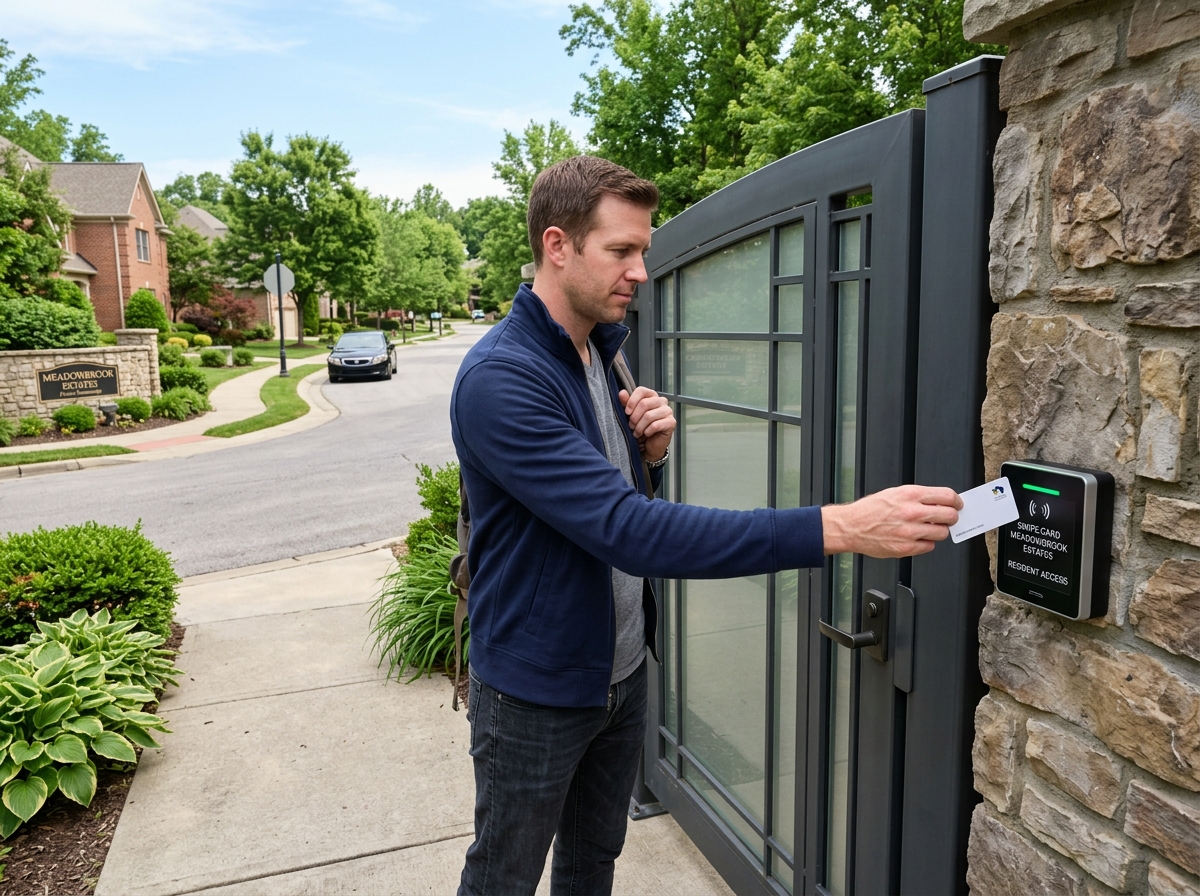
Unlike a traditional lock and key, or even a keypad where the “secret” code can be whispered to anyone, a card reader relies on proximity technology. This usually involves Radio Frequency Identification (RFID). When you bring your card or fob near the reader, the reader sends out an electromagnetic field. The card “wakes up,” sends its unique ID back to the reader via the Wiegand protocol (the industry-standard language for these devices), and the system decides if you’re allowed in.
This process happens in milliseconds, but the security benefits last a lifetime. Because the signals can be encrypted, it is incredibly difficult for bad actors to “sniff” or clone the credentials. For those of us living in areas like Bloomfield Hills or West Bloomfield, where privacy is paramount, this level of technical sophistication is a must-have for residential security.
The Advantage of Individual Credentialing
The biggest headache with old-school gate security is the “lost key” scenario. If an employee leaves a company or a tenant moves out of an apartment complex in Royal Oak, and they don’t return their key, you’re stuck. Do you re-key every lock? Do you change the keypad code and then have to tell 50 other people the new one?
With a gate card reader, you never have to do that. Each card or fob has a unique ID tied to a specific person. If a card is lost or a person’s privileges need to be revoked, we simply log into the system and delete that specific ID. The card becomes a useless piece of plastic instantly, while everyone else’s cards keep working perfectly. This level of control is why we recommend these systems for any modern property.
Real-Time Activity Tracking
Ever wonder who exactly came through your gate at 2:00 AM? With a card reader system, you don’t have to guess. Every time a card is tapped, the system creates an audit trail. It records the name of the cardholder, the date, and the exact timestamp of entry.
When we integrate these readers with Security Cameras, the security becomes even more robust. You can cross-reference the digital log with video footage to ensure the person using the card is actually the authorized owner. This is particularly useful for commercial sites in Troy or Southfield where monitoring staff and vendor access is a daily requirement.
Comparing Short-Range and Long-Range Proximity Technology
Not all readers are created equal. The “best” gate card reader for you depends entirely on whether you are walking through a side gate or driving a SUV through a main entrance.
| Feature | Short-Range (Proximity) | Long-Range (Transponder) |
|---|---|---|
| Typical Range | 2 to 4 inches | 10 to 30 feet |
| Frequency | 125 kHz or 13.56 MHz | 433 MHz or UHF (900 MHz) |
| Primary Use | Pedestrians, office doors | Vehicle gates, parking garages |
| Credential Type | Cards, fobs, smartphones | Windshield tags, visor clips |
Short-Range Readers for Pedestrian Access
Short-range readers are what most of us see every day. They usually have a read range of 2 to 4 inches. These are perfect for pedestrian side-gates or “man-doors.” They are compact, often “mullion-mounted” (which is a fancy way of saying they fit on a narrow door frame), and very durable.
In these setups, users typically carry a key fob on their keychain or a slim card in their wallet. Some modern versions, like the ones we install for tech-forward homes in Birmingham, even use 13.56MHz Mifare technology or NFC, allowing you to use your smartphone as your key.
Long-Range Solutions for Vehicle Gates
If you’ve ever used a “Fast Track” or “E-ZPass” on a toll road, you’ve used long-range transponder technology. For vehicle gates in gated communities or commercial depots in Livonia, stopping to roll down a window in a Michigan winter is… well, it’s unpleasant.
Long-range systems solve this. A reader is mounted on a pedestal near the driveway, and a specialized RFID tag is placed on the vehicle’s windshield or headlight. As the car approaches, the reader detects the tag from up to 30 feet away and swings the gate open before the driver even has to tap the brakes. It’s seamless, professional, and keeps traffic moving.
Seamless Integration: Connecting Your Gate Card Reader to Smart Systems
At SmartMait, we believe a gate card reader shouldn’t be a “lonely” device. It should talk to the rest of your property. This is where the magic of integration happens.
Through our expertise in Z-Wave and other smart protocols, we can link your gate access to your entire home or office ecosystem. Imagine this: you tap your card at the gate, and not only does the gate open, but your driveway lights turn on, your security alarm disarms, and your “Welcome Home” mood lighting activates in the hallway. That is the power of a truly integrated system.
Standalone vs. Networked Systems
When choosing your setup, you’ll need to decide between a standalone reader and a networked system.
- Standalone Readers: These have the “brains” built right into the unit. They store a limited number of cards (often up to 1,000 or 2,000) and manage access logic onboard. They are great for single-gate residential setups in Walled Lake or Clarkston because they don’t require a complex network. However, to add or delete cards, you usually have to be physically present at the gate.
- Networked Systems: These readers are connected to a central controller (like a NETQX 4-door controller) via RS485 or TCP/IP wiring. This allows you to manage everything from a central computer or a cloud-based app. If you’re managing commercial access solutions across multiple sites in Macomb County, networked systems are the only way to go. You can update permissions for hundreds of users across several locations with a single click.
Automation and Ecosystem Synergy
Because we specialize in comprehensive smart device integration, we often set up “triggers” based on gate activity. For a business in Farmington Hills, a “first arrival” card swipe in the morning could automatically trigger the HVAC system to move from “Economy” to “Comfort” mode. For a residential estate in Bloomfield Township, a gate entry after sunset could trigger a path of landscape lighting to guide the car to the garage. This isn’t just security; it’s a lifestyle upgrade.
Durability and Maintenance for Outdoor Readers
Let’s be real: Michigan weather is tough on electronics. Between the humid summers in Warren and the sub-zero, salt-heavy winters in Livonia, an outdoor gate card reader needs to be built like a tank.
We look for readers with at least an IP65 or IP66 rating. This means the device is dust-tight and can handle powerful jets of water (or a very intense rainstorm). Many of the high-quality readers we use, such as the waterproof PX2611 or ruggedized DoorKing models, are designed to operate in temperatures ranging from -40°F to 140°F.
Environmental Factors and Performance
Even the best reader can face challenges. Signal interference can occur if a reader is mounted directly onto a large metal surface without a spacer, as the metal can “absorb” the RFID field. We also have to account for power stability. A “voltage drop” — where the power gets weaker the further it travels down a wire — can cause a reader to reboot or fail to read cards.
To prevent this, we use high-quality shielded cabling and ensure the power supply is robust enough for the distance. We also recommend surge protection for every installation to protect your investment from Michigan’s frequent lightning storms.
Troubleshooting Common Connectivity Issues
If your reader stops working, don’t panic. Here is a quick checklist we use:
- Check the LED: Most readers have a status light. If it’s dark, check the power supply and jumpers on the controller.
- Clean the Face: While proximity readers don’t require physical contact, a thick layer of ice or mud can occasionally dampen the signal.
- Inspect the Wiring: RS485 and Wiegand wires are thin. A small nick from a weed-whacker or a loose terminal screw can break the communication.
- Firmware Updates: For networked systems, sometimes a simple software update is all that’s needed to fix a “buggy” connection.
Choosing the Right Setup for Your Property
Choosing a gate card reader isn’t just a technical decision; it’s an aesthetic and functional one too. Whether you’re in a historic home in Birmingham or a modern office in Southfield, you want a reader that looks the part.
Residential Gate Card Reader Solutions
For our residential clients in areas like Rochester Hills and Beverly Hills, we often recommend “Universal” readers that combine a keypad with a card reader. This gives you the best of both worlds. You can give a one-time keypad code to the pizza delivery driver or a contractor, while your family uses proximity fobs for quick, secure access.
Solar compatibility is another big factor for larger estates. If your gate is far from the house, we can install low-power readers designed to run efficiently on solar-charged battery systems, saving you the cost of trenching hundreds of feet of power lines.
Commercial and Industrial Gate Card Reader Use Cases
In the commercial world — think parking garages in downtown Royal Oak or office complexes in Farmington — the focus shifts to “high-traffic management.”
You need readers that can handle thousands of swipes a day without failing. For these sites, we often implement multi-frequency readers. These can read older 125kHz cards that employees might already have from a previous building, as well as newer, ultra-secure 13.56MHz smart cards. This “backward compatibility” saves businesses thousands of dollars in credential replacement costs.
Frequently Asked Questions about Gate Access
What is the typical read range for a gate card reader?
For a standard pedestrian gate card reader, you can expect a range of 2 to 4 inches. For long-range vehicle systems using UHF or specialized transponders, the range can extend from 10 to 30 feet, allowing for hands-free entry.
Can I manage my gate card reader from my smartphone?
Yes! If you choose a networked system with cloud integration, you can add or delete users, check entry logs, and even remotely trigger the gate to open for a guest right from your phone. Some modern readers also allow your phone to act as the “card” via Bluetooth or NFC.
How do I delete a lost or stolen access card?
In a standalone system, you typically use a “Master Card” or a built-in keypad to enter a programming mode and delete the specific card’s ID number. In a networked system, you simply log into the management software, find the user’s name, and click “Deactivate” or “Delete.” The change is pushed to the gate reader instantly.
Conclusion
Upgrading to a gate card reader is one of the most effective ways to modernize your property’s security. It moves you away from the vulnerabilities of shared codes and physical keys, offering instead a world of individual accountability, real-time tracking, and effortless convenience.
At SmartMait, we don’t just “install a reader.” We create a seamless, integrated environment where your gate, your lights, your cameras, and your home automation work in perfect harmony. Whether you are looking for a simple residential driveway solution or a complex multi-site commercial network across Southeast Michigan, we have the expertise to make it happen.
Ready to bring your property into the modern era? Secure your property with SmartMait access control and experience the peace of mind that comes with professional, integrated security.