Why the Gate Entry Keypad is Still King of Access
Why the Gate Entry Keypad is Still King of Access
The Gate Entry Keypad Is Still the Gold Standard for Property Access
A gate entry keypad remains one of the most reliable, flexible, and cost-effective ways to control who enters your property — whether you’re securing a private driveway or managing access for a commercial facility.
Before diving deep, here’s a quick comparison of the most common gate entry keypad types:
| Keypad Type | Best For | Code Capacity | Connection |
|---|---|---|---|
| Stand-alone wired | Residential & small commercial | 100–1,000 codes | Direct wire to gate opener |
| Wireless | Remote or retrofit installs | 24–500 codes | Radio frequency (300–433 MHz) |
| Solar-compatible | Off-grid or remote locations | 100–500 codes | Battery + solar panel |
| System-integrated (secondary) | Multi-point entry, larger sites | Up to 1,000 codes | RS-485 or Wiegand |
| Smart/cloud-managed | Gated communities, multi-family | Unlimited (cloud) | Wi-Fi or cellular |
The right choice depends on your site, your user count, and how much control you need day to day.
Keypads have been the go-to access method for decades — and for good reason. They eliminate the need for physical keys or remotes. They let you program unique codes for different people. And they work even when your phone battery is dead.
But not all keypads are built the same.
Code capacity alone ranges from as few as 24 codes on basic wireless units to over 1,000 on commercial-grade wired models. Add in differences in weather resistance, power requirements, mounting options, and smart integration — and choosing the wrong unit is an easy mistake to make.
This guide breaks down every major feature category so you can compare options clearly and pick the keypad that actually fits your property.
Understanding the Different Types of Gate Entry Keypads
When we talk about a gate entry keypad, we aren’t just talking about a box with numbers. There is a surprising amount of variety under the hood. Depending on whether you are securing a home in Bloomfield Hills or a commercial warehouse in Warren, the hardware you choose will vary significantly in how it communicates with your gate operator.
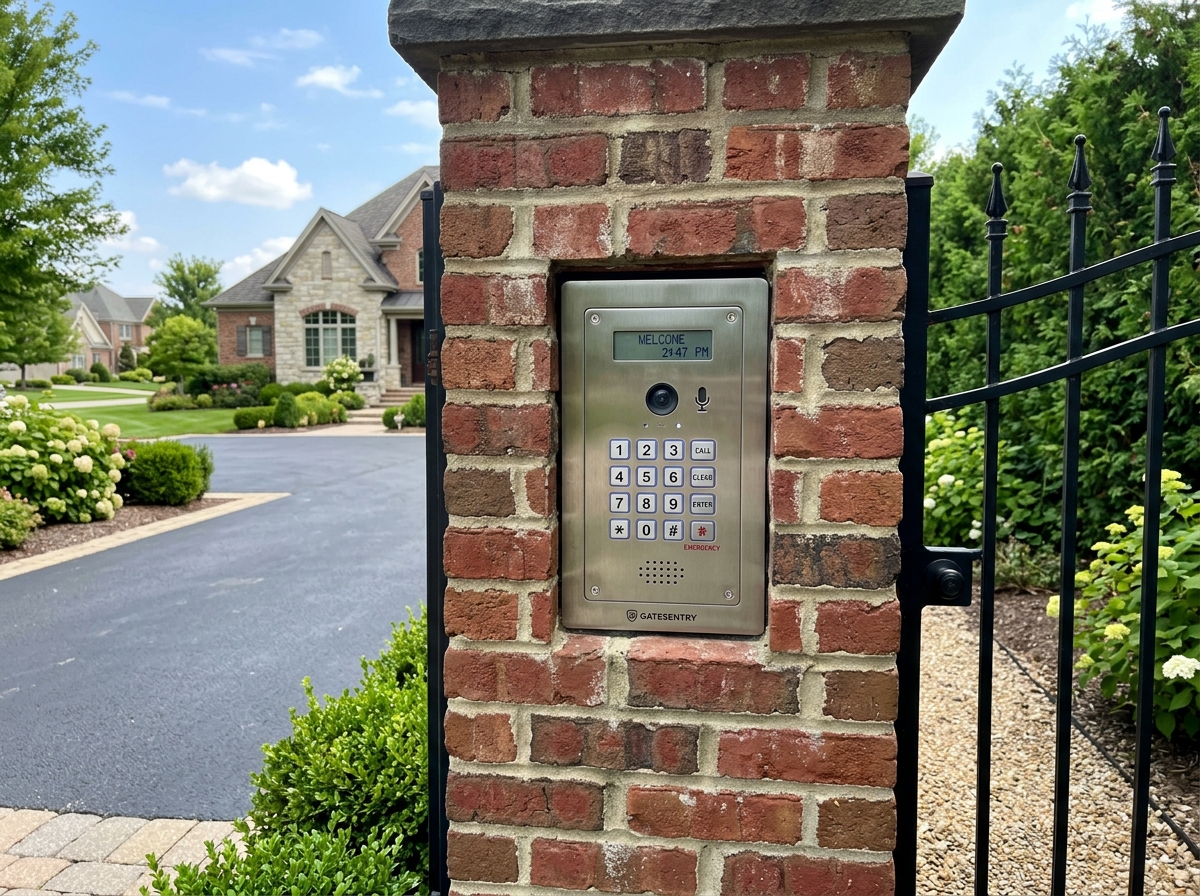
Stand-Alone vs. System Integrated Models
The first big fork in the road is deciding between a stand-alone unit and an integrated system.
Stand-alone keypads are the “all-in-one” heroes of the access world. These units contain their own relay logic and internal memory. When you punch in the correct code, the keypad itself decides to click the relay and tell the gate to open. These are incredibly popular for residential security because they are simpler to install and very cost-effective. For example, a model like the Linear AK-11 can store up to 480 codes and manage everything internally without needing an external “brain.”
System-integrated models (often using Wiegand output) act more like sensors. They don’t make the “open” decision themselves. Instead, they send the data to a central access controller or a telephone entry system. This is the gold standard for high-security or multi-tenant applications in places like Troy or Royal Oak, where you want a centralized log of every entry attempt.
| Feature | Stand-Alone Keypad | Integrated System |
|---|---|---|
| Decision Maker | Built into the keypad | Central controller/PC |
| Wiring | Power + Trigger wires | Wiegand or RS-485 data lines |
| Audit Logs | Usually none (basic) | Detailed real-time logging |
| Scalability | Harder to manage many units | Easy to manage 10+ doors/gates |
Primary vs. Secondary Keypad Applications
We often get asked if you can have a keypad on both sides of the gate. The answer is yes, but you have to be careful about which models you buy.
A primary keypad is usually the main entry point. In some setups, especially those involving telephone entry systems, you might use a secondary keypad. These are specifically designed to work in conjunction with a master unit. They often use RS-485 communication to talk back to the main “brain.” Why use a secondary unit? It allows you to have controlled exit (requiring a code to leave) without the expense of buying two full-featured master controllers.
Essential Features of a High-Quality Gate Entry Keypad
In Michigan, a gate entry keypad has a tough life. It has to survive the humid summers in Detroit and the sub-zero winters in Clarkston. If you pick a flimsy plastic model, you’ll be replacing it before the first snow melts.
Code Capacity and User Management in a Gate Entry Keypad
How many people need to get through your gate?
- Residential: Most homeowners only need a handful of codes—one for the family, one for the landscaper, and perhaps a few temporary guest PINs.
- Commercial/Multi-family: If you’re managing an apartment complex in Livonia, you’re looking at much higher requirements.
Typical capacities include the DoorKing 1506, which stores up to 1,000 4-digit codes, while the Nice Apollo 928 supports 100 codes. Some advanced “smart” keypads allow for nearly unlimited codes managed via a cloud app, which is perfect for revoking access the second a tenant moves out.
Weather Resistance and Physical Durability
Durability is non-negotiable. Look for these two ratings:
- IP65 Rating: This means the unit is dust-tight and protected against water jets. It can handle a Michigan downpour without shorting out.
- IK07 Impact Resistance: This measures how well the unit stands up to physical “oopsies” or deliberate vandalism.
High-end models feature rugged cast aluminum or stainless steel enclosures. Some even offer internal heating systems—a massive plus for our clients in northern Oakland County—to ensure the keys don’t freeze up when the temperature drops to single digits.
Wired vs. Wireless: Choosing the Right Connection
This is the age-old debate in gate automation. Do you dig a trench, or do you trust the airwaves?
Power Requirements and Solar Compatibility
Wired keypads typically run on 12-24V AC/DC power. They are extremely reliable because they aren’t dependent on batteries. However, if your gate is 200 feet from the house, trenching for wires can be expensive.
This is where solar-compatible keypads shine. Models like the Nice Apollo 928 are designed with ultra-low current draw, meaning they won’t drain your gate’s solar battery overnight. If you are using security cameras at the gate as well, you’ll need to calculate your total power budget carefully.
Range and Frequency Considerations
Wireless keypads operate on radio frequencies, usually between 300MHz and 433MHz.
- Range: Most quality wireless units, like the LiftMaster KPW250, offer a range of up to 250 feet, while some “long-range” models claim up to 500 feet with a clear line of sight.
- Interference: Large metal gates or thick stone pillars can act as a shield, killing your signal.
- Security: Always look for “Rolling Code” technology. This ensures that the signal sent from the keypad to the gate changes every time, preventing tech-savvy thieves from “grabbing” your code out of the air.
Advanced Security and Smart Integration
If you want your gate to do more than just open and close, you need to look at advanced features. At SmartMait, we specialize in making these devices part of a larger, cohesive ecosystem.
Enhancing Security with a Smart Gate Entry Keypad
A “smart” gate entry keypad takes security to a whole new level by connecting to the internet. This allows for:
- Activity Logs: See exactly who entered and at what time.
- Prop-Open Alerts: Get a notification on your phone if the gate is stuck open for more than three minutes.
- Cloud Management: Create or delete codes from your office in Southfield while you’re on vacation in Florida.
We focus on brands we carry that offer seamless integration, particularly those that can talk to your existing home automation system.
Proximity Readers and Multi-Factor Access
Sometimes a PIN code isn’t enough. Many commercial-grade keypads now include a proximity reader. This allows users to simply tap an RFID fob or an encrypted 13.56MHz DESFire card against the unit to gain entry. It’s faster, more secure (since fobs are harder to “share” than codes), and adds a professional touch to any property.
Some high-security units also feature anti-passback logic. This prevents a user from “passing” their card back to a friend behind them to let a second car in. If the system hasn’t seen the card “exit,” it won’t let it “enter” again.
Installation and Maintenance Best Practices
Even the best gate entry keypad will fail if it’s installed poorly.
Programming and Code Retention
One of the biggest headaches for property owners is losing all their programmed codes after a power outage. To avoid this, ensure your keypad uses EEPROM memory. This is a type of non-volatile memory that retains data even when the power is cut.
When programming, always change the Master Code immediately. The default factory codes are often found in online technical guides, and leaving them as-is is an open invitation for intruders.
Physical Mounting and Cable Management
How you mount the unit matters for both ergonomics and longevity.
- Gooseneck Posts: These are the standard for driveways. They bring the keypad to window-height for drivers.
- Mounting Height: Standard height is usually around 42 to 48 inches from the ground.
- Surge Protection: Since keypads are often the highest point of an electrical circuit outdoors, they are lightning magnets. Always use proper grounding and surge protection to save your electronics.
- Tactile Feedback: In cold weather, users appreciate “clicky” buttons or an audible beep to know their press was registered.
Frequently Asked Questions about Gate Keypads
How many codes can a standard gate entry keypad store?
For residential use, most basic units store between 24 and 100 codes. Commercial units, like the DoorKing 1506 or Linear AK-11, typically store between 480 and 1,000 codes. Smart systems managed via the cloud can support virtually unlimited users.
Can wireless keypads work through thick walls or metal gates?
Radio waves struggle with dense materials. A thick stone pillar or a solid steel gate can significantly reduce the effective range of a wireless keypad. In these cases, we often recommend a wired solution or mounting the receiver in a more “visible” location relative to the keypad.
What is the benefit of a dual-relay keypad?
A dual-relay keypad can control two separate things. For example, Relay #1 could open the main gate, while Relay #2 could turn on the driveway lights or open a separate pedestrian side-gate. It’s a great way to add functionality without adding more hardware.
Conclusion
The gate entry keypad remains the “King of Access” because it is the most reliable bridge between physical security and user convenience. Whether you need a simple wireless unit for a home in Farmington Hills or a high-capacity, vandal-resistant system for a commercial site in Detroit, the key is matching the features to your specific environment.
At SmartMait, we don’t just “install a keypad.” We integrate your access control into your entire lifestyle. By utilizing Z-Wave technology and seamless smart home automation, we ensure your gate works in harmony with your lights, your cameras, and your security system.
If you’re ready to secure your property with professional access control, we are here to help you navigate the options and find the perfect fit for your Michigan property.