Commercial Security System Installation in Metro Detroit: A Buyer’s Guide for 2026
What Alarm Monitoring Market Growth Means for Metro Detroit Businesses
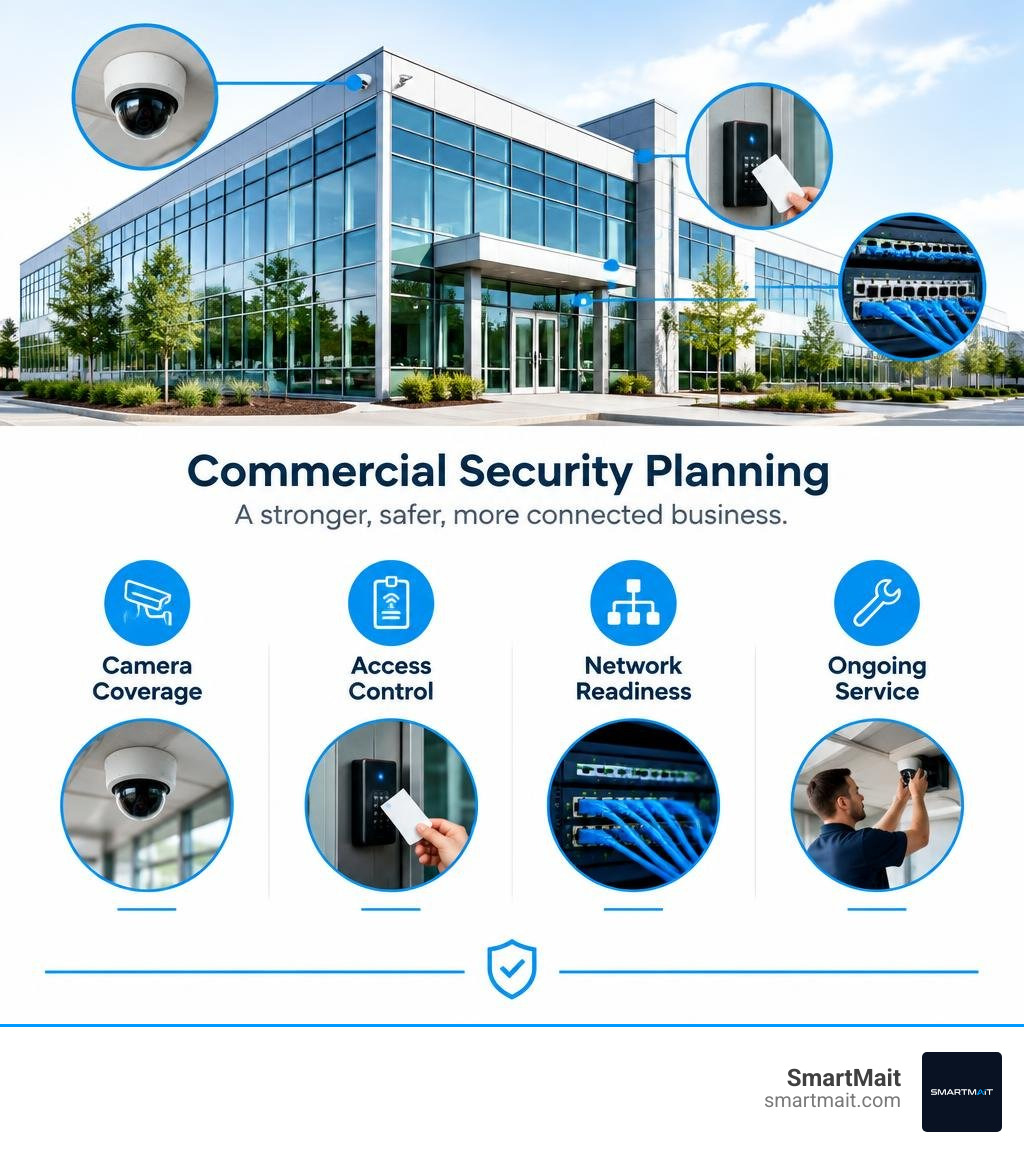
The alarm monitoring market is estimated at $69.05 billion worldwide in 2026 and projected to reach $92.96 billion by 2031, according to Mordor Intelligence. For a Metro Detroit business, that growth means more connected options, but it does not make every installation a good fit. Start with the building: identify where you need camera coverage and controlled access, then check whether the network can support both reliably.
Whether you manage an office in Troy or a retail space in Royal Oak, ask a local integrator to assess the site, explain retrofit costs, and plan for service after installation. Learn about SmartMait’s commercial security system installation services, or request a consultation to discuss your building.
I’m Dominic Hesano, founder of SmartMait. My hands-on work with security systems, structured wiring, and networks in southeast Michigan helps me turn alarm monitoring market trends into practical questions for local buyers.
Alarm monitoring market definitions:
Planning a Commercial Security System in Metro Detroit
Every commercial facility in Southeast Michigan presents its own operational hurdles. A multi-tenant office building along Big Beaver Road in Troy operates with different physical boundaries and foot-traffic patterns than a specialized medical suite in Rochester Hills or a boutique retailer in Birmingham. Planning an effective commercial security system begins by defining the daily operational demands of the space rather than buying a generic package of hardware.
We conduct comprehensive on-site physical assessments to examine perimeter boundaries, primary ingress points, staff-only corridors, high-risk inventory rooms, and parking facilities. By walking the site, we identify structural blind spots and review environmental layout considerations that direct system scope.
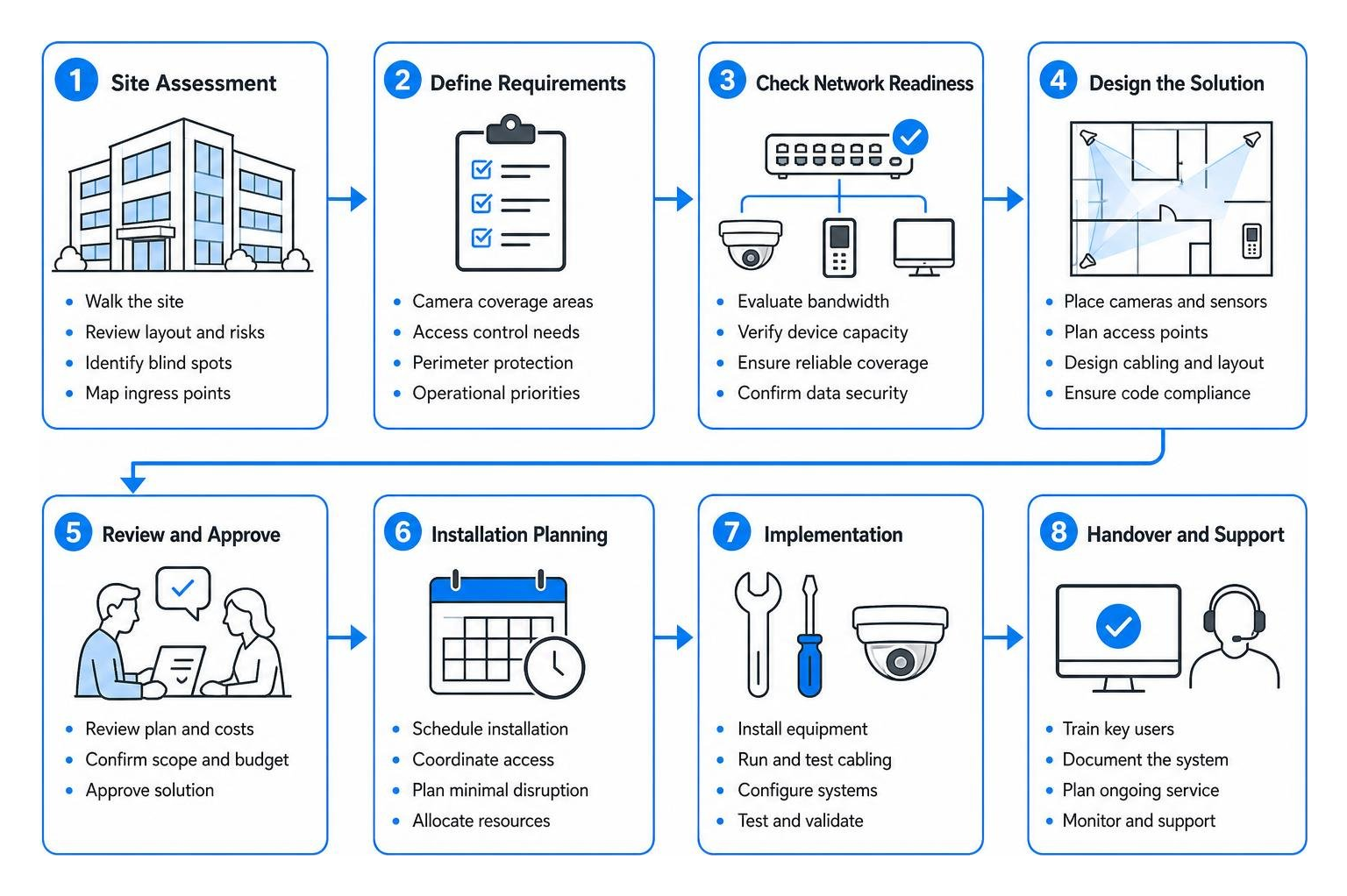
A functional deployment balances perimeter intrusion prevention, card access, surveillance visibility, and data integrity. Selecting a full-service, local low-voltage integrator ensures that your hardware, back-end structured cabling, network infrastructure, and building management protocols communicate as one unified ecosystem. Instead of juggling separate vendors for network installation, cameras, and key fobs, partner with an integrator that handles end-to-end design, code compliance, and recurring maintenance.
Budgeting and Project Planning
Commercial security project budgets vary based on physical building footprint, system density, and structural pathways. The overall expenditure is shaped by:
- Total interior and exterior square footage requiring clear visual coverage.
- The number of controlled physical doors requiring key card readers, electric strikes, or maglocks.
- The condition of the existing network backplane and server topology.
- Physical architectural pathways (plenum ceilings, drop ceilings, solid masonry, or exposed industrial beams).
- Project delivery constraints (active tenant hours versus unoccupied after-hours installation).
Retrofit installations in established buildings—such as vintage commercial properties in Royal Oak or Bloomfield Hills—require creative wire pathways, plenum-rated cabling runs, and core drilling through block or brick. In contrast, new construction projects in West Bloomfield or Novi allow us to lay dedicated low-voltage pathways before drywall is hung, streamlining labor costs. We provide clear, transparent timelines that detail everything from rough-in wiring to final IP commissioning, credential provisioning, and staff onboarding.
Video Surveillance, Network Infrastructure, and System Integration
Cameras are only as effective as the network infrastructure supporting them. Modern multi-megapixel 4K IP cameras with onboard AI object classification generate continuous streams of high-resolution video data. If installed on an outdated, unmanaged network switch, that data floods the system, resulting in dropped frames, pixelation, and network latency.
We engineer structured cabling backbones using high-performance Cat6 or Cat6A solid copper lines to guarantee consistent Power over Ethernet (PoE) delivery and maximum data throughput. Camera placement focuses on capturing critical identification angles—such as faces at entry vestibules, license plates at parking gates, and transaction activities at point-of-sale terminals—while respecting employee break spaces and neighboring boundaries. Off-site remote access is secured through encrypted virtual tunnels, allowing authorized administrators to review live and recorded events from any authenticated workstation or mobile device without exposing the system to public internet vulnerabilities.
Commercial Security System Components and Connectivity
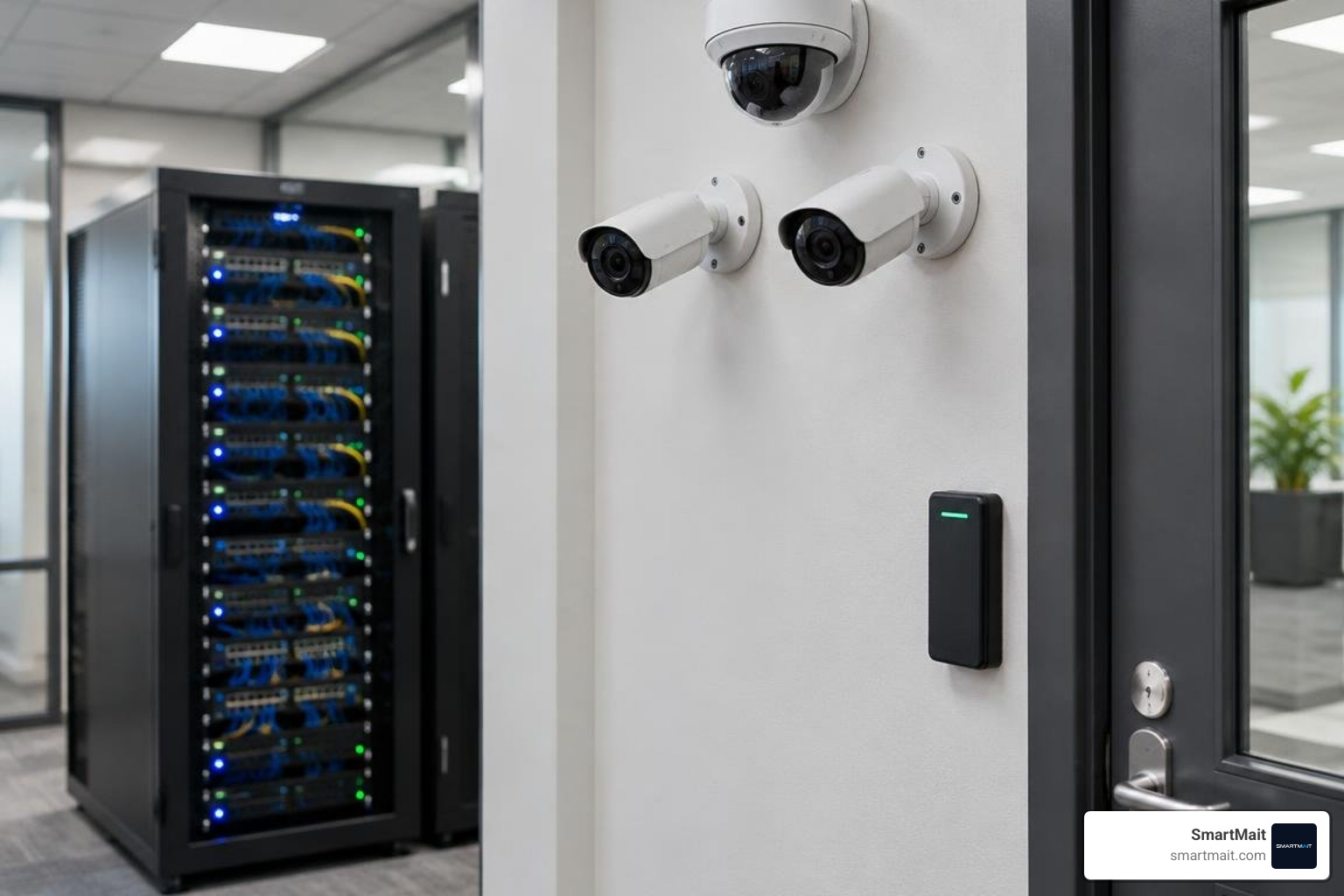
A dependable commercial security deployment relies on interconnected low-voltage sub-systems working in sync. Rather than treating access control, environmental sensors, and surveillance as standalone tools, our integrated designs ensure that a door forced open immediately cues the nearest pan-tilt-zoom camera to prioritize that frame, logs the timestamp in the central access database, and notifies the designated facilities manager.
Core Systems for Commercial Buildings
- Commercial Video Surveillance: High-definition IP cameras equipped with edge analytics, motorized varifocal lenses, wide dynamic range (WDR) for challenging sunlight reflections, and infrared illumination for nighttime visibility.
- Access Control & Key Card Systems: Centralized access management utilizing encrypted RFID cards, mobile NFC/Bluetooth credentials, key fobs, and audit-trail logging to replace physical master keys.
- Structured Cabling & Pathways: Clean, code-compliant low-voltage wiring bundled in dedicated J-hooks, cable trays, and patch panels to support high-speed data transmission without signal cross-talk.
- Enterprise Network Infrastructure: Dedicated rack-mounted hardware, enterprise-grade routers, managed PoE switches, and uninterruptible power supplies (UPS) that keep critical systems online during regional grid fluctuations.
- Environmental & Climate Monitoring: Integrated server-room temperature, moisture, and water-detection sensors that catch building infrastructure leaks before expensive equipment is ruined.
Medical facilities in Southfield require strict HIPAA-aligned access control at medical record storage areas, while distribution centers in Warren and Livonia prioritize loading dock surveillance and vehicle gate access control. Multi-tenant office properties throughout Oakland County benefit from tiered authorization, ensuring tenants access only their leased floors and common amenities.
Network Design and Reliable System Connections
Connected commercial building systems require deliberate physical and logical network architecture. We isolate security endpoints onto dedicated, private Virtual Local Area Networks (VLANs), separating video surveillance and door controller traffic from primary corporate data and guest Wi-Fi.
Bandwidth planning prevents network saturation by matching camera compression codecs (such as H.265 and Smart Stream algorithms) to available local throughput and on-site Network Video Recorder (NVR) drive write speeds. To protect against communication failures, we deploy secondary connectivity channels—including automatic cellular fallback links—so that essential monitoring and emergency signals broadcast without interruption if the primary fiber or broadband line goes down.
| Connectivity Type | Reliability Level | Installation & Labor Needs | Typical Commercial Application |
|---|---|---|---|
| Wired IP Network (Cat6/Cat6A) | High: Immune to wireless radio interference, provides dedicated power (PoE), and delivers consistent multi-gigabit throughput. | Structured cable pulls through walls, conduit, or drop ceilings; termination at patch panels; testing and certification. | Primary standard for enterprise IP cameras, door controllers, NVRs, and centralized access hardware. |
| Wireless RF / Cellular Backup | Moderate to High: Excellent flexibility and line redundancy; susceptible to structural RF attenuation or wireless congestion. | Fast field deployment; requires local low-voltage power at the device and line-of-sight RF planning. | Secondary communication backup lines, remote perimeter gates, detached guard shacks, and exterior asset yards. |
| Legacy Cabling (Coax / RS-485) | Low to Moderate: Lacks bandwidth for modern multi-sensor AI video feeds; higher maintenance requirements over time. | Existing historic wiring pathways; requires media converters or baluns to interface with modern IP hardware. | Retrofitting legacy systems where full structured cable replacement is physically restricted by historic building codes. |
Local Requirements, Privacy, and Cybersecurity

Deploying a commercial security system in Michigan involves more than just mounting hardware; it requires strict adherence to local building codes, life safety mandates, and data protection practices. A non-compliant installation can lead to municipal inspection failures, insurance denial, or regulatory fines.
Planning for Permits and Building Requirements
Every municipality in Oakland, Macomb, and Wayne counties enforces specific building and electrical standards governing low-voltage wiring, penetration firestopping, and egress pathways:
- Emergency Egress and Life Safety (NFPA 101 / Michigan Building Code): Access-controlled doors along designated primary exit routes must automatically release upon loss of power, activation of the building fire alarm system, or manual use of an integrated emergency push-to-exit bar. Maglocks installed without secondary pneumatic release switches will fail municipal fire marshal inspections.
- Firewall Penetrations: Any low-voltage structured cabling passing through fire-rated commercial walls must be sealed with approved intumescent firestop pillows, caulking, or rated pathway sleeves to prevent flame and smoke migration.
- Coordination with Allied Trades: We coordinate with primary electrical contractors, mechanical crews, door hardware vendors, and municipal inspectors in cities like Troy, Birmingham, and Detroit before running cable to verify electrical load limits and ensure all necessary permits are filed correctly.
Protecting Connected Security Systems
Modern security devices are specialized network endpoints. Leaving factory default passwords on IP cameras or using consumer-grade routers creates direct attack vectors into your corporate internal network.
We secure commercial installations through defense-in-depth principles:
- Port Security & VLAN Segmentation: Isolating physical RJ45 wall drops so unauthorized devices plugged into an accessible camera port cannot access internal corporate data.
- Role-Based Access Control (RBAC): Setting granular staff permissions so administrative rights remain restricted to designated personnel, with temporary visitor credentials expiring automatically.
- Encrypted Transmission & Storage: Implementing TLS 1.2/1.3 cryptographic protocols on all video streams and IP transmission pathways, backed by encrypted hard drive arrays at the local NVR.
- Regular Firmware Maintenance: Continuously patching device firmware and access control software to protect hardware against emerging cybersecurity vulnerabilities.
Commercial Security Needs Across Metro Detroit
Southeast Michigan combines corporate headquarters, manufacturing facilities, specialized medical clinics, and vibrant retail centers. Each district presents distinct spatial layouts and security demands.
- Troy & Southfield: Commercial office corridors along major thoroughfares require scalable key card access, visitor badging solutions, and multi-floor elevator access control.
- Birmingham, Royal Oak & Ferndale: High-density downtown retail, upscale hospitality venues, and boutique professional offices require unobtrusive, architecturally integrated security cameras and mobile smartphone-based access credentials.
- Bloomfield Hills & West Bloomfield: Private financial practices, high-end design studios, and expansive commercial properties demand discreet perimeter surveillance, optical line protection, and integrated environmental sensors.
- Rochester Hills, Novi & Farmington Hills: Multi-building corporate business parks and light manufacturing plants require unified access control management, long-range exterior optical surveillance, and centralized badging portals.
- Detroit & Grosse Pointe: Urban redevelopments, multi-tenant residential loft conversions, and commercial historic retrofits require low-voltage integrators skilled in working around solid brick, concrete, and historic plaster finishes.
Choosing a Local Commercial Security Integrator
Choosing the right integrator is just as important as selecting the hardware. A typical vendor sells equipment and moves on, but long-term security requires ongoing support, routine system calibration, and prompt service calls.
Key questions to ask potential low-voltage integration contractors:
- Do you conduct an on-site physical walk-through before providing a final scope of work?
- Are your technicians directly experienced in low-voltage structured cabling, managed IP networking, and fire-rated penetration codes?
- How do you isolate security hardware from our standard business network traffic?
- Do you offer continuing maintenance and system health verification, such as our SmartService concierge program, after initial commissioning?
- How quickly can your local technicians respond on-site in Oakland or Wayne County if an access-controlled entry door fails?
Retrofit and New-Construction Considerations
Integrating a security system into a new construction project allows for clean, hidden conduit runs, optimal camera vantage points, and pre-planned central server room racks. Our team collaborates directly with general contractors and architects during the blueprint phase to designate low-voltage cable paths and power delivery specs.
Commercial retrofits, by contrast, demand deep field problem-solving. When updating a mature commercial facility, we evaluate existing cabling to determine if legacy pathways can be leveraged, or if fresh plenum Cat6 runs are required. For expanded operational control, we interface access control and video surveillance with building automation systems—enabling smart lighting schedules, automated HVAC setpoints based on room occupancy, and unified off-hours arming routines.
Frequently Asked Questions About Commercial Security Systems
What affects the cost of installing a commercial security system?
Commercial installation costs are influenced by the total building square footage, the number of surveillance cameras and their required resolutions, the total number of physical doors needing access control hardware (such as card readers, electrified strikes, and crash bars), the condition of your existing network cabling, and whether the job is a new build or a complex structural retrofit.
How should a business plan camera coverage and access control?
Start by identifying primary perimeter entry points, public-facing reception desks, employee-only work zones, back-of-house storage areas, and parking areas. Access control should be assigned based on job roles, while camera layouts should balance wide-area situational awareness with targeted identification fields of view, always avoiding employee breakrooms and private spaces.
What should businesses consider when connecting security systems to their network?
Businesses need to account for total camera bandwidth draw, switch PoE power budgets, dedicated network segmentation (VLANs), and hardware cybersecurity protocols. Ensuring that security cameras and door controllers are isolated from the public guest network and protected with encrypted communication pathways prevents performance bottlenecks and keeps business data secure.
Conclusion
A dependable commercial security deployment requires thorough local planning, professional-grade low-voltage cabling, carefully positioned video surveillance, unified card access control, and an enterprise network backbone. Cutting corners with consumer equipment or uncoordinated sub-contractors leads to dropped camera feeds, compliance failures, and security blind spots.
At SmartMait, we deliver complete low-voltage integration—from initial engineering assessments and structured cabling to ongoing concierge support through our dedicated SmartService program. We serve businesses across Troy, Birmingham, Bloomfield Hills, Rochester Hills, Royal Oak, and the broader Metro Detroit area.
Contact us today to explore our commercial security system installation capabilities, or request a consultation with our engineering team to design an integrated security infrastructure tailored to your commercial facility.