The Best Alarm Monitoring Companies for Every Type of Homeowner
Find an Alarm Monitoring Service That Fits How You Live
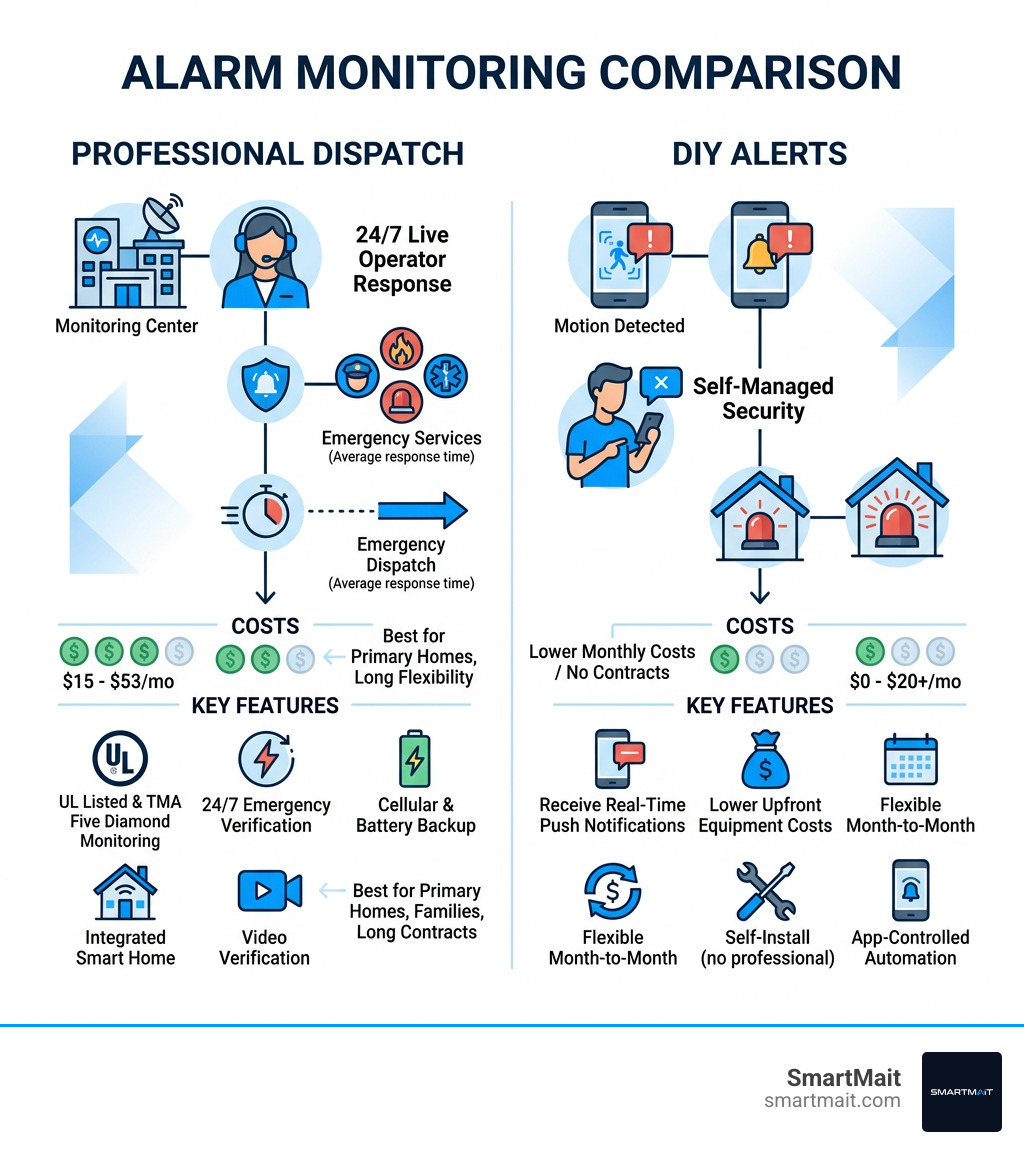
The best alarm monitoring companies pair dependable 24/7 emergency dispatch with cellular and battery backup, clear pricing, and equipment that works with your locks, cameras, lights, and thermostats. For most busy homeowners, professional monitoring is the better fit: a trained central station can respond when you are in a meeting, asleep, traveling, or unable to reach your phone.
Start by narrowing the choice to the service model you need:
- Professionally monitored systems: Best for primary homes, frequent travelers, families, and anyone who wants a live operator to verify alarms and contact emergency services.
- DIY systems with optional monitoring: Best for renters, smaller homes, and buyers who value lower upfront cost and month-to-month flexibility.
- Professionally installed smart-home systems: Best for larger homes with cameras, automation, multiple floors, or existing wiring that needs to work as one reliable system.
A strong provider should offer more than a loud siren. Look for cellular communication, backup power, smoke and carbon monoxide monitoring, water or freeze sensors, remote control through a secure app, and a monitoring center with respected credentials such as UL listing and TMA Five Diamond status. The industry average for a professional monitoring response is about 45 seconds, but signal delivery, verification procedures, and local dispatch practices all affect what happens next.
Professional monitoring commonly costs about $15 to $53 per month. The real comparison is not just the monthly price. Check equipment costs, installation charges, video storage, service calls, rate increases, and whether a long contract makes leaving expensive.
I am Dominic Hesano, founder of SmartMait, and I have spent years troubleshooting security, smart-home, and low-voltage systems that were poorly planned or left disconnected after installation. In this guide to the best alarm monitoring companies, I will focus on what makes a system reliable in a real Southeast Michigan home, not just impressive on a sales page.
Best alarm monitoring companies vocab to learn:
How to Choose the Best Alarm Monitoring Companies
Selecting an alarm monitoring partner is fundamentally about trust, infrastructure, and operational speed. When an alarm triggers, you need to know that the team receiving the signal possesses the technical capability and training to act immediately. Research confirms that properties without security systems are 300 percent more likely to experience a burglary, while 74 percent of property owners report feeling significantly more secure after installing a comprehensive system.

When evaluating the infrastructure behind any provider, look for recognized industry certifications:
- UL Listed Central Stations: Indicates that the monitoring facility meets rigorous standards for physical building security, backup power generation, hardware redundancy, and operational staffing.
- TMA Five Diamond Certification: Awarded by The Monitoring Association to centers that commit to 100% operator certification, random inspections, and the highest industry proficiency standards.
- ASAP-to-PSAP Technology: Automated Secure Alarm Protocol directly bridges central monitoring stations with local 911 Public Safety Answering Points, transmitting critical dispatch data electronically in seconds rather than relying on phone queues.
Understanding who is listening during a central station emergency helps demystify how these protocols protect your home when seconds matter most.
What the Best Alarm Monitoring Companies Offer for Smart Home Automation
Modern security is no longer an isolated control panel tucked inside a hallway closet. Today’s best solutions unify life safety, intrusion detection, and automation into a single responsive network. Rather than relying on consumer-grade Wi-Fi gadgets that crowd your router and drop offline during network congestion, high-performance systems utilize the dedicated Z-Wave ecosystem.
Z-Wave operates as an interference-resistant mesh network on a dedicated radio frequency. When your alarm disarms, your automated deadbolts can unlock, architectural lighting scenes can activate, and smart thermostats can adjust to comfort mode. By taking the time to master your home automation ecosystem, you ensure that your security hardware communicates seamlessly with your daily lifestyle routines across your entire property.
Contract Terms and Fee Transparency from the Best Alarm Monitoring Companies
Long-term contracts have historically caused headaches in the alarm industry. Traditional providers frequently bundle upfront hardware discounts with rigid 36- to 60-month agreements featuring steep early-termination penalties and automatic renewal clauses.
In contrast, modern service agreements prioritize flexibility:
- Month-to-Month Agreements: Common with owned equipment and DIY configurations, allowing you to pause or cancel services without penalty.
- Equipment Financing Models: Clear, interest-free separation between your monthly hardware repayments and actual monitoring service fees.
- Clear Maintenance Pricing: Predictable rates for ongoing maintenance, avoiding surprise fees for technician visits or software updates.
If your property already has sensors installed, exploring affordable monitoring options for equipment you own can save you hundreds of dollars while delivering top-tier central station protection.
Professional Dispatch vs Self-Monitoring: Cost and Reliability
Choosing between professional dispatch and self-monitoring comes down to how much personal responsibility you want during a crisis. A self-monitored system relies on push notifications sent to your smartphone. If you are sleeping, on an airplane, in a basement without cellular reception, or in a business meeting, an intruder or kitchen fire can progress completely unnoticed.
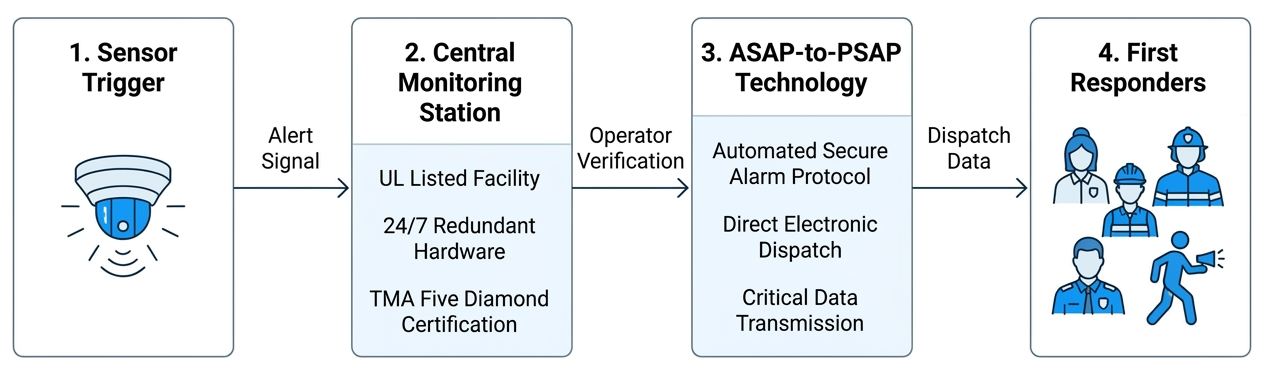
A professionally monitored system routes all sensor triggers through dedicated, redundant central stations staffed 24/7 by trained dispatchers who verify incidents and notify emergency personnel directly.
| Feature / Metric | 24/7 Professional Central Monitoring | Self-Monitoring (App Alerts Only) |
|---|---|---|
| Average Response Benchmark | ~45 seconds from signal to verification | Dependent entirely on homeowner alert review |
| Emergency Dispatch Method | Direct ASAP-to-PSAP / 911 dispatch | Manual call to local dispatch by property owner |
| Power / Internet Outages | Protected via internal battery & cellular link | Alerts fail if local home internet goes down |
| False Alarm Filtering | Two-way voice and video verification | Homeowner must self-verify via camera feeds |
| Insurance Premium Discount | Up to 15% – 20% with monitoring certificate | Typically ineligible for monitored policy discounts |
| Typical Monthly Fee | $15 to $53 / month | $0 to $10 / month (cloud storage fees) |
Reviewing our modern back-to-base monitoring guide offers deeper insights into how dedicated signal routing outperforms casual push notifications during severe emergencies.
Dedicated 24/7 Central Station Monitoring
A dedicated central station acts as an unwavering safety net for your property. Modern setups utilize encrypted 4G/5G cellular transmitters that bypass landline clipping and maintain direct communication even during neighborhood-wide power or internet outages.
With live operators monitoring critical life safety and security channels around the clock, you can enjoy peace of mind knowing you have uninterrupted 24/7 alarm monitoring protection standing by at all times.
Self-Monitoring and Video Verification
For secondary outbuildings, workshops, or budget-conscious setups, self-monitoring paired with smart video alerts provides an accessible first step. When cameras detect unauthorized movement, you receive immediate high-definition video clips on your mobile device.
Advanced AI video analytics differentiate between passing cars, pets, swaying branches, and actual human intruders. Understanding the essentials of integrated video monitoring platforms ensures you can visually assess any situation before escalating it to local authorities.
Core Hardware and Comprehensive Life Safety Add-Ons
An effective security foundation guards against physical perimeter breaches while simultaneously monitoring your environment for silent, destructive hazards.
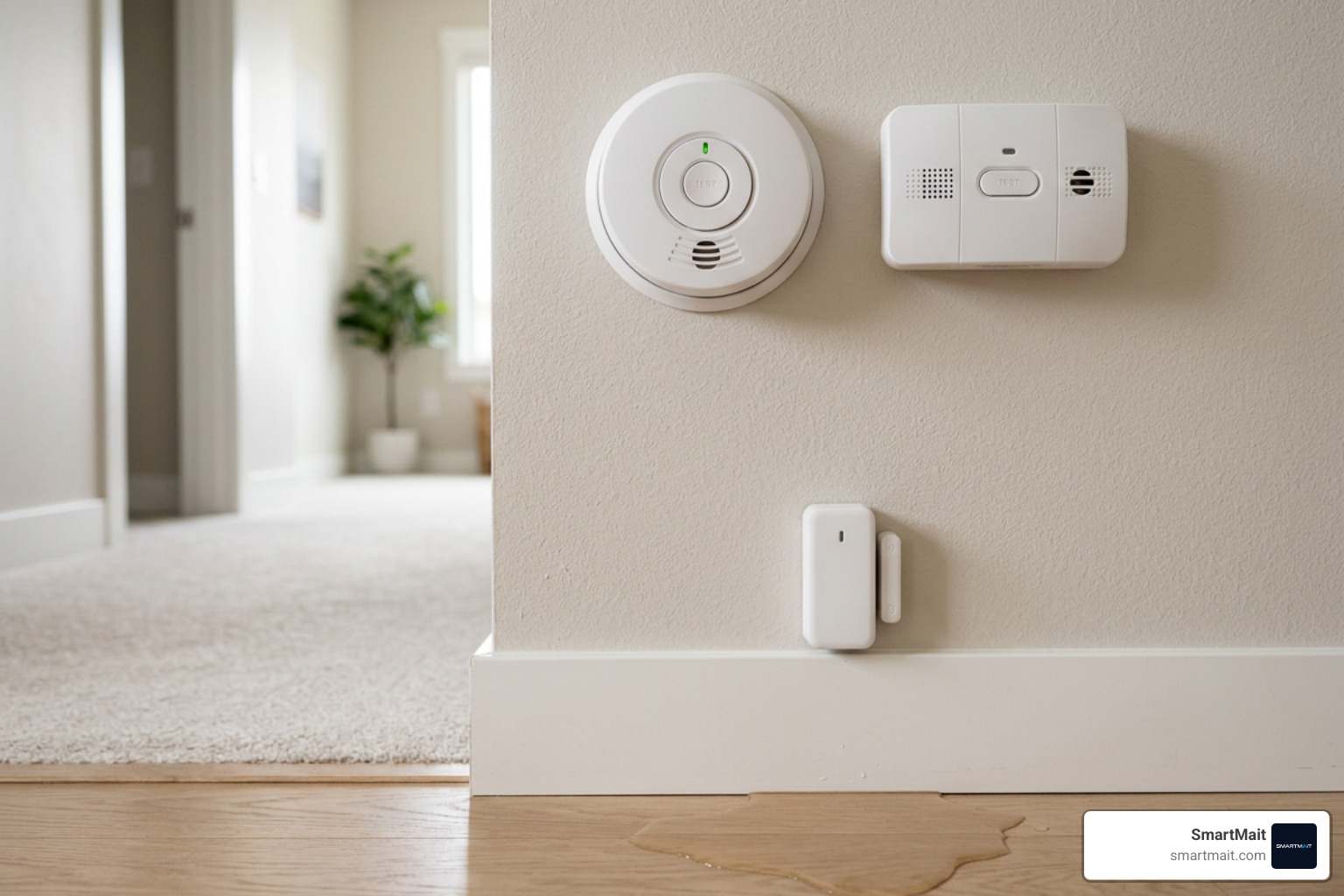
A comprehensive security installation incorporates:
- Perimeter Defense: Hardened door and window contact switches that trigger the moment a point of entry is opened.
- Glass-Break Detection: Acoustic sensors calibrated to detect the specific ultrasonic frequency of breaking plate, tempered, or laminated glass.
- Interior Motion Sensors: Dual-element infrared and microwave detectors configured to avoid false alarms from family pets.
Layering these devices allows you to secure your entire perimeter against unauthorized entry while discovering smart strategies for budget-friendly monitoring.
Environmental and Life Safety Sensors
Property threats extend beyond burglary. In many cases, environmental emergencies cause far more devastating and costly property damage:
- Monitored Smoke & Heat Detectors: Unlike standard battery buzzers, monitored smoke alarms alert the central station instantly, ensuring fire rescue dispatch even if no one is home.
- Carbon Monoxide Sensors: Electro-chemical sensors identify odorless, colorless gas buildup from faulty furnaces or water heaters before dangerous levels accumulate.
- Water Leak & Flood Sensors: Placed near water heaters, sump pumps, laundry rooms, and under sinks to detect moisture instantly, triggering smart shutoff valves to prevent catastrophic water damage.
- Low-Temperature Freeze Sensors: Monitor plumbing zones in crawl spaces and utility closets to alert you before freezing temperatures burst water pipes during harsh Michigan winters.
Repurposing Existing Hardware and System Takeovers
Moving into a property that already has a legacy hardwired alarm system does not mean you need to discard functional wiring and sensors. Professional integrators utilize hardwired-to-wireless takeover modules. These conversion boards wire directly into existing contact loops, translating legacy signals into modern, encrypted wireless data transmitted to a modern touchscreen panel.
By repurposing your existing security hardware, you can avoid costly wall patching and sensor repurchasing. Pairing your existing infrastructure with top-rated cellular and central station systems provides an immediate technology upgrade while keeping equipment expenses low.
Frequently Asked Questions About Alarm Monitoring
What is the average response time for professional alarm monitoring?
The industry standard response time for central monitoring stations is roughly 45 seconds from the moment an alarm signal reaches the receiver to operator acknowledgement. Top-tier monitoring facilities using ASAP-to-PSAP data links can cut emergency dispatch times down significantly compared to legacy phone-based centers.
Can existing security sensors work with a new monitoring service?
Yes. In most cases, existing hardwired door contacts, window sensors, and motion detectors can be linked to a new control panel using hardwired-to-wireless takeover modules or Z-Wave translation boards. As long as the underlying wiring and sensor switches remain physically sound, a modern panel can monitor your existing equipment without issue.
Do insurance companies offer discounts for professionally monitored alarms?
Most major homeowners insurance carriers offer policy discounts ranging from 5% to 20% for properties protected by 24/7 professionally monitored systems. To claim this discount, your provider will supply an official Certificate of Monitoring verifying that your system includes continuous burglary, fire, and life safety monitoring.
Conclusion
Securing your home requires a dependable blend of professional monitoring, reliable hardware communication, and ongoing technical support. At SmartMait, we deliver tailored security, access control, and smart automation across Oakland, Macomb, and Wayne counties. From high-performance Z-Wave mesh networks to full smart-home integration in Birmingham, Bloomfield Hills, Rochester Hills, Troy, and Farmington Hills, we build systems designed for long-term reliability.
Unlike installers who set up equipment and vanish, our SmartService concierge maintenance program provides continuous system optimization, seasonal health checks, and responsive support. Explore our complete smart home automation and security services to discover how seamless professional protection can be.