Going Up? A Guide to Modern Elevator Card Access Systems
How Elevator Access Card Technology Secures Commercial Buildings
In any multi-story commercial property, the lobby doors are only the first line of defense. Once someone passes the main entrance, elevators become an open highway to executive suites, research labs, inventory rooms, and private residential penthouses. Leaving vertical transit unrestricted leaves your facility exposed to theft, industrial espionage, and tenant safety risks.
An elevator card access system solves this by turning elevator cabs into secured checkpoints. Instead of pressing any button on the car operating panel (COP) and heading straight to a restricted floor, passengers must authenticate themselves first.
Vertical transit access control delivers three core security benefits:
- Elimination of Unrestricted Wandering: Visitors cannot accidentally or intentionally wander into tenant suites or sensitive operational zones.
- Granular Time-Based Protection: Floors can remain open to the public during normal business hours (such as 8:00 AM to 5:00 PM) and automatically lock down after hours, requiring a validated credential.
- Complete Digital Accountability: Every elevator ride to a secure floor is logged with a timestamp, credential ID, and destination, establishing a clear audit trail.
Understanding Elevator Access Card Frequencies and Credentials
Not all access cards offer the same level of protection. Choosing the right credential technology is critical to preventing credential cloning and unauthorized access.
- Legacy 125 kHz Proximity Cards: These older cards transmit a basic, unencrypted facility code and card number. Handheld duplication tools can clone these cards in seconds. While common in older facilities, low-frequency cards represent a major security vulnerability for modern commercial spaces.
- 13.56 MHz High-Frequency Smart Cards: Standards like MIFARE DESFire EV2 and EV3 use multi-layered cryptographic keys to secure data transmission. Upgrading to modern high-frequency card access technology protects your vertical access against card duplication.
- Mobile Credentials (BLE and NFC): Modern readers let occupants use their smartphones or smartwatches via Apple Wallet or dedicated apps. Mobile credentials offer convenience, support multi-factor biometric authentication (like Face ID), and eliminate the ongoing cost of replacing lost plastic badges.
- Anti-Copy Rolling Codes: Advanced smart cards utilize dynamic rolling codes that change with every communication exchange, ensuring intercepted signals cannot be replayed by bad actors.
Hardware Architecture: Traveling Cables, Controllers, and COP Readers
Connecting access control hardware to a moving elevator cab requires specialized commercial low-voltage infrastructure.

The physical architecture involves three primary elements:
- The Car Operating Panel (COP) Reader: A low-profile RFID, smart card, or mobile reader mounted directly into or alongside the elevator button panel.
- The Traveling Cable: The flexible multi-conductor cable hanging beneath the elevator cab that carries power, data, and relay signals from the moving cab to the elevator machine room. Modern retrofits often utilize RS-485 serial communication or CAN bus signaling to transmit data over twisted-pair lines within the traveling cable, avoiding the need to pull dozens of individual wires.
- Relay Expansion Boards and Controllers: The reader transmits credential data to a dedicated access control controller located in the elevator machine room or low-voltage closet. The controller activates specific relays wired into the elevator cab’s button matrix, enabling only the floor buttons the user is authorized to press.
Key Features to Look for in a Commercial Elevator Access Solution
When specifying an elevator access system for an office building, medical center, or mixed-use development, look for flexible software rules and seamless user experiences.
Customizing Elevator Access Card Permissions by Floor and Role
Modern access software allows property managers to build precise, role-based access profiles:
- Tenant Partitioning: Restrict commercial tenants strictly to the floors they lease, plus common amenity levels (such as fitness centers or rooftop lounges).
- Vendor and Contractor Passes: Provide maintenance staff or cleaning crews temporary access to service floors, mechanical rooms, or tenant suites only during assigned shifts.
- Executive Privilege: Enable single-badge access to executive suites and boardrooms, bypassing standard floor restrictions.
- Multi-Site Credentialing: Program a single badge or mobile credential to open perimeter doors and call elevators across multiple buildings in a corporate campus.
Destination Dispatch vs. Traditional Floor-Relay Control
Building owners can choose between two main control topologies based on traffic volume and security needs.
| Feature / Capability | Traditional Car-Relay Control | Destination Dispatch Integration |
|---|---|---|
| Reader Location | Inside the elevator cab on the COP | Lobby kiosks, turnstiles, or hall-call stations |
| User Interaction | Enter cab, swipe card, press authorized button | Swipe card in lobby, system assigns specific elevator car |
| Traffic Optimization | Standard FIFO call queuing | Groups passengers by floor to cut wait times |
| Cabling Complexity | Traveling cable relays inside every cab | Network connection at lobby stations and central elevator bank controller |
| Best Suited For | Low- to mid-rise buildings, retrofits (2–8 floors) | High-traffic, multi-tenant high-rises (8+ floors) |
Mitigating Piggybacking, Tailgating, and Elevator Surfing
“Elevator surfing” occurs when an unauthorized individual enters an elevator behind a valid user and rides along to a restricted floor when the doors open. To counter this, advanced access control strategies include:
- The “One-Button” Rule: After a credential is swiped, the system unlocks permitted floor buttons for a strict time window (e.g., 5 seconds) and registers only one button press before locking down again.
- Integrated Optical Turnstiles: Positioning card-controlled turnstiles in the elevator lobby stops unauthorized visitors before they ever reach the elevator doors.
- Floor Sensor Feedback: Integrating with elevator load-weighing sensors and door-beam counters allows the system to flag suspicious occupancy mismatches.
Integrating Elevator Controls with Building-Wide Security and Automation
An elevator access system should not exist in a silo. It performs best as part of an integrated building automation and security ecosystem.
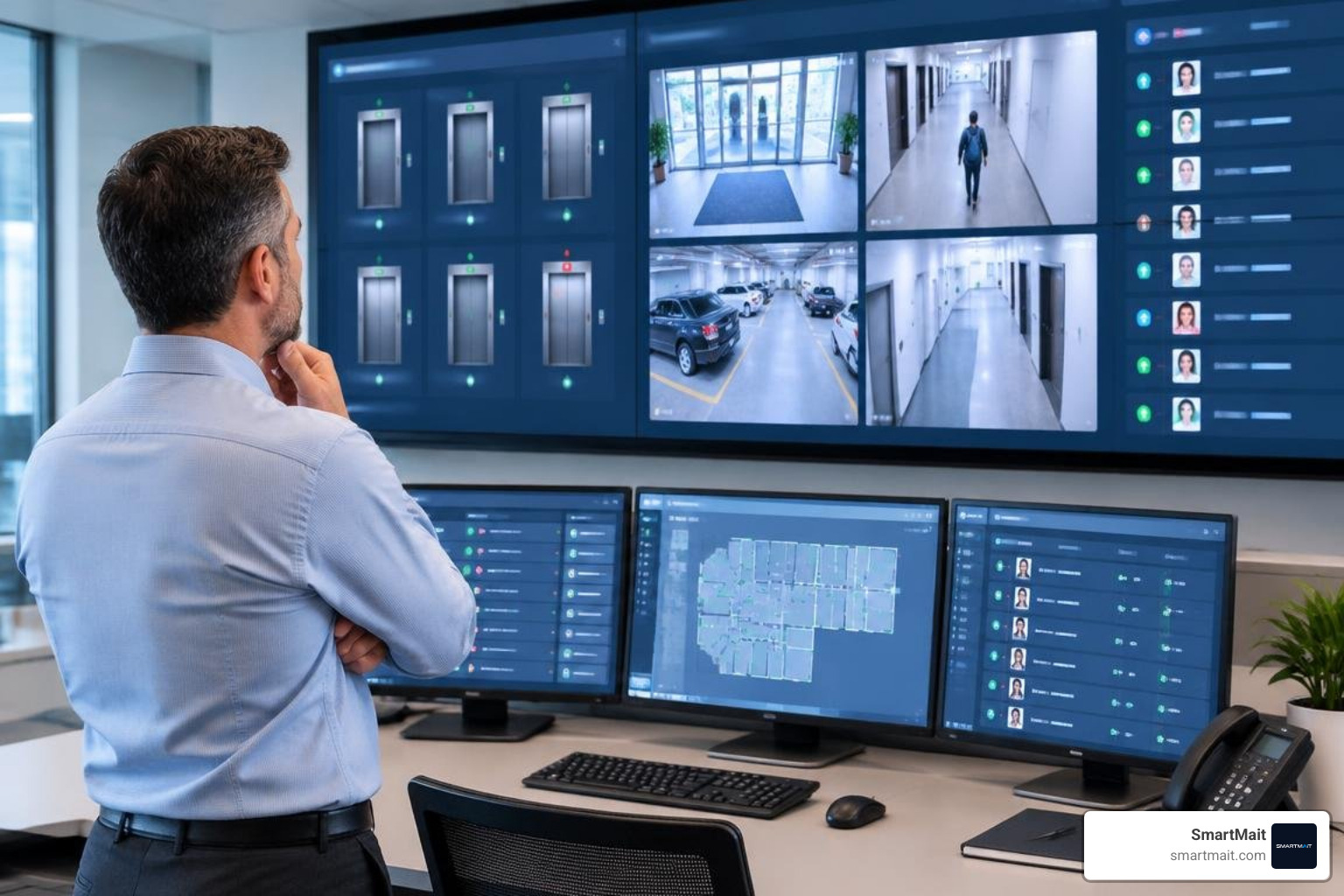
Unifying Door Readers, Surveillance, and Vertical Access
Connecting vertical control with workplace door access control solutions and perimeter gates creates a unified security perimeter. When a tenant swipes into the parking garage, passes through the main entryway, and enters the elevator, their movement is managed through one credential database.
Pairing elevator events with IP security cameras enables automated video tagging. If an unauthorized user attempts to select a restricted floor, the system triggers a camera preset to record the cab interior, logging a short video clip alongside the access event for rapid review. Linking these systems with comprehensive electronic door access systems ensures complete visibility from the sidewalk to the suite.
Remote Management, Cloud Administration, and Audit Trails
Cloud-managed access platforms give property administrators complete operational control from any browser or mobile app:
- Instant Revocation: Deactivate lost badges or departed employee credentials in seconds across all doors and elevators.
- Real-Time Dashboards: Monitor elevator traffic patterns, track after-hours access attempts, and receive instant alerts for door forced or tamper alarms.
- Exportable Audit Logs: Generate detailed compliance reports showing who accessed specific floors during security audits or incident investigations.
Code Compliance, Installation, and Maintenance in Michigan
Installing elevator access controls requires strict adherence to safety standards and local low-voltage building codes.
Navigating ASME A17.1, ADA Standards, and LARA Elevator Codes
Elevator access modifications in Michigan must comply with state safety regulations and national standards:
- Emergency Fire Service Override: In accordance with ASME A17.1 safety codes, access control systems must immediately release and fail-safe during Phase I Emergency Recall and Phase II In-Car Firefighter Operation, returning full, unrestricted control to emergency personnel.
- Michigan LARA Compliance: Work must align with Michigan elevator licensing and safety standards enforced by the Department of Licensing and Regulatory Affairs (LARA).
- ADA Accessibility: Card readers and destination kiosks must be installed at ADA-compliant heights (between 34 and 48 inches above the finished floor) with clear tactile and audible feedback.
Commercial Retrofit vs. New Construction in Metro Detroit
Whether modernizing a historical multi-story property in Birmingham, an established corporate facility in Troy, or a private medical practice in Bloomfield Hills, installation strategies differ:
- New Construction: Enables low-voltage integrators to rough in dedicated Cat6 structured cabling, fiber backbones, and high-capacity traveling cables alongside the elevator contractor’s initial build.
- Commercial Retrofits: Requires careful evaluation of existing traveling cables and relay space within existing car operating panels. Modern serial interfaces minimize the need for full cable replacements.
At SmartMait, we provide turnkey low-voltage integration backed by our SmartService concierge maintenance program. Instead of leaving you with an unmanaged system after installation, we provide ongoing firmware updates, credential management support, hardware maintenance, and annual code compliance checks across Oakland, Wayne, and Macomb counties.
Frequently Asked Questions About Elevator Access Systems
How does an elevator access control system handle emergency fire service modes?
Under ASME A17.1 and NFPA guidelines, life safety systems always supersede access control. When a building fire alarm triggers Phase I Emergency Recall, or when a firefighter inserts a physical service key for Phase II operation, the access controller immediately cuts power to the floor-lock relays. All floor buttons become fully functional for emergency personnel.
Can one credential work across building perimeter doors, parking gates, and elevators?
Yes. By deploying multi-technology smart card or mobile credential readers, tenants can use a single card, keyfob, or smartphone wallet pass to unlock parking barriers, exterior doors, amenity areas, and elevator cabs.
How are visitor elevator permissions managed in multi-tenant buildings?
Property managers can issue temporary digital guest passes via SMS or email containing time-limited QR codes or mobile links. When visitors arrive, scanning their QR code at a lobby intercom kiosk or destination dispatch station unlocks only the host’s floor for a single trip.
Conclusion
Securing your building’s vertical transit is essential for protecting tenants, sensitive assets, and operational workflows. Moving to modern, encrypted elevator access credentials eliminates blind spots and streamlines everyday movement throughout your facility.
SmartMait designs, installs, and maintains commercial access control, video surveillance, structured cabling, and smart automation systems throughout Troy, Birmingham, Bloomfield Hills, Rochester Hills, Royal Oak, and Metro Detroit. Our dedicated low-voltage specialists ensure your system meets all Michigan safety standards while delivering lasting reliability through our SmartService concierge support.
Ready to modernize your building’s vertical security? Learn more about our SmartMait commercial access control solutions or schedule a consultation with our low-voltage integration team today.