How to Choose the Perfect Electronic Card Lock System for Your Building
Choose an Electronic Card Lock System That Fits Your Building
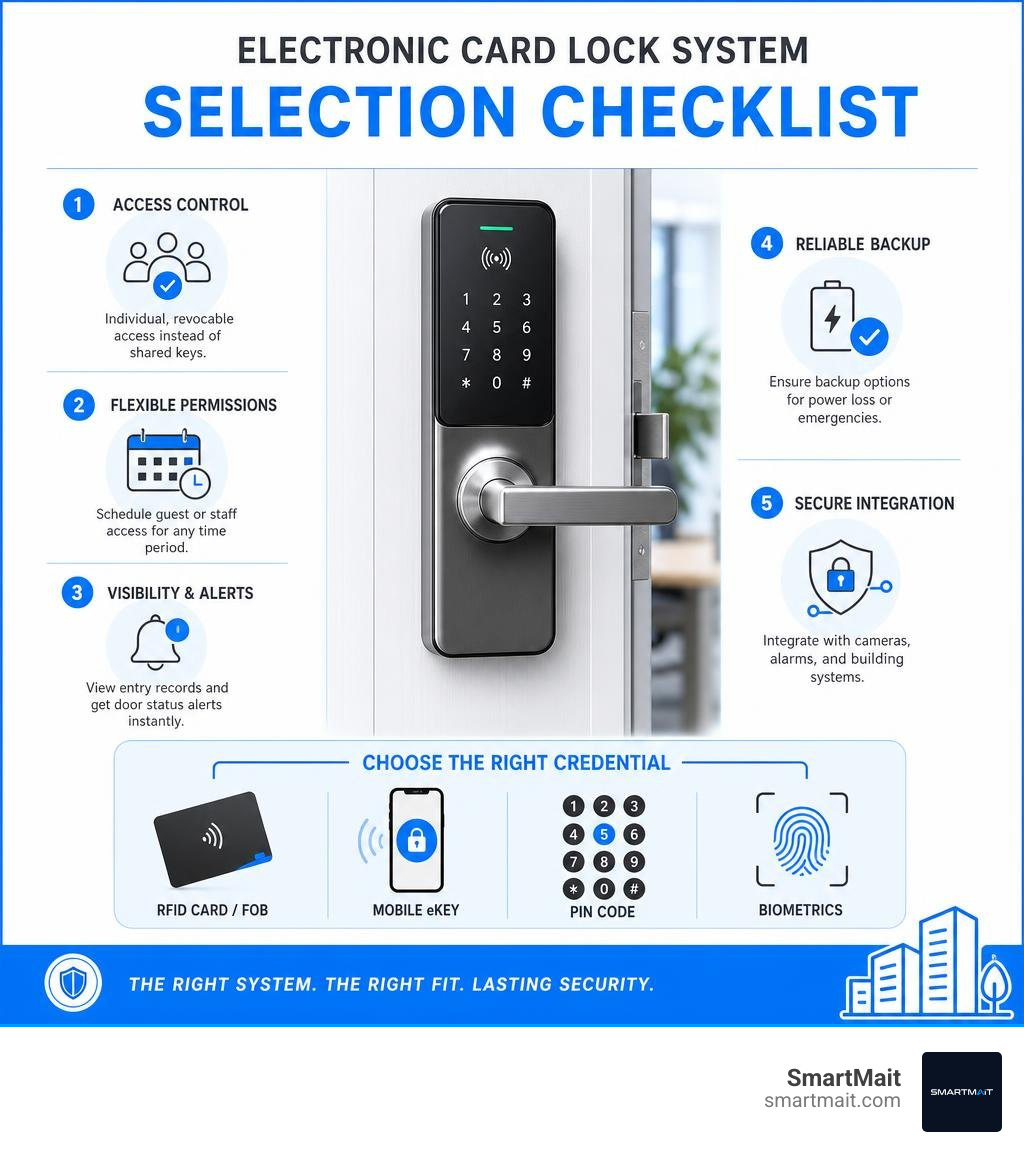
The right access control door lock gives approved people simple entry while keeping everyone else out. Start by choosing the credential your people will actually use – encrypted RFID cards or fobs, mobile eKeys, PINs, or biometrics – then confirm the lock works with your door, network, power plan, and security goals.
For most homes and small businesses, a good system should provide:
- Individual, revocable access instead of shared metal keys.
- Scheduled guest or staff permissions for cleaners, contractors, visitors, and former employees.
- Entry records and door-status alerts so you can see who accessed a door and when.
- A reliable backup plan, such as a mechanical override, emergency battery connection, or battery backup.
- Secure integration with cameras, alarms, and smart-home or building-management platforms where needed.
Electronic card locks are not all the same. A battery-powered smart deadbolt may suit a residence or a single office door. A busy commercial entry may need a controller, electrified strike or mortise hardware, encrypted credentials, and code-compliant egress. The goal is not to buy the lock with the longest feature list. It is to build an access system that remains dependable when Wi-Fi drops, batteries run low, an employee leaves, or a delivery arrives after hours.
I’m Dominic Hesano, and I’ve spent years troubleshooting low-voltage wiring, security systems, and smart-home setups across Southeast Michigan. In this guide, I’ll help you evaluate each access control door lock option from the door hardware and credentials to installation, power, and long-term reliability.
Simple guide to access control door lock:
Evaluating Every Access Control Door Lock Type and Unlocking Method
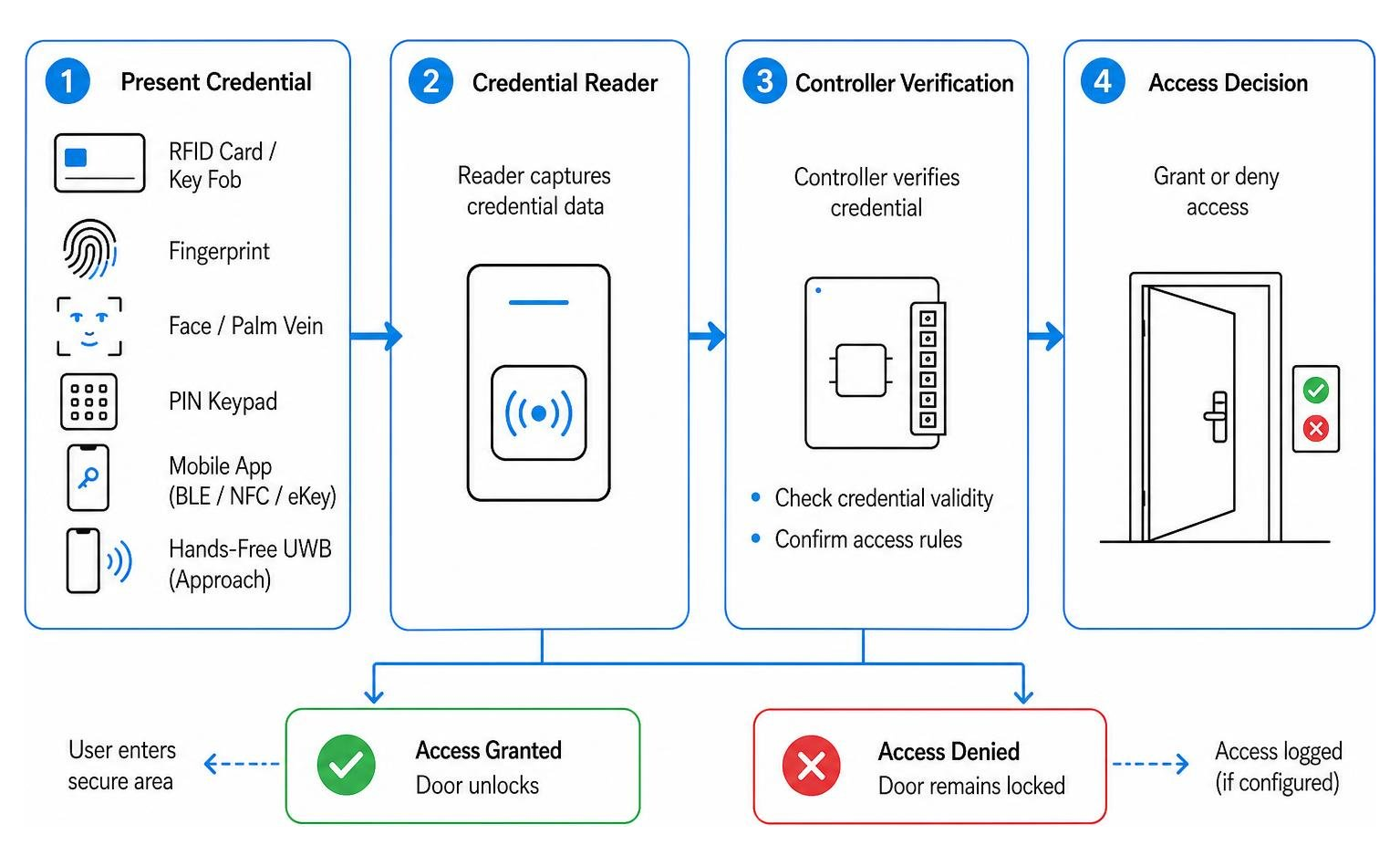
Selecting the right unlocking method requires balancing day-to-day convenience against strict security protocols. Hardware options range from standalone smart deadbolts to multi-credential commercial panels. Understanding the operational friction, credential security, and response time of each method ensures your system serves its intended purpose without causing user frustration.
For a deeper dive into credential selection, explore our Key Card Access Systems A Buyer Guide.
| Credential Format | Security Level | Recognition Speed | Best Use Case | Primary Limitation |
|---|---|---|---|---|
| High-Frequency RFID (MIFARE / DESFire) | Very High | < 0.2 seconds | Commercial offices, multi-tenant entries | Requires carrying physical card/fob |
| Biometric Fingerprint | High | 0.3 seconds | High-end residential, executive suites | Degrades with wet or dirty fingers |
| Touchless 3D Face / Palm Vein | Extremely High | < 0.4 seconds | High-security zones, luxury estates | Higher initial hardware investment |
| Randomized PIN Keypads | Moderate to High | 2.0–4.0 seconds | Guest access, utility rooms, deliveries | Vulnerable to observation if unshielded |
| Mobile App (BLE / NFC / eKey) | High | 0.5–1.5 seconds | Remote unlocking, flexible staff access | Dependent on phone battery and Bluetooth state |
| Hands-Free UWB (Ultra-Wideband) | High | Real-time approach | Executive entry, private garages, hands-full access | Requires modern compatible mobile devices |
Comparing RFID Cards, Key Fobs, and Mobile Credentials
Radio-frequency identification (RFID) remains an industry standard for commercial buildings and shared residential entries. Modern deployments have shifted away from legacy 125 kHz proximity cards—which broadcast unencrypted facility codes that are vulnerable to basic handheld cloning devices—toward 13.56 MHz smart cards utilizing high-grade cryptographic handshakes.
Hardware such as the Lockly Secure Plus | Special Edition with Card Access | Lockly® can store up to 99 distinct RFID cards and 99 fingerprints, providing flexibility for light commercial environments.
For an in-depth look at encrypted credentials, check out The Ultimate Guide To Modern Card Access Technology. For facilities managing frequent shift rotations and physical badge issuance, discover Why The Badge Access Door System Is Still King.
Next-Gen Biometrics and Proximity Entry Innovations
Biometric security has evolved beyond basic optical fingerprint pads. Advanced residential hardware like the Aqara U100 Smart Door Lock – Biometric & Apple Home Compatible – Aqara LLC utilizes sub-dermal semiconductor fingerprint readers with a 98.6% recognition accuracy rate, storing up to 50 fingerprints locally with AES-128 encryption.
In high-security and luxury environments, systems like the KX2 Pro Smart Lock: Face & Palm Vein with Intercom | KEYPLUS combine touchless 3D facial recognition with sub-dermal palm vein scanning. By reading subcutaneous vascular patterns, palm vein scanning delivers a False Acceptance Rate (FAR) under 0.0001% and a False Rejection Rate (FRR) under 0.01%.
For individuals seeking frictionless, barrier-free access adaptations, resources like the Door Locks – Assistive Devices – Veterans catalog highlight how hands-free and biometric systems dramatically improve physical accessibility. Additionally, the Smart Lock U400 – One of The World’s First Apple UWB Smart Locks – Aqara LLC demonstrates spatial awareness: its built-in Ultra-Wideband (UWB) transceiver calculates distance and entry vector, unlocking the deadbolt precisely as an authorized user steps up to the threshold.
Key Hardware and Security Standards for Commercial and Residential Buildings
Physical build quality is just as important as digital encryption. An electronic lock with military-grade encryption is useless if its mechanical deadbolt shears under modest pressure.
When evaluating locks, verify ANSI/BHMA (Builders Hardware Manufacturers Association) grading:
- BHMA Grade 1: Heavy commercial duty, tested to withstand 1 million cycles and high-impact hammer strikes.
- BHMA Grade 2: Light commercial and high-security residential duty, rated for 400,000 cycles.
- BHMA Grade 3: Standard residential security, tested to 200,000 cycles.
Weatherproofing is equally crucial across Michigan’s harsh seasonal shifts. Exterior escutcheons must carry an IP65 ingress rating to guard internal printed circuit boards against dust, heavy rain, and freeze-thaw cycles ranging from -31°F to 151°F.
To plan comprehensive physical protections, read our guide to Secure Your Workspace With Modern Door Access Control Solutions.

Magnetic Locks vs. Electrified Strikes and Mortise Latches
Selecting the right physical locking hardware depends on door construction, traffic volume, and strict adherence to life safety and fire codes.
For specialized architectural challenges, such as floor-to-ceiling glass installations, see our breakdown on Securing Your View With A Glass Door Maglock.
Controllers, Door Sensors, and Audit Trails
The brain of any robust commercial installation is the central access controller. Rather than each lock processing credentials independently, readers transmit data to a centralized panel installed within a secure server closet.
Integrated door position sensors (such as internal gyroscopes or frame-mounted magnetic reeds) track whether a door is physically latched or resting ajar. Audit trails log timestamps, user IDs, authentication methods, and unauthorized attempts. If an unapproved credential is presented multiple times, or if a door is held open beyond a set threshold, the controller triggers local sounders and dispatches push alerts to building managers.
Learn more about central controllers by reading Everything You Need To Know About Your Access Control Controller.
Smart Integration and Network Architecture
Modern access control systems should operate as an integrated part of your broader building intelligence. Linking your locks to video surveillance, intrusion alarms, automated lighting, and HVAC systems creates a responsive, unified environment.
Explore commercial workflow improvements in our guide to Upgrade Your Office With Better Door Entry Systems For Business.
Connectivity Protocols for Access Control Door Lock Ecosystems
Selecting the right communication protocol dictates network stability, battery longevity, and susceptibility to radio frequency interference:
- Z-Wave (908.42 MHz): Our preferred protocol for professional smart estates and light commercial buildings across Oakland, Macomb, and Wayne counties. Operating on a dedicated sub-GHz frequency band, Z-Wave bypasses crowded 2.4 GHz Wi-Fi channels, creating an ultra-reliable, encrypted mesh network with zero signal congestion.
- Zigbee 3.0 & Matter over Thread: Low-power 2.4 GHz mesh protocols providing rapid local execution across multi-vendor smart environments without relying on external cloud connections.
- Standalone Wi-Fi: Consumer-grade convenience found in devices like the August Wi-Fi Smart Lock | Secure Wi-Fi Lock | August Home. While eliminating the need for a separate bridge, direct 2.4 GHz Wi-Fi connections draw significantly more power, reducing battery life to approximately 3 months under standard use.
- Bluetooth Low Energy (BLE): Used primarily for direct smartphone-to-lock handshakes, initial device commissioning, and local proximity discovery.
For municipal and county security guidance, review the Safety and Security Information | Oakland County, MI portal.
Guest Management, Scheduled Access, and eKeys
Managing visitor access without compromising operational security is a major advantage of modern electronic locking hardware. Commercial platforms and advanced standalone deadbolts, like the Wi-Fi Smart Lock | Lockly Secure Pro | Lockly®, feature algorithmic Offline Access Codes (OAC). These allow administrators to issue time-bound PINs remotely that work even if the lock is completely disconnected from the local network.
For high-turnover environments, physical credentials like RFID key fobs streamline guest logistics. Discover the workplace advantages of these systems in our overview: Fob Door Entry System The Key To A Productive Office.
Installation Requirements, Door Compatibility, and Power Reliability
Before ordering hardware, an onsite architectural assessment must confirm physical door compatibility:
- Door Thickness: Standard residential doors measure 1 3/8 inches to 1 3/4 inches (35mm to 45mm), whereas commercial insulated steel doors frequently measure 2 inches to 2 3/4 inches (50mm to 70mm).
- Backset: Confirm whether your door uses a 2 3/8-inch (60mm) or 2 3/4-inch (70mm) backset from the door edge to the center of the bore hole.
- Bore Hole Diameter: Standard residential bore holes require a 2 1/8-inch opening, while commercial mortise preparations require precise pocket routing into the door stile.
- Door Alignment & Frame Latch Gap: If a door requires manual pulling or pushing to throw the bolt, motorized smart deadbolts will bind, stall, and rapidly drain their batteries.
To avoid costly installation errors, review our comprehensive resource on How To Choose Your Next Door Access Control System.
Maintenance and Power Management for an Access Control Door Lock
Power management dictates whether an electronic lock remains an asset or becomes a lockout liability:
- Battery Optimization: Low-power Zigbee and Z-Wave deadbolts operating on 4 standard AA batteries deliver 8 to 12 months of operation. Direct Wi-Fi deadbolts average 3 to 5 months. High-capacity lithium packs, like those in the KX2 Pro, sustain up to 500 charge-discharge cycles.
- Emergency Power Contacts: Exterior escutcheons should feature USB-C emergency power ports or 9V battery jumpstart terminals to jump a depleted system from the outside.
- Power over Ethernet (PoE): Commercial electrified strikes and maglocks run on dedicated 12V/24V low-voltage lines backed up by centralized UPS battery enclosures, ensuring seamless operation during grid outages.
- Mechanical Key Bypass: Standard 5-pin or 6-pin rekeyable cylinders provide a physical mechanical override if electronic components fail.
Keypads also serve as a reliable fallback. Learn why in our article on Why Every Building Needs A Door Entry Keypad.
Frequently Asked Questions about Door Access Control Systems
How do electronic card lock systems prevent unauthorized credential cloning?
Modern systems use high-frequency 13.56 MHz RFID technology (such as MIFARE DESFire EV2/EV3) featuring 128-bit or 256-bit AES cryptographic handshakes. Unlike legacy 125 kHz proximity cards that broadcast fixed numbers, smart cards execute dynamic, mutual challenge-response handshakes with the reader, making unauthorized skimming or cloning virtually impossible.
What happens to electronic door access systems during power outages?
Standalone smart locks run on internal batteries, keeping them fully functional during grid outages. Commercial electrified doors rely on central controllers backed up by 12V/24V sealed lead-acid or lithium UPS battery banks that provide 8 to 24+ hours of continuous uptime. In addition, exterior doors retain mechanical key cylinders, and fail-safe hardware automatically releases along designated emergency egress paths in compliance with local fire safety codes.
Can electronic card locks integrate into broader building security networks?
Yes. Professional access control systems link directly to local IP video surveillance, intrusion alarms, and whole-building automation controllers via Wiegand, OSDP (Open Supervised Device Protocol), or encrypted sub-GHz mesh protocols. Presenting an authorized badge can unlock the entryway, disarm the alarm partition, cue entry cameras to bookmark video footage, and trigger pathway lighting scenes.
Conclusion
A well-designed electronic access control system balances dependable physical hardware, unbreachable digital credentials, and intuitive daily operation. Whether you are securing a commercial facility in Troy, a luxury residence in Bloomfield Hills, or a boutique office in Birmingham, success comes down to choosing the right hardware for your doors, wiring, and workflow.
At SmartMait, we design, install, and support end-to-end access control, structured networking, smart lighting, and security infrastructure across Oakland, Macomb, and Wayne counties. Through our SmartService concierge maintenance program, we provide ongoing operational monitoring, firmware patching, battery replacements, and rapid onsite support so your access systems perform flawlessly year after year.
Ready to upgrade your property’s security? Connect with our engineering team today to explore our full suite of Commercial Access Control and Integrated Security Solutions.