Level Up Your Skills with Audio Visual Courses
How to Evaluate Audio Visual Installation Courses for Better AV Results
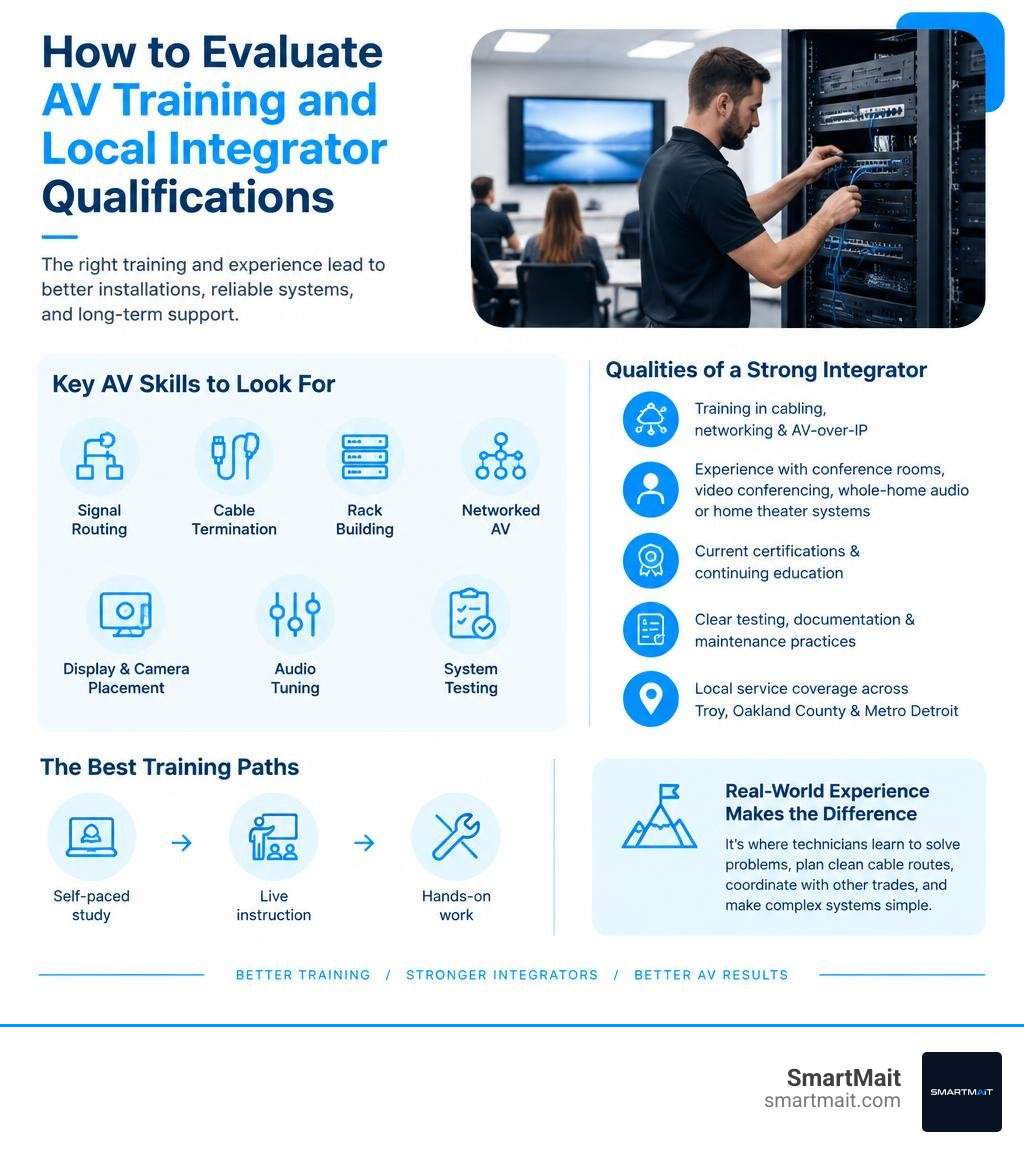
When comparing audio visual installation courses, look for training that covers signal routing, cable termination, rack building, networked AV, display and camera placement, audio tuning, and system testing. For a Metro Detroit business or homeowner, the key question is not simply whether an integrator completed a course. It is whether they can apply those skills to deliver a reliable system and support it after installation.
Prioritize integrators with:
- Training in structured cabling, networking, and AV-over-IP
- Experience with conference rooms, video conferencing, whole-home audio, or home theater systems
- Current industry certifications and continuing education
- Clear testing, documentation, and maintenance practices
- Local service coverage across Troy, Oakland County, and Metro Detroit
The strongest training paths combine self-paced study, live instruction, and hands-on work. Courses can build technical knowledge, but field experience is where technicians learn to diagnose signal issues, plan clean cable routes, coordinate with other trades, and make complex systems simple for the people who use them. Industry standards such as those maintained by AVIXA provide a useful benchmark for evaluating whether an integrator’s training reflects current commercial AV practices.
At SmartMait, our conference room AV and video conferencing work is built around that practical standard: dependable design, careful installation, and systems that fit the space. If you are planning an AV upgrade in Southeast Michigan, schedule a consultation to discuss the infrastructure, integration, and support your project needs.
I am Dominic Hesano, founder of SmartMait, and my experience troubleshooting low-voltage wiring, networks, security, and integrated home systems shapes how I evaluate audio visual installation courses and real-world technical skill. The goal is always the same: install systems correctly the first time, then remain available when a client needs help.
Discover more about audio visual installation courses:
Top Audio Visual Installation Courses and Training Programs

Professional audiovisual systems are no longer standalone setups featuring isolated amplifiers and analog video cables. Modern commercial facilities demand unified platforms where sound, ultra-high-definition video, control processing, and building management converge on enterprise data networks. As a result, educational programs in this field have evolved significantly.
When evaluating an integrator’s qualifications, business owners and property managers should examine the training methodologies behind the team. Leading industry education paths balance theoretical foundations with rigorous physical lab work:
- Virtual and On-Demand Classrooms: Ideal for mastering foundational topics such as digital signal processing math, bandwidth calculations, EDID management, and network subnetting.
- Manufacturer and Association In-Person Labs: Intensive workshops focused on hands-on rack fabrication, wire dressing, fiber optic termination, and live control protocol programming.
- Apprenticeship and Practicum Models: Extended learning formats that pair technical instruction with real-world job-site troubleshooting.
Understanding these structures helps clients assess technical capabilities during the vetting process. A foundational reference point for what proper execution entails can be found in our audio visual installation ultimate guide, which walks through end-to-end deployment workflows.
Foundational Audio Visual Installation Courses for Commercial System Integrators
At the foundational level, reputable coursework instills the strict mechanical and electrical standards required for commercial durability. Technicians learn that an AV system is only as dependable as its low-voltage infrastructure.
Key competencies taught in entry-to-intermediate installation courses include:
- Cable Termination and Testing: Best practices for terminating Category cabling (Cat6/Cat6A), shielded audio lines, coaxial runs, and fiber optics, including verification via time-domain reflectometers.
- Signal Routing Fundamentals: Understanding analog versus digital signal degradation, balanced versus unbalanced audio feeds, impedance matching, and transmission limits over copper.
- AV Math and System Calculations: Calculating throw distances, speaker coverage patterns, power amplifier loads, heat dissipation in BTUs, and structural load limits for mounted hardware.
- Equipment Rack Fabrication: The art of thermal management, power distribution, signal-type separation (preventing high-voltage AC from inducing hum into low-voltage mic lines), and clean lacing.
- Network Basics: Subnetting, IP addressing, switch configuration, and VLAN separation to ensure AV traffic does not disrupt corporate business operations.
For medical offices, professional suites, retail stores, and multi-tenant commercial properties throughout Oakland County, selecting an integration partner with verified foundational training prevents costly rework. Reviewing what goes into professional audio video installation illustrates why clean wire management and proper physics calculations are non-negotiable on day one.
Advanced Audio Visual Installation Courses for Conference Rooms and Video Conferencing
Moving beyond basic connectivity, advanced coursework centers on complex unified communications (UC), room acoustics, automated switching, and enterprise collaboration spaces. In modern corporate environments, boardrooms must connect flawlessly with remote participants across Microsoft Teams, Zoom Rooms, or hybrid platforms with zero user friction.
Advanced training curricula emphasize:
- Acoustic Modeling and DSP Tuning: Setting up digital signal processors with acoustic echo cancellation (AEC), noise reduction filters, auto-mixing, and proper gain staging to eliminate room reverberation.
- Intelligent Video Tracking: Designing multi-camera layouts with PTZ auto-framing, presenter tracking, and ceiling microphone beamforming arrays.
- AVoIP Architectures: Distributing uncompressed 4K video over standard 1GbE or 10GbE network switches using protocols such as Dante AV, SDVoE, or SMPTE ST 2110.
- Building Integration: Tying video conferencing hardware into motorized window shades, smart occupancy sensors, and room environmental controls.
These competencies are especially critical when addressing commercial retrofit challenges in historic or existing office buildings across Troy, Birmingham, Bloomfield Hills, Royal Oak, Rochester Hills, West Bloomfield, Novi, Grosse Pointe, Detroit, and broader Oakland County. Unlike new construction, where conduit paths and ceiling heights can be planned ahead of time, retrofitting demanding conference room technology requires deep diagnostic mastery to route signals through solid walls, navigate plenum spaces, and adhere to local building codes.
Interactive Media and Commercial Presentation Technology Programs
Beyond standard boardrooms, commercial properties often require interactive media walls, digital signage networks, and automated presentation systems. Specialization programs in this category teach technicians how to deploy interactive displays, ambient light sensors, automated video wall processors, and room scheduling panels.
In high-traffic settings like healthcare waiting suites, automotive design studios, or flagship retail stores, interactive presentation systems must run continuously without system crashes. Integrators trained in these media environments understand how to balance high processing power with active thermal cooling, redundant power supplies, and automated system health monitoring.
Core Curriculum: Essential Skills Taught in Modern AV Programs

Whether a technician completes an intensive industry certification track or specialized low-voltage training, the core curriculum of modern commercial audiovisual engineering centers on five interconnected pillars:
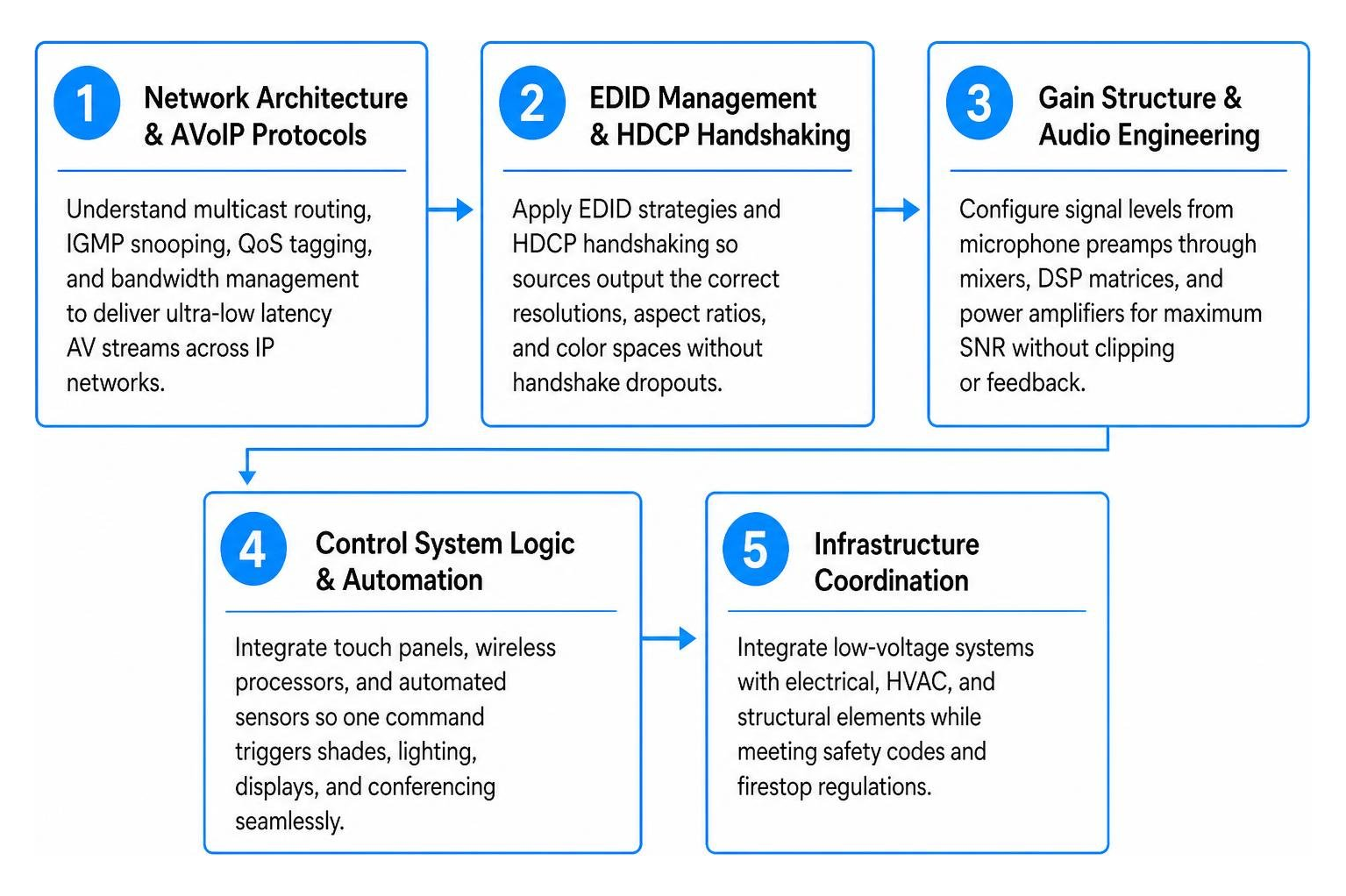
- Network Architecture & AVoIP Protocols: Audio and video systems reside on the IP network. Technicians must understand multicast routing, IGMP snooping, Quality of Service (QoS) tagging, and bandwidth management to ensure ultra-low latency streams across local switches.
- EDID Management & HDCP Handshaking: Digital video signals require precise Extended Display Identification Data (EDID) strategies so that sources (laptops, media players, cameras) output the correct resolutions, aspect ratios, and color spaces without handshake dropouts.
- Gain Structure & Audio Engineering: Technicians learn how to configure signal levels from microphone preamplifiers through mixers, DSP matrices, and power amplifiers, ensuring maximum signal-to-noise ratios without introducing clipping or feedback.
- Control System Logic & Automation: Integrating touch panels, wireless control processors, and automated sensors into a cohesive interface. When a presenter taps “Meeting Start,” the shades lower, the lighting adjusts, the display activates, and the conferencing codec dials into the bridge seamlessly.
- Infrastructure Coordination: Integrating low-voltage systems with high-voltage electrical, HVAC ductwork, and structural wall framing according to local safety codes and firestop regulations.
Mastering these areas ensures that complex installations behave predictably. To see how these engineering elements translate into clean architectural blueprints, you can read our guide on how to master AV system design.
Industry Certifications vs. Degree Pathways
When hiring an integration team for a commercial or high-end residential project, understanding the difference between manufacturer credentials, industry certifications, and academic degrees is essential.
Industry certifications, such as AVIXA’s Certified Technology Specialist (CTS, CTS-D for Design, CTS-I for Installation), focus heavily on real-world installation standards, safety codes, mathematical validation, and cross-platform troubleshooting. In contrast, academic degrees in electrical engineering, media technology, or broadcast systems offer broad theoretical frameworks and software development exposure, but may lack daily field wiring and code compliance practice.
| Pathway | Primary Focus | Best Suited For | Continuing Education |
|---|---|---|---|
| CTS / CTS-I / CTS-D | Field installation standards, rack design, AV math, codes, system testing | Commercial integrators, field lead technicians, system designers | Mandatory renewal every 3 years via CEUs |
| Manufacturer Certifications | Brand-specific hardware setup, specialized DSP software, direct control logic | Commissioning technicians, enterprise platform specialists | Regular updates aligned with firmware and new product launches |
| Associate / Technical Degrees | Electronics theory, basic signal paths, general studio production | Entry-level technical apprentices, production assistants | Varies by institution |
| University Engineering Degrees | Advanced circuit design, digital signal processing algorithms, software | Hardware engineers, firmware developers, high-level project architects | Voluntary professional engineering credits |
For commercial building owners, verifying that an integrator maintains active CTS credentials and manufacturer-certified technicians ensures the team understands standards-based installation. This technical rigor directly supports broader commercial audio video system design goals, ensuring systems remain scalable over years of operation.
Frequently Asked Questions About Audio Visual Installation Training
What training should a commercial AV integrator’s technicians have?
Qualified commercial AV technicians should have documented training in basic electrical safety, low-voltage cable pulling, structured cabling standards, digital signal routing, and IP networking. They should understand how to terminate Cat6A, coaxial, and fiber cables, read architectural plan sets, calculate speaker impedance, and configure digital signal processors. In addition, technicians working in Metro Detroit commercial properties should be familiar with local building codes, plenum-space fire regulations, and proper safety practices for mounting heavy displays and ceiling hardware.
How long does it take to become certified in professional AV installation?
Achieving recognized baseline industry certification, such as the CTS credential, typically takes between six months and two years of combined classroom study and field experience. While self-paced prep courses can be completed over several weeks, mastering system commissioning, physical rack wiring, and troubleshooting requires hands-on job-site hours. Furthermore, professional credentials require ongoing continuing education units (CEUs) every three years, ensuring technicians stay up to date with evolving AVoIP standards and network security protocols.
What should a business look for when hiring a commercial AV integrator?
When selecting an AV integrator, businesses should evaluate:
- Proven Unified Communications Experience: A track record of designing reliable conference room AV and video conferencing systems.
- In-House Low-Voltage Capabilities: Expertise in structured cabling, network switch setup, and clean rack fabrication.
- Integrated Solutions: The ability to unite access control, video surveillance, climate automation, and lighting into a single ecosystem.
- Ongoing Maintenance and Support: Look for integrators offering dedicated post-installation support plans—such as our SmartService concierge maintenance program—so your systems receive proactive firmware updates, routine tuning, and rapid on-site service across Troy, Birmingham, Bloomfield Hills, and the greater Metro Detroit area.
Conclusion
A well-engineered audiovisual system elevates how your team collaborates, communicates with clients, and presents your brand. However, high-performance equipment only delivers when supported by proper infrastructure, standards-based installation, and ongoing maintenance.
At SmartMait, we combine certified low-voltage expertise with an integrated approach to commercial technology. Headquartered in Troy, Michigan, we design, install, and support conference room AV, access control, video surveillance, structured cabling, and smart automation systems for businesses throughout Oakland County and Metro Detroit. Through our ongoing SmartService maintenance program, we stay actively involved long after the initial build, protecting your technology investment and keeping your systems operating smoothly.
Schedule a consultation with our engineering team today to review your commercial AV project requirements and build an audiovisual solution tailored to your space.