Modern Connectivity for Commercial Access Control in Metro Detroit
Moving Beyond Landline-Dependent Building Security
For alarm monitoring without a landline, have a local integrator check whether your existing alarm panel can send signals over a cellular or internet connection. Confirm that your monitoring provider supports the new path, then test alarm signals, backup power, and what happens when the internet goes down before removing the phone line. This transition matters for commercial properties across Troy, Birmingham, and the greater Metro Detroit area, where aging copper infrastructure no longer provides the reliability that modern building security demands.
If you’re also updating access control at a Metro Detroit business, review its network and cabling separately. A connected door reader helps manage entry, but it does not replace alarm monitoring. The same structured cabling that supports access control can also carry encrypted alarm signals, but each system needs its own supervised communication path and backup planning. Explore SmartMait’s integration services or contact SmartMait to plan a consultation.
I’m Dominic Hesano, founder of SmartMait. My hands-on work with security systems and low-voltage wiring in Southeast Michigan informs how I assess alarm monitoring without landline connections alongside commercial access control. For a broader look at how monitored alarm systems operate, the security alarm entry on Wikipedia provides useful background on signal transmission and supervision concepts.
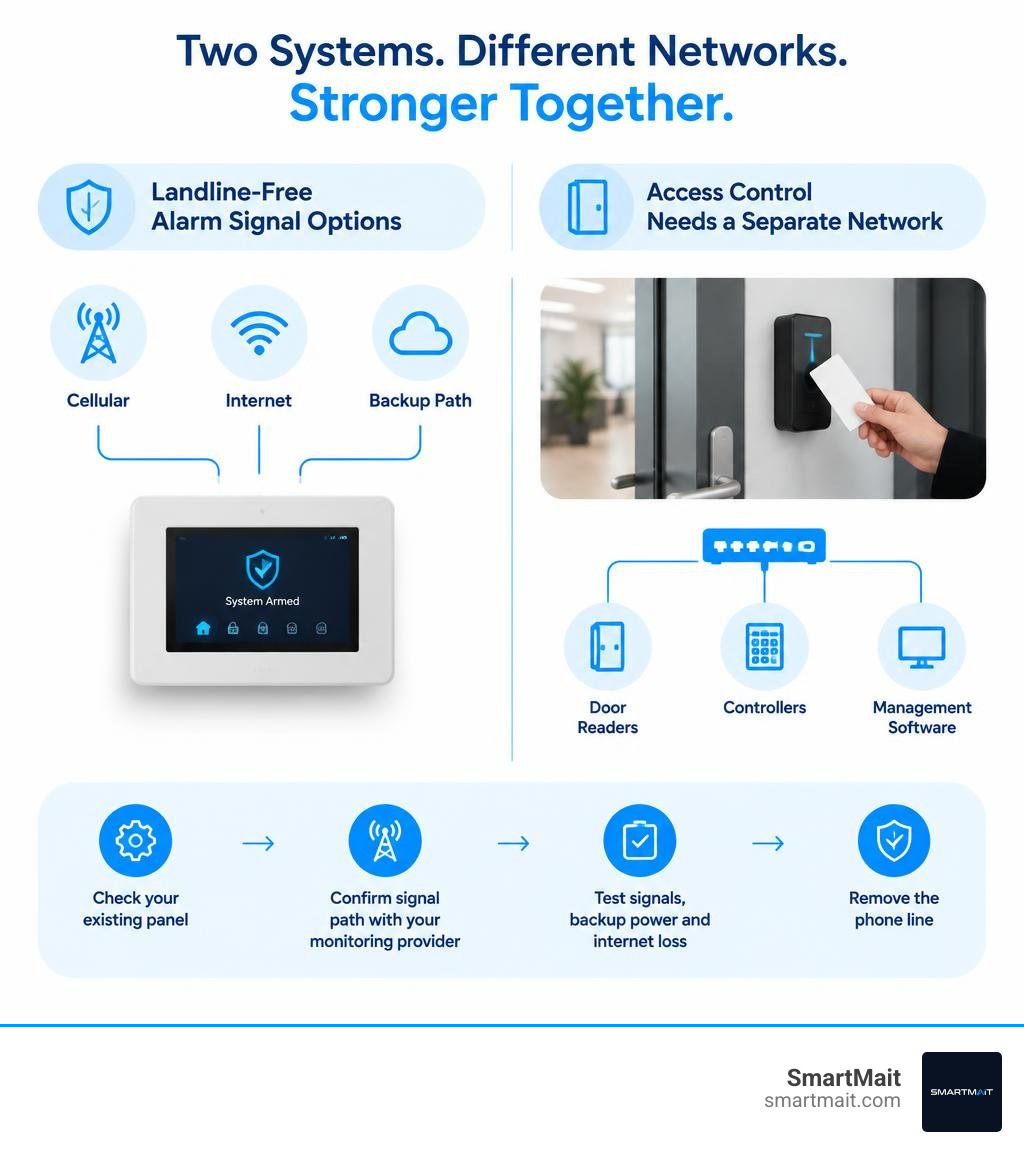
Quick alarm monitoring without landline definitions:
- 24 7 professional monitoring
- alarm monitoring service for existing system
- alarm com monitoring service
Why Legacy Telephone Lines Can Limit Commercial Access Control
Legacy copper telephone lines (POTS) were once the backbone of commercial security and building communications across Metro Detroit. However, aging copper infrastructure across Southeast Michigan has become increasingly vulnerable to service interruptions, weather exposure, physical line damage, and carrier phase-outs. When commercial entry systems and dialers rely exclusively on these lines, property owners encounter severe operational bottlenecks.
A legacy telephone path provides virtually no real-time diagnostic visibility. If a telephone line deteriorates or experiences a ground fault during a harsh winter freeze in Oakland County, the building manager typically only discovers the failure when an entry point stops responding or an emergency dialer fails. Furthermore, traditional landlines cannot support modern remote management capabilities, such as real-time credential revocation, cloud-managed audit trails, high-resolution video intercom streams, or scheduled door unlocks across multi-tenant facilities.
Network-based alternatives eliminate these communication delays. By shifting building security, entry panels, and intrusion reporting to modern IP and cellular infrastructure, commercial facilities gain instantaneous transmission speeds, encrypted data pathways, and automated health checks that immediately notify administrators of connectivity disruptions.
Core Connectivity Options for Commercial Access Control
Modern commercial facilities require resilient data transmission methods to handle user credentials, door controllers, video surveillance feeds, and intrusion signals. Evaluating your communication infrastructure ensures that building access remains uninterrupted, even during severe storms or local utility outages. The right connectivity architecture also determines how quickly administrators can respond to security events, revoke credentials, or audit entry activity across multiple locations.
| Connectivity Type | Primary Medium | Key Advantages | Backup Power Requirements | Ideal Application |
|---|---|---|---|---|
| Wired Network (LAN/Ethernet) | Category 6 / 6A Structured Cabling | Highest throughput, low latency, robust physical security | Centralized battery backup / UPS in server rack | Interior controllers, high-traffic access doors, card readers |
| Broadband IP (WAN/Fiber) | Dedicated Commercial ISP | Seamless cloud administration, real-time remote user management | Network closet UPS / Generator circuit | Multi-tenant office suites, remote administrative portals |
| Redundant Cellular Path | Dedicated Commercial LTE / 5G Transceiver | Independent of local broadband outages, immune to severed cables | Dedicated 12V/24V panel standby batteries | Critical alarm monitoring, off-grid secondary gates, failover |
Wired Network Connectivity for Access Control
Wired Ethernet infrastructure backed by structured cabling represents the foundational standard for enterprise-grade building access. By deploying enterprise low-voltage cabling directly from centralized server racks to edge door controllers, facility managers achieve dependable, interference-free communication across every portal.
Wired local area networks (LANs) provide predictable data delivery for high-security environments, such as medical clinics in Rochester Hills or corporate headquarters in Troy. A certified local integrator designs and installs this infrastructure with proper cable pathways, patch panels, and managed network switches, isolating access control traffic on dedicated Virtual Local Area Networks (VLANs) to prevent unauthorized network bridging. This segmentation also simplifies troubleshooting and keeps credential data separate from general business traffic.
Broadband IP and Remote Administration
Broadband internet connectivity transforms static door access into an agile, remotely managed access ecosystem. Through dedicated IP pathways, property managers in Birmingham or West Bloomfield can instantly modify credential permissions, issue temporary mobile passes, review entry timestamps, and manage lockdown protocols from anywhere.
However, broadband-dependent systems require careful network planning. Integrators must account for available upload bandwidth, router uptime, Quality of Service (QoS) configurations, and robust cybersecurity firewalls. Without enterprise-grade firewalls and network segmentation, remote administrative access could introduce network vulnerabilities or suffer latency during peak business traffic hours. A properly configured system also logs every administrative action, creating an audit trail that supports compliance requirements for medical offices, financial firms, and multi-tenant commercial buildings.
Redundant Connectivity and Building-System Integration

A comprehensive commercial security setup pairs a primary wired or broadband connection with an independent cellular communicator. If a utility outage or construction crew severs local fiber or coaxial cabling, the secondary cellular communicator instantly assumes the transmission load without dropping access logs or alarm supervision. This redundancy is especially important for facilities that rely on alarm monitoring without a landline, where the cellular path serves as both primary and backup communication depending on the building’s infrastructure.
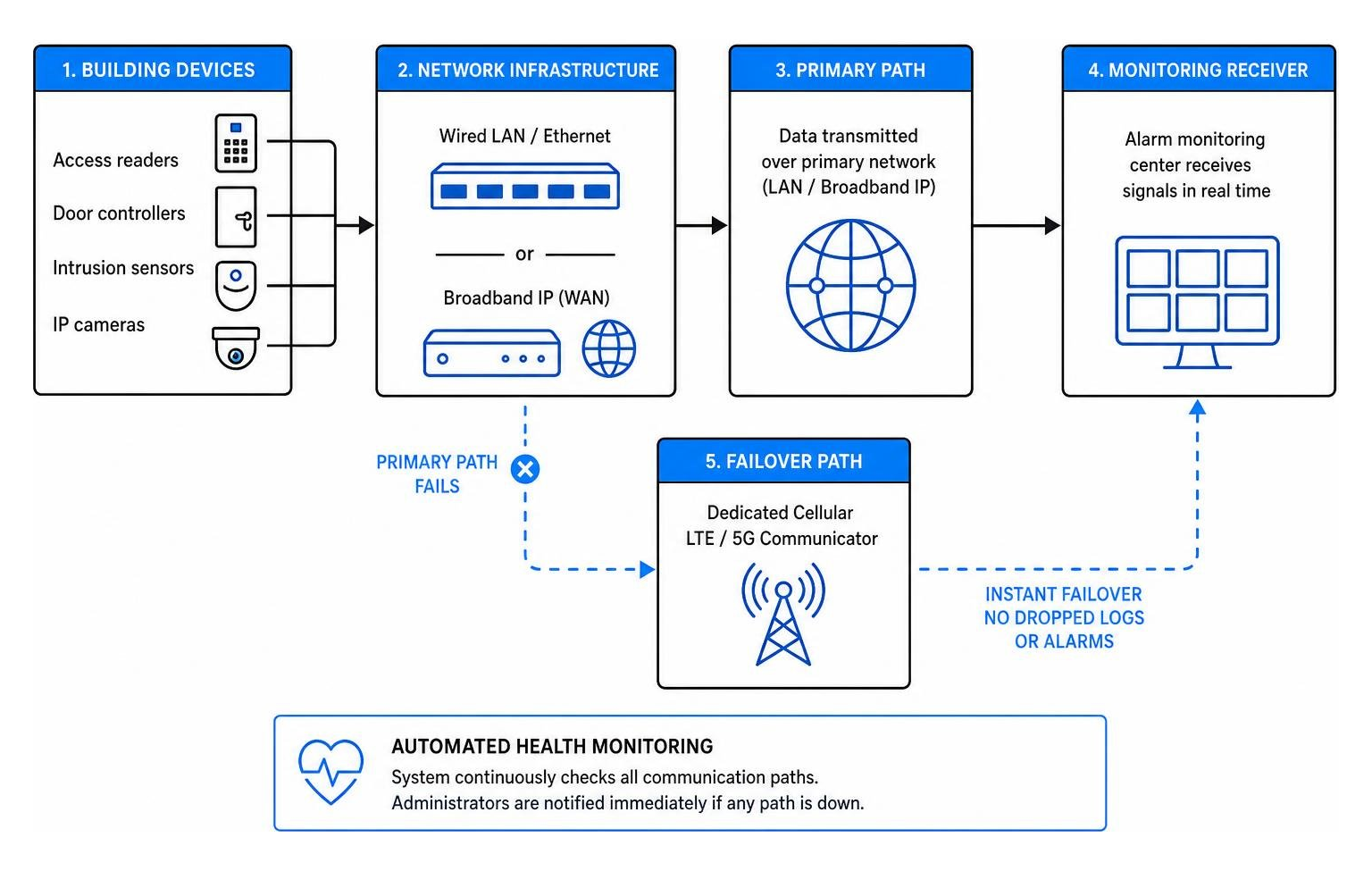
This multi-path approach ensures seamless interoperability with broader low-voltage installations, including high-definition IP security cameras, commercial building automation, and environmental sensors. By leveraging professional Z-Wave sub-systems alongside high-speed IP controllers, building managers maintain an interference-resistant, integrated automation framework that ties lighting, temperature setbacks, and perimeter protection into cohesive security scenes. The result is a single managed ecosystem where access events, video footage, and environmental data share a common infrastructure without competing for bandwidth or creating single points of failure.
How to Upgrade a Commercial Property’s Access Control Connectivity
Transitioning a commercial facility from obsolete dialers or standalone analog panels to modern networked architecture requires an orderly, systematic retrofit process.
Step-by-Step Access Control Modernization
- Site and System Audit: An on-site evaluation examines existing door strikes, magnetic locks, low-voltage wiring, credential types, and current panel communication routes.
- Hardware & Controller Selection: Choose IP-native access control panels, multi-tech smart credential readers (supporting RFID, mobile BLE, and encrypted smart cards), and dedicated power supplies.
- Network Configuration & Cybersecurity: Establish a dedicated access VLAN, assign static IP parameters, configure secure port forwarding or encrypted outbound tunnels, and deploy edge firewalls.
- Low-Voltage Wiring & Termination: Pull commercial-grade Category cabling or reuse verified 18/2, 18/4, and 22/6 shielded wiring where appropriate, terminating all runs neatly in an accessible low-voltage enclosure.
- Supervised Testing & Failover Verification: Simulate network and utility outages to ensure battery backups deploy instantly and that secondary communication paths carry system events without delay.
- Administrator Onboarding & Concierge Support: Train facility administrators on cloud dashboards, credential management, and enroll the property in an ongoing concierge maintenance plan for continuous software, firmware, and hardware supervision.
Planning for Local Requirements in Southeast Michigan

Commercial security and access installations throughout Oakland, Macomb, and Wayne counties must strictly adhere to local life-safety codes, National Electrical Code (NEC) standards, and municipal permit guidelines. Cities such as Troy, Bloomfield Hills, and Detroit enforce specific commercial building regulations regarding emergency egress, fire alarm tie-ins (fail-safe door releases), and alarm user registration permits.
Partnering with an experienced local low-voltage integrator guarantees that every motorized door lock, emergency crash bar, and access control power supply complies with Michigan building codes. Proper coordination between your integration team, local inspectors, and internal facility managers ensures zero operational friction during system sign-off and annual safety audits.
Frequently Asked Questions about Networked Commercial Access Control
What happens to access control during a prolonged power outage?
Commercial access control systems are engineered with dedicated uninterruptible power supplies (UPS) and rechargeable standby battery banks housed inside the main controller enclosure. During an electrical outage, the batteries instantly keep controllers, readers, and electronic locking hardware operational. Depending on the battery capacity specified during engineering, systems typically maintain active operation for 8 to 24 hours. Furthermore, life-safety fire alarm relays ensure that critical egress doors remain safely passable regardless of power status.
Can existing access control systems be upgraded without running new cabling?
In many commercial retrofits across Metro Detroit, existing multi-conductor wiring (such as 18/4 or 22/6 shielded cable) can be repurposed to connect new smart readers and locking hardware to modern IP door controllers. If the existing wiring passes continuity and resistance integrity tests, your integrator can update the central head-end controllers and edge readers without tearing into finished drywall, significantly reducing installation timelines and retrofit costs.
How can a local integrator assess connectivity for a commercial access control system?
A professional integrator performs an on-site structural and network survey. This includes testing available bandwidth, evaluating network switch capabilities, analyzing physical low-voltage pathways, inspecting cellular signal strength across major carrier bands at the controller location, and verifying panel compatibility. The integrator then provides a tailored engineering blueprint detailing hardware, network architecture, and redundancy options matched to your facility’s operational demands.
Conclusion
Modernizing commercial access control connectivity safeguards your property against the vulnerabilities of obsolete copper infrastructure. By integrating wired Ethernet, reliable broadband management, and redundant communication paths, commercial facilities across Troy, Birmingham, and the greater Metro Detroit area maintain continuous entry oversight, robust data security, and simplified multi-site administration.
Ensuring your building’s long-term operational integrity requires more than just hardware installation—it requires an ongoing service partnership. To bring professional, architect-grade intelligence to your commercial facility, explore SmartMait’s access control integration services and schedule a consultation with SmartMait today.