Planning Professional Security Camera Installation for Southeast Michigan Homes
Plan Camera Coverage Before Installation
When planning cameras installed in a house and across the surrounding property, start with the primary routes people use: entry doors, the driveway, and side or back access. Mark what each camera needs to see, then check the view at night, the available power and network connection, and whether the angle respects your neighbors’ privacy. Test those views before mounting anything.
For homeowners in Troy, Birmingham, and Bloomfield Hills, a professional plan also accounts for hidden cable routes and how the cameras will work with the rest of the home. SmartMait’s residential security and surveillance service covers that planning and installation. If you’re ready to discuss your home, request a consultation with SmartMait.
I’m Dominic Hesano, founder of SmartMait. Years of pulling wire through finished walls and fixing unreliable security systems shape how I design comprehensive surveillance layouts for residential entryways and outdoor areas.
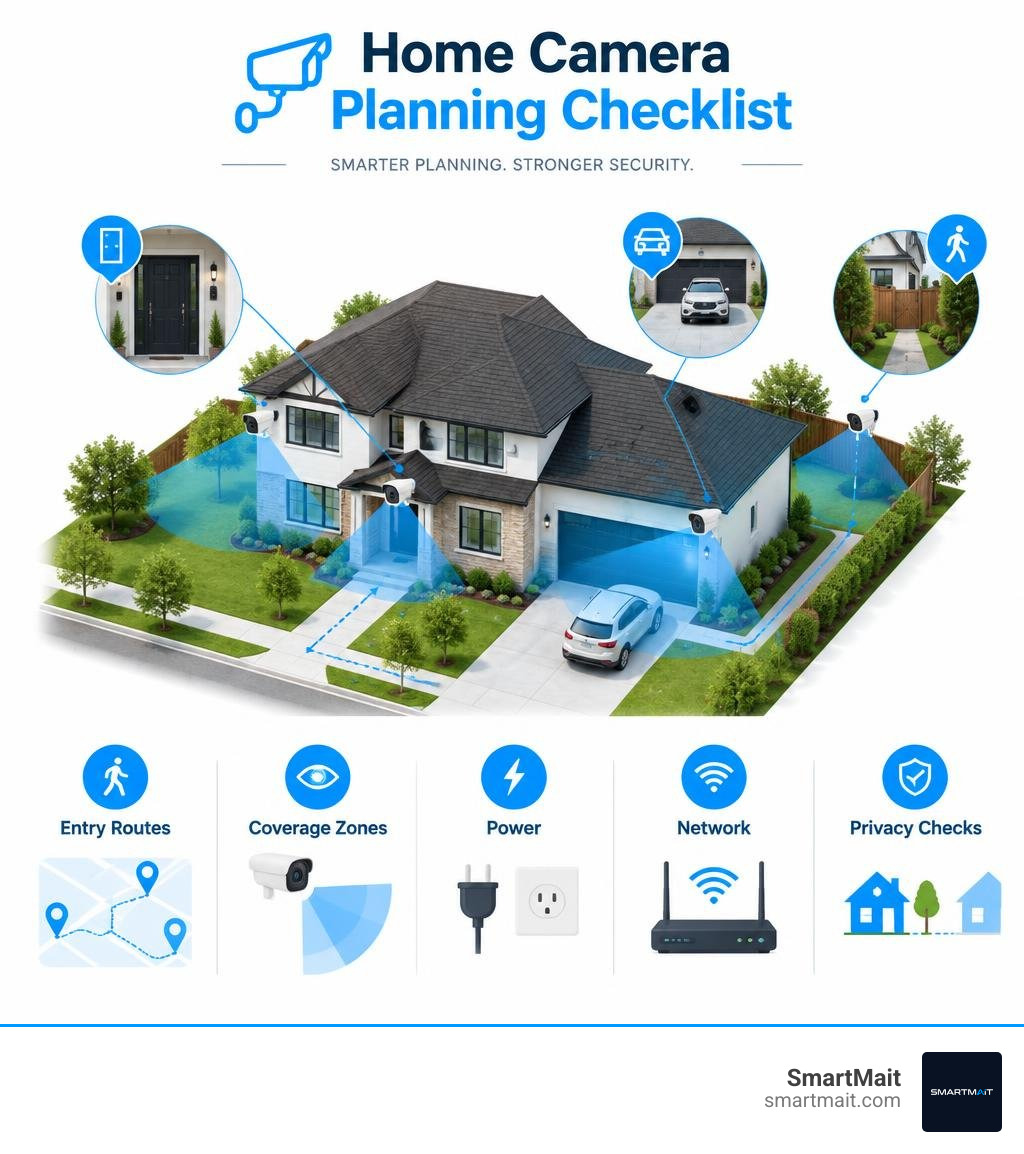
Professional Planning for Cameras Installed in House Layouts
A proper surveillance design begins well before any technician steps onto a ladder or drills a mounting hole. When designing a comprehensive layout for custom residential properties in Oakland, Macomb, and Wayne counties, we map the entire physical landscape to create clear, overlapping lines of sight without creating visual clutter on the home’s exterior. Thoughtfully placed cameras installed in a house and across its grounds should work together as a single coordinated system rather than isolated devices.
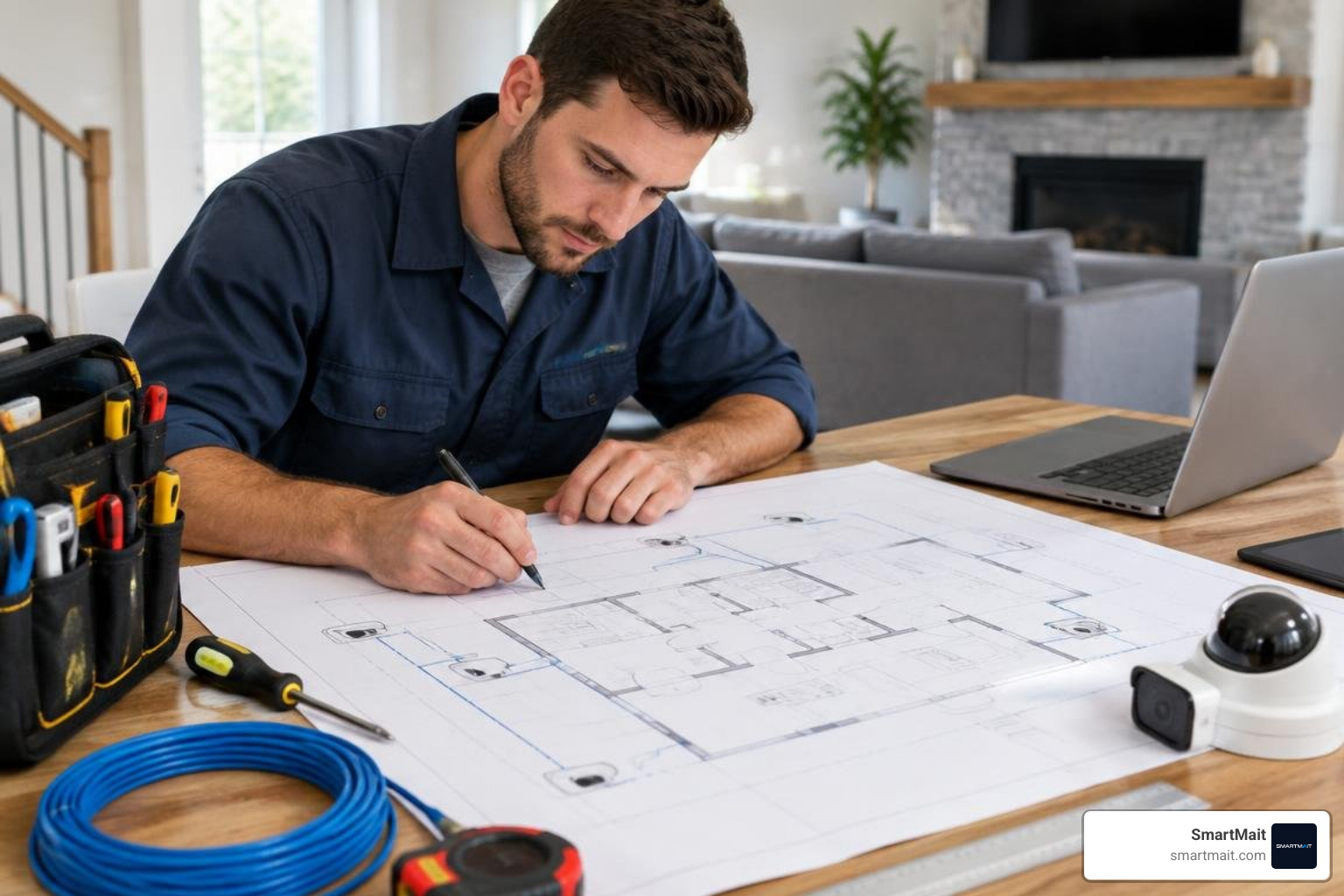
Effective planning starts at the property boundary. Perimeter defense acts as your first line of protection, capturing vehicle approach paths and pedestrian access points the moment someone enters the grounds. Moving inward, we identify primary targets:
- Main front entryways and porticos
- Garage aprons, driveways, and side service doors
- First-floor off-street windows and patio walkouts
- Hidden basement egress points and rear sliding glass doors
- Interior high-traffic corridors and utility rooms
Evaluating environmental lighting conditions is equally critical. Michigan winters bring low daylight hours and reflective snowbanks, while summer foliage can introduce shifting shadows and lens obstructions. Our approach to professional outdoor camera installation planning evaluates the dynamic range of each camera sensor, calculating wide horizontal angles (often between 110 and 152 degrees) alongside targeted optical fields of view. This design ensures crisp recognition of license plates and faces without blinding reflections from outdoor architectural lighting.
Selecting Wiring and Power Architecture for Long-Term Reliability
The underlying infrastructure determines whether a residential surveillance system performs reliably year after year or suffers constant dropouts. While battery-powered units exist for light applications, estate properties and custom homes require dedicated low-voltage wiring to ensure continuous 24/7 recording and uncompromised video bandwidth.
| Feature / Architecture | Hardwired PoE (Power over Ethernet) | Wi-Fi / Battery-Powered |
|---|---|---|
| Power Stability | Constant, uninterrupted low-voltage power via Cat6 | Intermittent; requires battery swaps or solar exposure |
| Bandwidth & Latency | Dedicated Gigabit data stream with zero latency | Shared wireless spectrum; subject to RF congestion |
| Video Recording Mode | Continuous 24/7 recording to local NVR storage | Motion-triggered event clips only |
| Cold Weather Resiliency | Unaffected by freezing Michigan winter temperatures | Chemical battery capacity drops sharply below freezing |
| Data Privacy | Isolated on local network; optional air-gapped NVR | Mandatory cloud server transmission |
Hardwired PoE vs Wireless Protocols for Cameras Installed in House Perimeters
For permanent residential surveillance, Power over Ethernet (PoE) represents the gold standard. Running a single Cat6 network cable delivers both clean DC power and multi-gigabit data transmission directly to each device over distances exceeding 300 feet. This hardwired connection eliminates the common failure points of wireless cameras—such as RF interference, dropped signals, and dead batteries during sub-zero January cold snaps.
When wireless devices must be deployed in detached outbuildings or historic stone structures where retrofitting cable is physically impossible, enterprise-grade structured cabling solutions are required. We deploy commercial-grade dual-band access points connected via high-speed backhauls to ensure video data never bogs down the primary household network.
Structured Cabling and Network Infrastructure Requirements
A robust physical network architecture routes all low-voltage lines cleanly back to a centralized network headend, typically located in an equipment rack inside a dedicated basement utility room or conditioned AV closet.
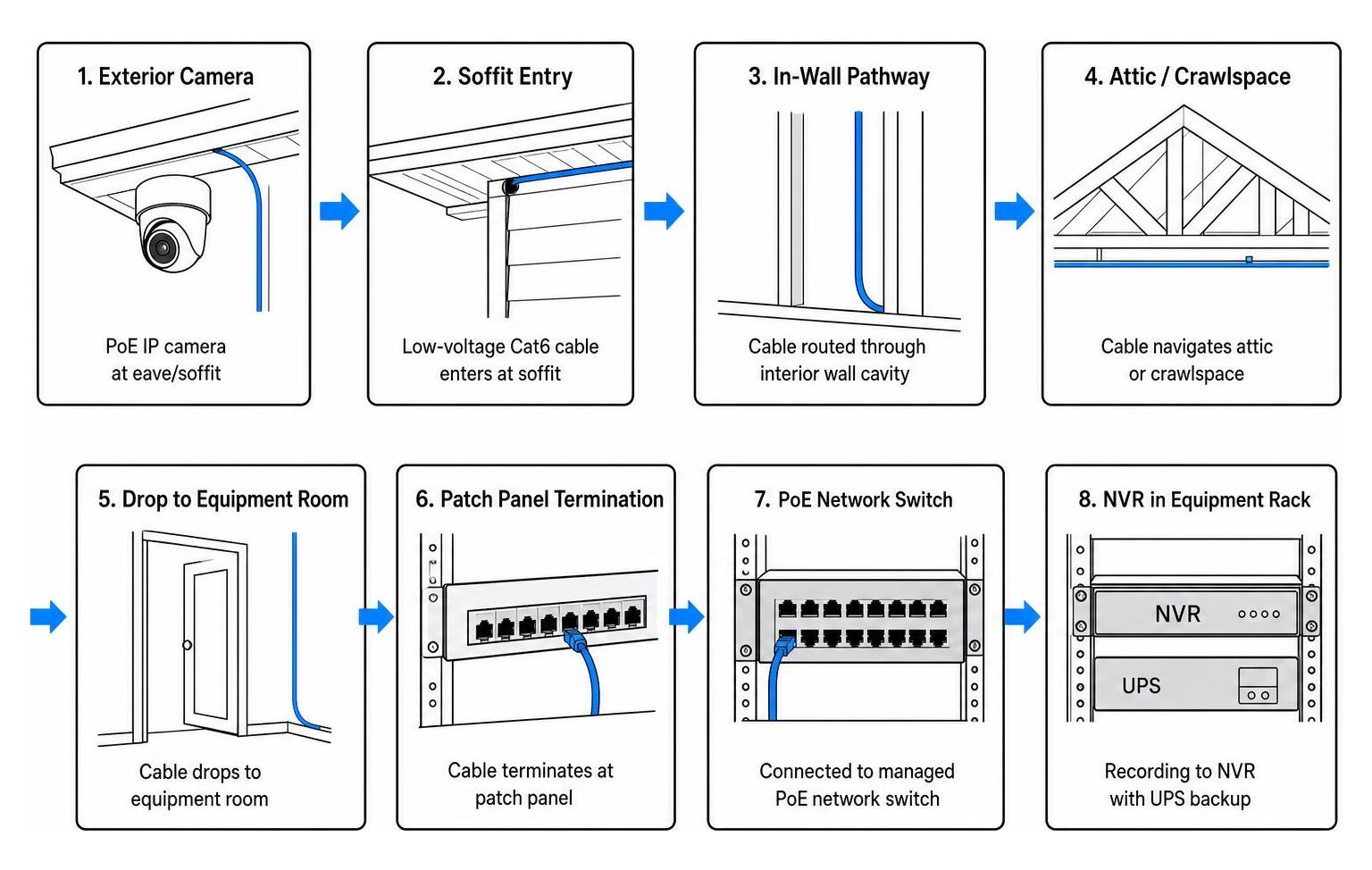
During installation, our technicians navigate attic trusses, crawlspaces, and interior wall cavities using fish tape and protective conduits to ensure no exposed wiring blemishes the home’s finished architecture. Low-voltage cables terminate into managed PoE network switches backed by uninterruptible power supplies (UPS). This design keeps your cameras running and recording to an onboard Network Video Recorder (NVR) even during localized utility power outages.
Strategic Placement and Weatherproofing for Residential Coverage
Mounting a camera involves balancing two competing needs: capturing identifiable human detail and keeping the hardware out of physical reach. Poorly aimed cameras record the tops of visitors’ heads or get washed out by the morning sun, rendering high-resolution sensors practically useless.

Critical Angles and Heights for Cameras Installed in House Entryways
Outdoor cameras should generally be mounted between 8 and 10 feet above finished grade. This elevation provides several functional advantages:
- Tamper Prevention: The camera sits well beyond the reach of casual vandals or intruders attempting to cover the lens.
- Facial Identification: Angled downward at approximately 15 to 20 degrees, the optical field frames faces and torso details rather than merely scanning hats and foreheads.
- Vehicle and Approach Tracking: Placing cameras along driveway aprons at this height allows optical sensors to capture vehicle make, color, and license plate characters without excessive distortion.
For front doorways and porticos, positioning the camera slightly offset from exterior sconces prevents direct light glare from blinding the imaging sensor when the fixtures switch on at dusk.
Weatherproofing, Concealment, and Environmental Durability
Southeast Michigan homes face substantial seasonal shifts, from humid 90-degree summer afternoons to sub-zero blizzards. Outdoor equipment must carry an ingress protection rating of at least IP65 or IP66, indicating a fully sealed enclosure that prevents dust infiltration and resists sustained driving rain.
To preserve the aesthetic beauty of custom masonry, siding, and trim work, we install discreet turret or dome enclosures painted to match fascia and soffits. All cable penetrations use drip loops and exterior-rated silicone sealant behind low-profile architectural junction boxes, preventing water from tracking into exterior walls.
Legal Privacy Standards and Smart Home Integration
Surveillance systems must operate ethically and in full compliance with state and municipal privacy standards. A well-designed security blueprint protects your home without intruding on the privacy of neighbors or house guests.
Audio Recording Laws, Michigan Compliance, and Privacy Zones
In Michigan, audio recording falls under strict statutory guidelines. Eavesdropping laws require that private oral communications are not recorded without consent. While capturing visible public outdoor areas on video is standard practice, modern low-voltage integration utilizes hardware and software privacy masking to blackout neighboring windows, patios, or yards from both live monitoring and recorded logs.
Additionally, municipalities in Oakland County frequently operate community camera initiatives. For example, residents can review the Bloomfield Township camera registration information to understand how voluntary municipal programs coordinate with residential security to assist local investigations while preserving homeowner data control.
Z-Wave Integration, Control4, and Unified Automation
Modern surveillance reaches its highest potential when it works seamlessly alongside the rest of your home’s systems. By integrating camera triggers with professional Z-Wave automation networks and platforms like Control4 or Savant, security feeds become active participants in whole-home management.
When an exterior camera’s onboard analytics detect a person crossing the driveway boundary after 11:00 PM:
- Exterior architectural floodlights can ramp up smoothly to 100% brightness.
- Pathway landscape lights illuminate to deter trespassers.
- Touchscreens in the master suite and kitchen switch on to display the active live feed.
- Access control locks secure automatically across every exterior perimeter door.
This level of architectural integration transforms passive recording into an active, intelligent defense system.
Frequently Asked Questions About Residential Camera Installation
Do security cameras installed in house spaces require local registration in Michigan?
Most residential security cameras do not require mandatory municipal registration in Michigan unless specified by local township alarms ordinances. However, several local departments—such as Bloomfield Township—maintain voluntary registries that allow homeowners to assist law enforcement during neighborhood incidents while retaining full ownership and privacy over their systems.
What is the ideal mounting height for outdoor perimeter cameras?
The ideal mounting height for residential perimeter cameras is 8 to 10 feet with a 15-to-20-degree downward tilt. This elevation keeps the hardware safe from physical tampering while keeping the lens angle low enough to capture clear facial features and vehicle details.
How does continuous local storage compare to cloud subscription plans?
A dedicated Network Video Recorder (NVR) with high-capacity surveillance hard drives records 24/7 video without consuming your home’s internet upload bandwidth. Local storage keeps all video footage inside your home’s private network, eliminating recurring monthly cloud storage fees while providing immediate, uncompressed playback.
Conclusion
A high-performance residential surveillance system requires thoughtful planning, clean architectural installation, and robust low-voltage infrastructure. When cameras are professionally wired, correctly angled, and seamlessly tied into your lighting and access controls, they provide unmatched peace of mind.
To explore how unified security fits into a broader whole-home automation strategy, review our complete 24-hour home security guide.
At SmartMait, we design, install, and continuously maintain custom surveillance and smart automation systems for homeowners throughout Troy, Birmingham, Bloomfield Hills, Rochester Hills, and the greater Oakland County community. Through our ongoing SmartService concierge maintenance program, our team remains by your side long after initial installation to keep your hardware updated, optimized, and running flawlessly.
Contact SmartMait today to schedule your private on-site consultation and design the ideal security layout for your home.