The Most Reliable Wired Surveillance Systems for 2026
Why Hardwired Surveillance Outperforms Wireless Systems
#
The best wired security cameras use Power over Ethernet (PoE), a local NVR recorder, and 4K or 2K cameras to provide dependable, around-the-clock coverage without relying on a strong Wi-Fi signal. For most larger homes and light-commercial properties, start with a PoE NVR system that has more camera channels than you need today, local storage, person and vehicle detection, and weather-rated outdoor cameras.
Wired surveillance costs more to install than a basic Wi-Fi camera, but it delivers the things that matter most when footage is needed: stable power, consistent video, local recording, and room to expand. Internet is optional for recording; it is mainly needed when you want to view live feeds and alerts from your phone away from the property.
In this guide, we compare leading wired camera options for 2026, covering dedicated PoE NVR configurations and standalone hardware platforms. We will also cover what separates a strong long-term system from a collection of cameras that only works when the network cooperates.
I am Dominic Hesano, founder of SmartMait, and I have hands-on experience designing and installing structured wiring, home security, and smart-home systems across Southeast Michigan. I help homeowners and businesses evaluate the best wired security cameras based on real cable paths, coverage needs, network design, and long-term reliability.
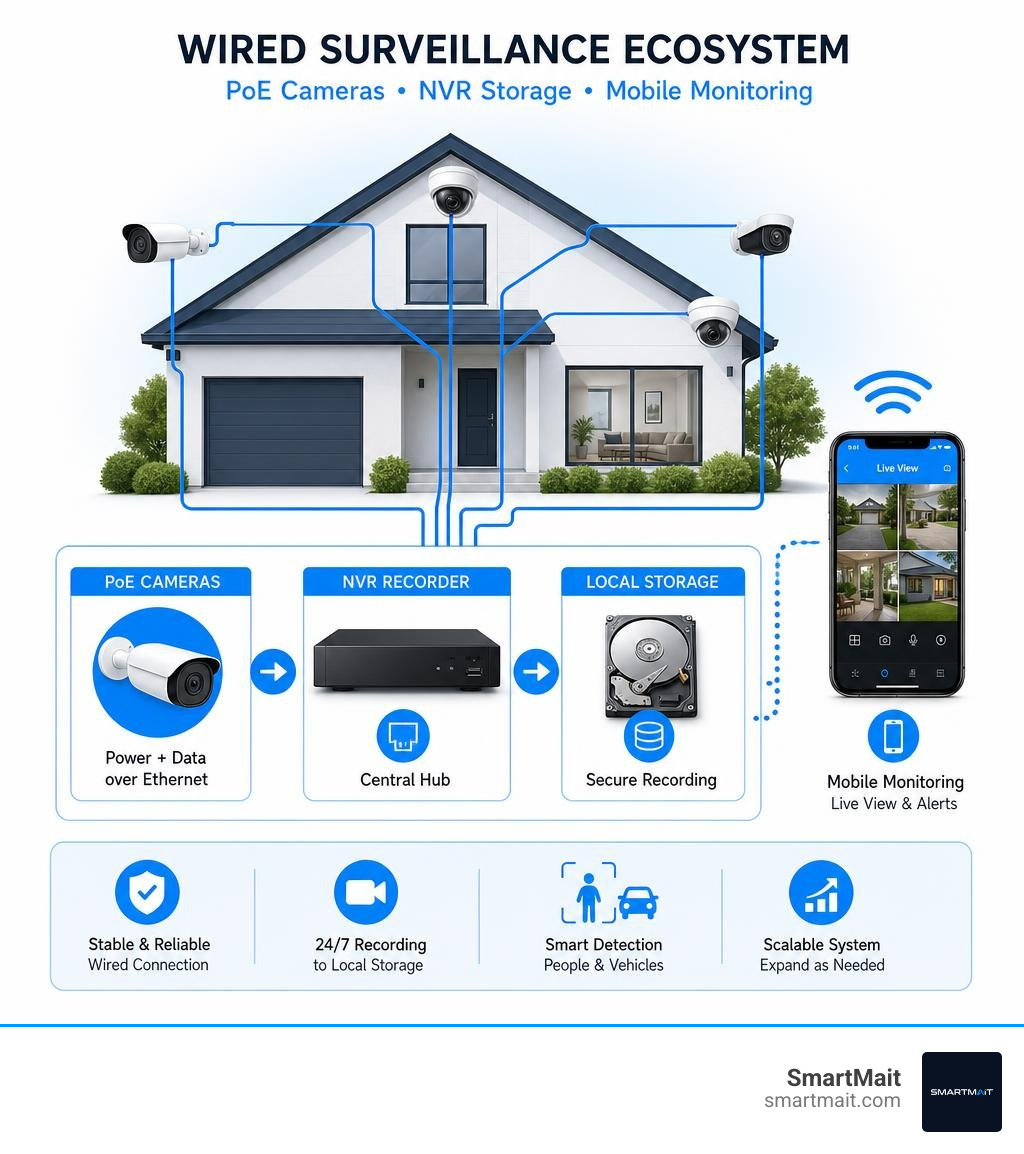
Best wired security cameras terms to know:
When property owners assess surveillance options, the choice between wireless, wire-free (battery-operated), and hardwired setups forms the critical foundation. Wire-free cameras rely entirely on battery packs and Wi-Fi data links. While simple to stick on a wall, they suffer from sleep cycles, wake-up delays, and cold-weather battery drain. Wireless cameras utilize plug-in AC power cords but still transmit footage over radio waves, leaving them vulnerable to bandwidth congestion and intentional jamming.
Hardwired infrastructure establishes an uninterrupted, physical link for both electrical power and video streams.
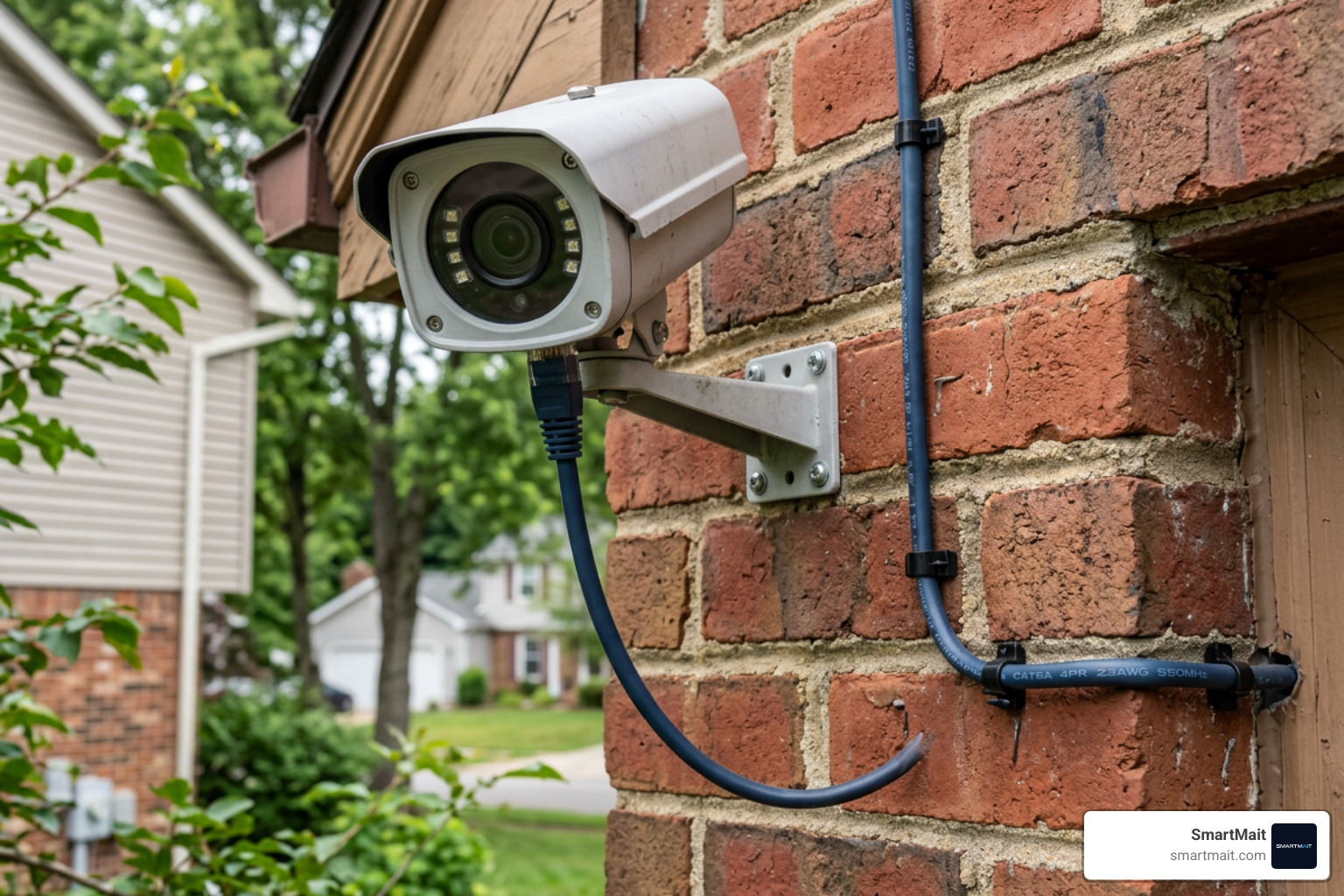
Studies consistently confirm that visible security cameras serve as a strong crime deterrent both at your immediate property line and across surrounding neighborhoods. A hardwired camera never misses the critical seconds before an incident occurs because it does not rely on motion sensors to wake up from a power-saving sleep mode. Instead, it captures continuous, 24/7 video streams directly to dedicated on-premise hardware.
Key operational advantages include:
- Zero Wi-Fi Interference: High-resolution video streams do not congest home wireless networks or drop frames during heavy household bandwidth usage.
- Constant, Reliable Power: There are no batteries to recharge or replace in sub-zero winter temperatures.
- High Energy Efficiency: On average, a modern wired security camera consumes only a few watts of electricity—comparable to a single low-draw LED bulb.
- Hardware Durability: Built with metal chassis and impact-rated lenses, these cameras outlast consumer-grade plastic units.
- Complete Privacy: Continuous video streams remain inside your private local network rather than uploading unencrypted clips to external cloud servers.
To understand how physical cabling integrates into an overarching residential security architecture, read the ultimate guide to building a home security camera setup for a deeper architectural breakdown.
Key Features to Look For in the Best Wired Security Cameras
Evaluating surveillance hardware requires looking beyond basic marketing promises. The performance difference between an entry-level kit and a high-tier surveillance installation centers on image processing, recorder intelligence, physical durability, and ecosystem compatibility.
NVR vs DVR Recorders for the Best Wired Security Cameras
The recorder serves as the brain of your hardwired surveillance layout. Two core recording architectures exist: Network Video Recorders (NVR) and Digital Video Recorders (DVR).
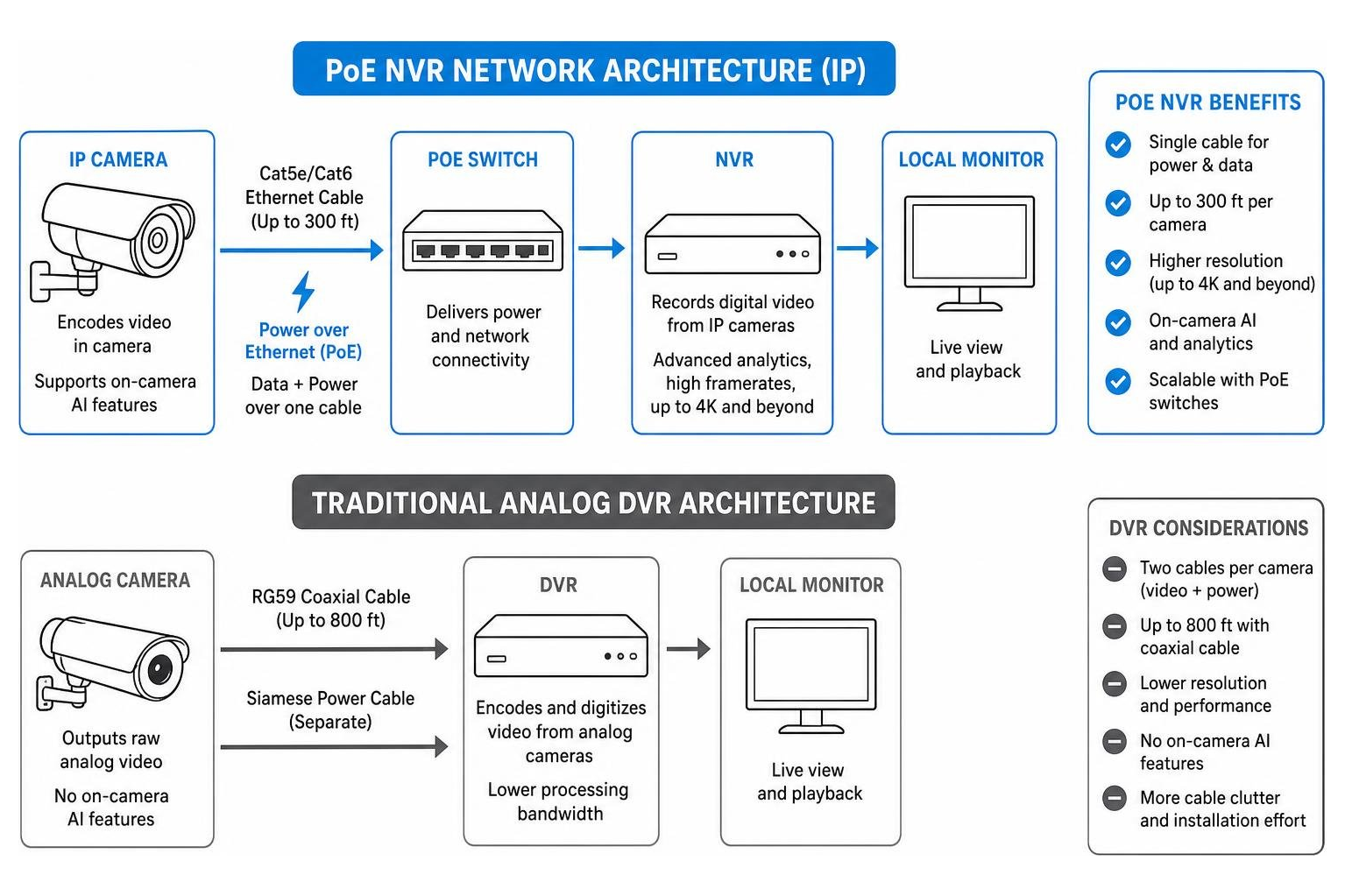
- Network Video Recorders (NVR): NVR setups represent modern IP (Internet Protocol) surveillance. IP cameras process and encode video directly inside the camera housing before transmitting digital data over a single Cat5e or Cat6 Ethernet cable. Power over Ethernet (PoE) standards (IEEE 802.3af/at) allow that same network cable to deliver both low-voltage electrical power and two-way digital communication. Standard PoE Ethernet runs support up to 300 feet per camera without signal degradation, and can be extended further using dedicated PoE switches. NVRs support advanced video analytics, higher framerates, and resolutions reaching 4K Ultra HD and beyond. Leading kits such as the eufy PoE NVR Security System S4 Max | 16MP & PTZ – eufy US highlight how modern NVRs integrate localized AI searching and multi-lens tracking directly at the edge.
- Digital Video Recorders (DVR): DVR platforms rely on analog or HD-over-Coax cameras. The camera transmits raw, uncompressed analog signals over RG59 coaxial cables to the DVR, where the recorder’s internal hardware encodes and digitizes the video. While coaxial cabling can reach up to 800 feet for analog setups, each camera typically requires a separate Siamese power wire, creating double the physical cable clutter. DVR systems are budget-friendly but carry lower processing bandwidth and lack the intelligent on-camera AI features found in modern IP networks.
For homeowners taking their first steps from standalone devices into dedicated hardware, our guide on From CCTV to Smart Alarms: Building Your First 1-Camera Security System covers scaling from a single entry point to an interconnected recording hub.
Essential Optical and Deterrence Specs for the Best Wired Security Cameras
When selecting optical equipment, choose cameras that deliver forensic clarity day and night:
- Resolution Standards: 1080p Full HD provides baseline visibility, but 4K (8-Megapixel) resolution captures 16 times more pixel detail than standard HD. This added pixel density allows digital zooming on license plates, clothing textures, and facial features without transforming footage into pixelated blur.
- Night Vision Performance: Basic black-and-white infrared (IR) LEDs illuminate subjects up to 100 feet in complete darkness. Advanced Color Night Vision uses high-sensitivity image sensors to retain full-color video in low ambient lighting before falling back to IR illumination.
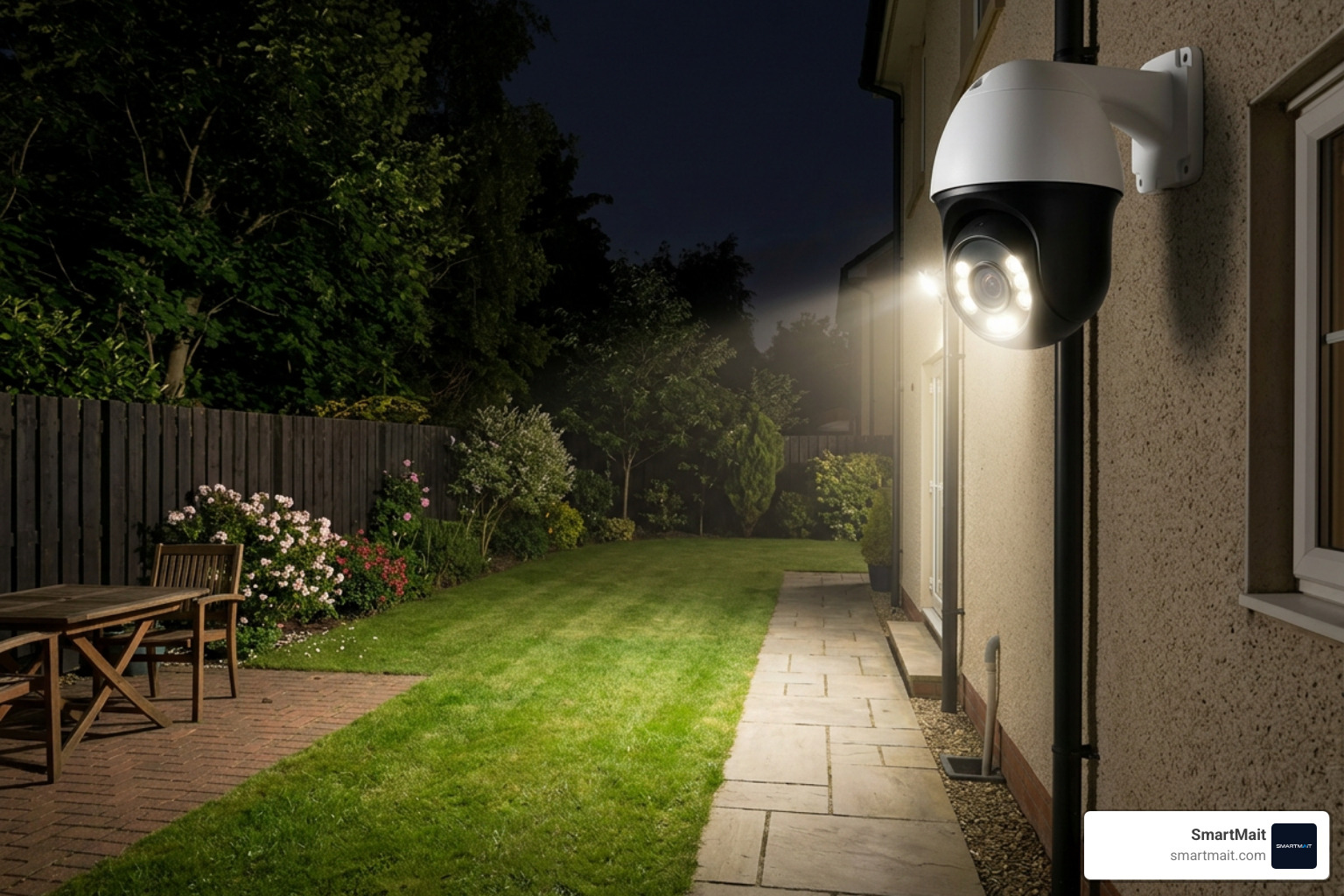
- Active Deterrence Mechanisms: Passive recording documents crimes, but active deterrence stops them. Cameras equipped with bright motion-activated LED spotlights and integrated sirens (such as 90dB-110dB warning alerts) confront trespassers the moment a boundary line is crossed. Specialized options like the Philips Hue 2K wired security camera – black | Philips Hue UK show how visual lighting integration turns camera motion events into synchronized environmental warnings.
- Physical Build and Ingress Protection: Outdoor cameras require an IP67 rating, guaranteeing complete protection against dust ingress and continuous rain or snow. For areas vulnerable to physical tampering, look for an IK10 vandal-proof rating, indicating the dome or housing can withstand heavy mechanical impacts.
- Smart Edge AI Detection: Onboard chips classify movement into human, vehicle, and animal categories. This edge filtering eliminates false alerts triggered by windblown tree branches or neighborhood pests.
Review our roundup of Top Expert Recommended Outdoor Cameras for 2026 to compare specific optical profiles side by side.
Planning Storage, Cabling, and Network Architecture
Configuring an enterprise-grade surveillance system requires calculating hard drive retention times, laying structured cabling pathways, and establishing isolated local area networks.
| System Parameter | PoE NVR Architecture | Analog DVR Architecture |
|---|---|---|
| Cable Type | Single Cat5e / Cat6 Ethernet | Siamese RG59 Coaxial + Power |
| Maximum Cable Distance | 300 ft (extendable via PoE switch) | Up to 800 ft |
| Power Delivery | Integrated Power over Ethernet (PoE) | Separate 12V/24V power supply |
| Video Quality Options | 2K, 4K, up to 16MP / Multi-Sensor | 1080p up to 4K (Analog HD) |
| AI Analytics Placement | Onboard Camera Edge AI + NVR | Centralized on DVR processor |
| Monthly Cloud Fees | $0 (Local Hard Drive Storage) | $0 (Local Hard Drive Storage) |
| Smart Ecosystem Support | Z-Wave, Home Automation, Mobile Apps | Basic Mobile App / HDMI Monitor |
Hardware brands across the market balance pricing and functionality across different tiers:
- Lorex: Offers the widest selection of wired 4K IP dome and bullet setups. They record strictly to local NVR/DVR hard drives with zero monthly cloud fees, featuring plug-and-play PoE setup and rugged builds.
- Ring: Provides accessible wired floodlight and spotlight models. However, Ring leans heavily on cloud storage subscriptions, starting at $4.99 per month per camera for basic event recording.
- Swann & Night Owl: Deliver cost-conscious multi-channel DVR and entry-level NVR kits, offering functional multi-camera packages for basic perimeter coverage.
Storage Capacity Planning
Because hardwired systems support 24/7 continuous recording rather than short motion clips, storage calculation is critical. High-efficiency H.265 video compression cuts bandwidth and file sizes in half compared to older H.264 formats without degrading visual clarity.
For a standard 4-camera 4K PoE setup recording continuously:
- 1TB Hard Drive: Provides approximately 4 to 6 days of continuous 24/7 video retention.
- 2TB to 4TB Hard Drive: Provides 12 to 24 days of continuous recording before cycling over the oldest data.
- 8TB to 16TB Enterprise Drives: Allows multi-camera residential estates or light-commercial sites to store 30 to 60+ days of uninterrupted surveillance footage.
When planning physical cable runs through walls, attics, and exterior soffits, proper routing protects your investment. Follow our professional walkthrough on How to Handle Your Outdoor Security Camera Installation Like a Pro to avoid costly structural wiring errors.
Professional vs DIY Installation and Strategic Placement
Installing a hardwired surveillance network involves pulling structured cabling, weatherproofing exterior penetrations, configuring IP subnets, and fine-tuning field-of-view angles.
While DIY kits from brands like Lorex include pre-terminated cables and quick-start instructions suitable for tech-savvy homeowners, running cables across multi-story residences or finished basements presents substantial physical challenges. Concealing Cat6 cables behind drywall, navigating insulated attics, and ensuring clean drop terminations require specialized tools and structural knowledge.
Strategic camera placement separates an effective security installation from a frustrating one:
- Mounting Height (8 to 10 Feet): Mounting cameras 8 to 10 feet off the ground places them out of reach of casual tampering while maintaining a downward angle that captures clear facial profiles rather than the tops of hats.
- Eliminating Glare: Never point a lens directly toward reflective glass windows, unshaded southern horizons, or direct exterior floodlights. Backlighting blinds the camera sensor, resulting in dark, silhouetted subjects.
- Perimeter Overlap and Cross-Coverage: Position corner cameras so that the blind spot directly beneath one camera falls within the field of view of an adjacent unit.
- Motion Masking Zones: Define custom privacy and motion masks within the recorder interface. Excluding swaying trees, public sidewalks, or neighboring driveways prevents notification fatigue on your connected devices.
For a detailed evaluation of coverage zones for driveways, backyards, and side gates, check out our guide on What Are the Best Outdoor Security Cameras for a Residential Home.
Frequently Asked Questions About Wired Security Systems
Do wired security cameras require an internet connection or monthly subscriptions?
No. A hardwired PoE or DVR camera system records directly to its local internal hard drive completely independent of an internet connection. The system will continuously record, apply motion detection, and store video footage even during broad internet outages or neighborhood network disruptions.
An active internet connection is only necessary when you want to connect your smartphone or remote computer to the recorder for live off-property streaming and push notifications. Furthermore, because footage resides locally on your NVR, you pay zero monthly subscription fees or cloud storage charges.
How difficult is it to run wiring for a PoE wired camera system?
Power over Ethernet (PoE) simplifies physical deployment by combining power and network data into a single Cat5e or Cat6 Ethernet cable. You do not need an electrician to place dedicated 120V electrical outlets near every camera location.
However, fishing network cabling through interior walls, attics, soffits, and crawl spaces requires dedicated tools (such as fish tape, glow rods, and low-voltage brackets) alongside proper exterior silicone weather-sealing. For finished homes with complex architecture, professional integrators handle cable routing cleanly without damaging interior trim or exterior siding.
What is the ideal resolution and storage size for continuous 4K recording?
For modern surveillance, 4K Ultra HD (8MP) is the recommended standard for primary exterior coverage areas like driveways, front entrances, and street approaches. It provides the pixel density needed for actionable forensic evidence.
For continuous 24/7 recording on a 4-camera 4K system using modern H.265 video compression, a 2TB hard drive represents the minimum recommended baseline, yielding approximately 10 to 14 days of retention. Expanding to a 4TB or 8TB surveillance-grade hard drive (such as Western Digital Purple or Seagate SkyHawk) ensures 30+ days of uninterrupted recording history.
Conclusion
Wired surveillance represents the gold standard for homeowners and business managers who refuse to compromise on perimeter defense, recording uptime, and privacy. By pairing high-bandwidth Power over Ethernet cabling with dedicated local NVR storage, you eliminate the vulnerabilities of Wi-Fi drops, battery degradation, and recurring monthly cloud subscriptions.
A truly robust surveillance setup reaches its full potential when integrated seamlessly into a broader smart home ecosystem. When your 4K cameras, smart access control, automated lighting, and security sensors communicate across a unified, interference-resistant Z-Wave infrastructure, your property transitions from passive observation to proactive protection.
At SmartMait, we design, wire, configure, and maintain complete smart home automation and hardwired security ecosystems across Southeast Michigan—serving communities throughout Bloomfield Hills, Troy, Rochester Hills, Birmingham, and Farmington Hills. Beyond clean, architect-grade installations, our dedicated concierge maintenance programs provide continuous support, firmware updates, and system health monitoring so your surveillance investment delivers unwavering reliability year after year.